In the past, we have always
found at least a half dozen new SLR cameras at the photokina trade show.
That has changed, at least for now, as most manufacturers devote their
R&D resources to digital equipment. During my five days of touring
the many buildings at photokina, I discovered only two new 35mm SLR
cameras. Happily, there was no shortage of new lenses intended to satisfy
every photographer, regardless of specialty or the type and brand of
camera used.
Not all of the new lenses will be in stores by the time you read this
but additional information on most models should be available on the
manufacturers' web sites. Do visit those to find full specifications
on any lenses of interest, since lack of space precludes us from providing
the full lists. For actual selling prices, visit some of the online
retailers' sites since the prices provided to us in October were
often estimates or full list prices.
|

Rebel With A Cause
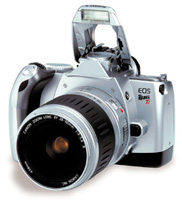
The best selling autofocus SLR in many countries, Canon's EOS
Rebel camera is frequently upgraded. The most recent incarnation is
the Rebel Ti, one of the most sophisticated entry-level cameras on the
market. Featuring an entirely new, curvy style, the Rebel Ti offers
a better control layout than its predecessors, including a huge LCD
data panel on the camera back. Competitive with more expensive cameras,
this model includes a multitude of automatic, semiautomatic, and manual
capabilities. Boasting an "autofocus tracking speed rivaling that
of the professional EOS-1N," the Ti employs a seven-point CMOS
AF sensor.
While touring the castles and villages in the Mosel River valley of
Germany, I used a Rebel Ti to shoot a dozen rolls of film and found
its autofocus system to be incredibly successful: ultra fast, highly
reliable, and very versatile. The additional feedback--in large
numerals in the rear data panel--made overall camera operation
highly convenient. Other new features worth noting include 2.5 fps motor
drive, a stainless steel lens mount, eyepiece diopter correction dial,
superior built-in flash, and more advanced flash metering capabilities
with EX Speed- lites. At the $379 street price--with a 28-90mm
zoom--this camera offers incredible value for the money.
|
|
Next Gen Leica SLR
At the other end of the price spectrum, there's the new Leica R9,
an SLR camera that should squelch two rumors: that Leica would introduce
an autofocus SLR model or that it would discontinue SLR cameras entirely.
This manual focus camera bears a strong resemblance to the R8 but includes
several enhancements including new materials such as magnesium that make
it 3.5 oz lighter while retaining the same rigidity. A new exposure counter
on the top cover and additional information shown on a back cover display
offer more feedback. The new six-zone metering system should provide more
accurate exposures while a superior flash system should produce better
fill flash results in Program mode.
Naturally, the Leica R9 is a well-equipped camera, with all the features
of the R8 including three metering patterns, high-speed flash sync with
Metz Mecablitz 54 MZ-3 flash with SCA 3502 M3 adapter. The body is available
in black or in "anthracite lacquer" finish. Although it is
not a conservative camera like the M7, this model should satisfy Leica
aficionados, with a satisfying blend of proven mechanical and computerized
technology. The appeal of the R9 and the R-series lenses is certainly
understandable and the system should attract serious photographers who
can afford the very best. (List price: $2150.)
|
New Tamron Lens Series
As discussed in Bob Shell's and Joe Farace's photokina coverage
of digital SLR cameras, Olympus and Kodak discussed a new format to be
available in the future. The new "Four Thirds" system will
include lenses optimized specifically for the 18x13.5mm size image sensor.
However, neither company plans to show any actual products until the spring
of 2003, at the earliest.
In the meantime, Tamron USA was already demonstrating functioning prototypes
of five new lenses that are optimized for use with current digital SLR
cameras; these will be released one by one, between March and August 2003.
Designated as "Di" or "digitally integrated,"
they should also be ideal for use with conventional SLR cameras.
By press time, I had not been able to obtain full specifics as to the
Di technology but a Tamron USA rep provided the following preliminary
summary of its benefits. "Lenses designed for 35mm SLR cameras pose
two problems with digital models: ghosting and flare in backlighting,
as well as peripheral light falloff with less light reaching pixels at
the edges of the image area. Depending on the specific focal length the
problem is more, or less, noticeable. The optical systems of the new Di
lenses were designed to decrease flare/ghosting and to offer increased
peripheral light gathering capability or `increased corner luminosity.'
Hence, they provide better performance with both silver halide film and
digital sensors."
|
|
These new lenses will offer
other benefits as well. To minimize weight, the barrels include components
of "engineering plastics that excel in dimensional stability and
strength." Unless otherwise stated, all Di lenses offer internal
focusing and are available in Canon AF, Minolta AF-D, Nikon AF-D, and
Pentax AF mount. The three new Di telephoto models employ a Filter Effect
Control (FEC) system: a ring near the front of the barrel that can be
used to rotate a polarizer while the lens hood is attached. This is a
highly convenient arrangement that precludes the need to frequently remove
the lens hood.
Regardless of the type of camera used--digital or film--light
falloff near the corners of the image is most common with conventional
zooms of short focal length. Consequently, I was most interested in the
wide angle Tamron models that should correct this problem. The SP AF 17-35mm
f/2.8-4 Di LD Aspherical [IF] is the shortest of the new zooms and its
optical formula includes an aspherical element plus a Low Dispersion (LD)
element to correct all types of aberrations. Claimed advantages for this
pro grade zoom include "high contrast in the low frequency range"
and "super high definition" across the entire frame.
Because it has smaller maximum apertures than most competitors, the 17-35mm
f/2.8-4 zoom is not excessively large (3.4x3.3") or heavy (weight
info not available). Like the other Di models, it features two gold tone
metallic rings, a more detailed pattern in the rubber of the zoom and
focus rings, plus a new "burnished" (matte) black finish for
a professional look. At a street price of about $449, this ultra-wide
zoom is likely to become a best seller.
Billed as the "world's lightest and most compact fast standard
lens" the new Tamron SP AF 28-75mm f/2.8 XR Di Aspherical [IF] Macro
zoom is surprisingly small (2.9x3.6" with 67mm filter size) and
reasonably light (19.4 oz) for an f/2.8 model. The optical formula is
impressive. It includes XR (Extra Refractive Index) glass plus four hybrid
aspherical elements and three LD elements to correct all aberrations.
This zoom does not include the Filter Effect Control system, but is surprisingly
affordable. (Street price: $299.)
Many serious enthusiasts and pros love a fast tele-zoom, and the new Tamron
SP AF 70-200mm f/2.8 Di LD [IF] model will satisfy their needs. Employing
two LD elements to effectively correct chromatic aberration, the optical
formula should produce high resolution, excellent color rendition plus
high contrast. The focus ring does not rotate during AF operation and
it offers plenty of friction in manual focus for a familiar feel. There's
a bonus with the Nikon and Canon AF models: "one-touch switching"
between auto and manual focus by sliding the ring backward or for ward.
Although this model is quite large (7.3x3.5"), it's said to
be "the world's lightest fast tele-zoom" at 41.9 oz
with removable magnesium alloy tripod mount. (Street price: $749; not
available in Pentax AF mount.)
Tamron has not offered a long macro lens in the past, but their new SP
AF 180mm Di [IF] Macro 1:1 model addresses that omission. This long lens
is ideal for nature photography especially, allowing for high magnification--up
to 1:1 or "life size" --without the need to get excessively
close to a subject. As with the 70-200mm model, two LD elements compensate
chromatic aberration while the optical formula also emphasizes high contrast.
Tamron's floating element technology plus internal focusing ensures
that the lens length remains constant at all focused distances. Resembling
the 70-200mm zoom, this macro lens close focuses to 18", includes
the one-touch AF/MF control, and weighs 31.2 oz including the magnesium
alloy tripod mount. (Street price: $749; not available in Pentax AF mount.)
The longest of the five Tamron Di lenses, the SP AF 200-500mm f/5.6-6.3
Di LD [IF] is a big tele-zoom with one low dispersion/low diffraction
(LD) element to minimize chromatic aberration at long focal lengths. Replacing
the highly popular AF 200-400mm LD model, this one offers several advantages:
even better contrast and resolution across the frame, a more convenient
rotary zoom mechanism (not push/pull), the FEC control, plus reduced size
(8.8x3.7") and weight (not stated) plus a tripod mounting collar.
The maximum aperture at the longest focal lengths is a bit small, but
otherwise this affordable zoom should be great for wildlife or sports
photography. (Street price: $749; not available in Pentax AF mount.)
|
|
Lenses With Camera Shake
Compensation
As the first independent lens manufacturer to announce a lens with Image
Stabilizer, Sigma attracted a lot of attention with its APO 80-400mm f/4.5-5.6
EX HSM OS ("Optical Stabilizer") zoom. This model incorporates
two shake-detecting sensors that measure the angle and speed of lens movement.
Once that is determined, a high-speed microcomputer sends an electronic
signal to an actuator to shift a group of lens elements in the appropriate
direction to counteract the effect. By moving the elements in parallel,
incoming light rays are refracted and the image is returned to the center
of the frame. Consequently, light rays reaching the film or image sensor
are stable instead of vibrating at the moment of exposure.
Intended for static subjects, OS Mode 1 provides horizontal and vertical
stabilization to assure sharp images without blur from camera shake. Providing
only horizontal stabilization, OS Mode 2 is useful for panning with a
moving subject at long shutter speeds. In handheld shooting, this technology
should certainly produce sharper images in longer exposures: roughly a
two shutter speed step advantage over conventional lenses. The only drawbacks?
This zoom does not include a USM (ultrasonic) focus motor in any of the
available mounts (Sigma, Canon, or Nikon D) and it is larger (3.7x7.5")
and heavier (58.2 oz) than the previous Sigma 70-200mm f/2.8 USM model.
Other notable features include two Special Low Dispersion (SLD) glass
elements to control aberrations, manual focus override in AF mode, removable
tripod collar, a lock to prevent "zoom creep," and rear focus
system that prevents rotation of a polarizing filter. This is a pro grade
lens in both construction and appearance as reflected by the $2600 list
price.
Nikon's VR Intro
Nikon continues to expand its own line of lenses with a Vibration Reduction
system that offers a three shutter speed step advantage over conventional
lenses. To be made in black and light gray, the AF-S VR Zoom-Nikkor 70-200mm
f/2.8G IF-ED will offer some significant features starting with a three
mode VR function. Each mode is suitable for a specific situation: for
a static subject, for panning with a moving subject, and for correcting
vibrations while the camera is mounted on a tripod. As the AF-S designation
indicates, it also includes the Silent Wave (ultrasonic) focus motor for
nearly silent and super fast AF operation.
As a G-type lens, this zoom does not have an f/stop ring but offers all
of the advantages of a D-type lens in Matrix metering; it's fully
compatible only with the F5, F100, F80, F65, D1-series and D100 cameras.
The AF-S VR Zoom-Nikkor 70-200mm f/2.8G IF-ED incorporates 21 elements
including a full five made of ED (Extra-low Dispersion) glass to correct
chromatic aberration and produce high resolution and contrast. Naturally,
it is a large/hefty zoom (3.4x8.5"; 51.9 oz plus tripod collar)
and it is extremely rugged, offering the high degree of durability required
by pros such as news photographers. The all-metal body, internal seals,
black crackle finish, and rubber external protection should also appeal
to serious outdoor photography enthusiasts. (US price and shipping date
not available at press time.)
|
|
Other Long Zoom Lenses
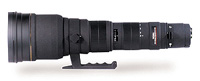
While Sigma makes many very affordable zooms, some of its latest lenses
are more likely to appeal to serious photo enthusiasts. The two most impressive
models are their long tele-zooms both designated as APO EX IF HSM and
featuring metal construction: the 120-300mm f/2.8 and 300-800mm f/5.6
zooms. Both include two elements of low dispersion glass, internal focusing,
removable tripod collars, and ultrasonic HSM focus motor for fast, nearly
silent operation. Some photographers will consider the shorter zoom as
"hand holdable" since it's not excessively large (4.4x10.6")/heavy
(91.7 oz) and offers a very wide maximum aperture for fast shutter speeds.
Naturally, the price is high as you would expect for a 120-300mm zoom
of professional quality with a constant maximum aperture of a very wide
f/2.8. (List price: $4600.)
The 300-800mm model is huge (6.5x21.3") and very heavy (weight info
not yet available) but it will be of great interest to wildlife and action
photographers whose work can justify buying a $12,000 lens (list price).
Encompassing the favorite focal lengths of those who use single super-tele
focal length lenses--300mm, 500mm, 600mm--it extends by an extra
200mm for very distant subjects. The f/5.6 aperture is adequately wide
to allow for fast shutter speeds, but I would recommend a very rigid tripod
and ISO 400 film to reduce the risk of image blur from the slightest vibration.
Both lenses will be available in Sigma, Canon, and Nikon D AF mounts at
actual selling prices that are lower than the published list prices.
|
|
Other Short Zoom Lenses
While the "big gun" lenses are certainly impressive, most
photographers tend to use more moderate focal lengths. Some short zooms
are becoming smaller and smaller. For example, Sigma's affordable
28-70mm f/2.8-4 High Speed Zoom is only 2.4" long and weighs only
8.6 oz, impressive specs considering its wide maximum apertures. (List
price: $250.)
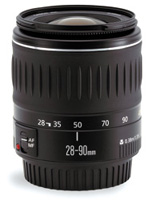
Announced at the same time as the new EOS Rebel Ti, Canon's three
new compact zooms would be great with any small EOS body. The EF 28-90mm
f/4-5.6 II (non-USM) model is the least expensive and will be available
in black or silver finish. The silver model will be included in the kit
with the Rebel Ti and perhaps some other Canon cameras. Optically identical
to the previous lens, including one aspherical element, this one includes
a new lens CPU and data algorithm for faster autofocus. The USM II version
is very similar but includes the nearly silent ultrasonic focus motor;
this model is said to provide the "fastest autofocus in its class."
|
|
Canon's new EF 28-105mm
f/4-5.6 USM II zoom is a bit more versatile since it reaches longer focal
lengths. Billed as "the smallest and lightest zoom in the 28-105mm
class" this one is surprisingly tiny--smaller than the 28-90mm
models--thanks in part to a new ultrasonic focus motor that's
half the size of earlier Micro USM motors. In spite of the small size,
this model includes an aspherical element and internal focusing plus full-time
manual focus. The latter is a useful feature that allows the user to fine-tune
focus without switching out of the AF mode.
Other zooms target the pro and the serious enthusiast and are much larger.
The Canon EF 24-70mm f/2.8L USM lens for instance, is 4.9" long
and weighs 33.5 oz because of its wider maximum aperture and extremely
rugged construction. Well sealed against dust, rain, and snow, it should
withstand the harshest conditions encountered by photojournalists and
adventure photographers. When used in conjunction with recent pro cameras,
the system is "virtually impervious to moisture" according
to Canon. Naturally, the optical formula is of top quality, with two different
types of aspherical lens elements and a UD (Ultra-low Dispersion) glass
element for obtaining sharper image quality. Useful features include internal
focus, an ultrasonic focus motor and manual focus override even in AF
mode. At the $2100 list price, this lens clearly targets professional
photographers.
|
| |
 |
Other Noteworthy Lenses
Announced in conjunction with the new R9 camera, the Leica APO-Summicron-R
90mm f/2 lens is intended for portraiture and photojournalism. The optical
formula incorporates two "high-refractive" glass elements
for Apochromatic correction, an aspherical lens element, plus two elements
with a special refraction property (high anomalous dispersion). This combination
should eliminate all types of aberrations and produce "distortion
so slight that it is practically undetectable" as well as "outstanding
contrast and exceptional definition." Because the elements are very
large, a new type of system was used to grind the aspherical surface,
using "computer-controlled CNC machines." Relatively compact
for a very fast Leica lens (2.7x2.3") it weighs 16.6 oz and will
sell for about $2300 (list price).
Contax has expanded its line of AF lenses with a fast telephoto that will
be available by year end, with a list price of $6000. The Carl Zeiss Tele-Apotessar
T* 400mm f/4 is an Apochromatic lens that should produce exceptional sharpness,
contrast, and color rendition. Although little technical information was
available by press time, this lens is very long (11.5") with a moderate
diameter (4.7") and a 46mm filter slot at the rear. Quite heavy
(7.16 lbs) as expected with a lens that's built like a tank for
long-term reliability, it's beautifully finished and includes a
rotating tripod mounting collar. That feature is important because this
lens is not likely to be used handheld. Intended for wildlife and sports
photography, the 400mm f/4 model should satisfy Contax N camera owners
who have been waiting for a long Carl Zeiss AF lens.
Manufacturers/Distributors
|