


- REVIEWS
Camera Reviews 
More Reviews Mobile Reviews Photography Reviews - GALLERIES
- VIDEOS
- BUYER'S GUIDES

Zeiss “Nikon-Fit” ZF Lenses; Manual Focus For “F” Mount Cameras
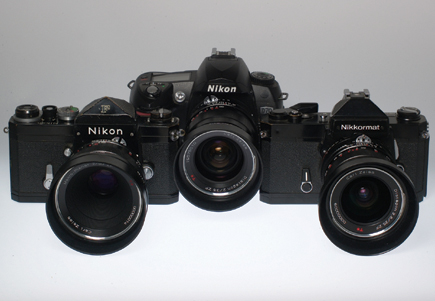
Quality, according to the old saying, doesn't cost: it pays. These new manual-focus, Nikon-fit "ZF" lenses are a perfect illustration of that saying. Sure, they are built by Hirofumi Kobayashi in Japan, but they are built to Zeiss standards from Zeiss designs, and they feel like the Zeiss lenses of yesteryear: smooth, solid, beautifully finished, with a lot of brass and glass. They are clearly built to last. And, of course, they deliver stunning image quality.
 |
|
|
Four new lenses were recently released to add to the existing 50mm f/1.4 and 85mm f/1.4, making six in all. They are the 25mm f/2.8 Distagon (10 glass, eight group); the 35mm f/2 Distagon (nine glass, seven group); the 50mm f/2 Makro-Planar (eight glass, six group, including one floating element); and the 100mm f/2 Makro-Planar (nine glass, eight group). Unfortunately, only the 25mm f/2.8, 35mm f/2, and 50mm f/2 were available for test. But we thought you would prefer to read about three of them now, rather than all four at some indeterminate future date.
The sizes and weights give some indication of the quality. The 25mm f/2.8 is 66mm long and 65mm in diameter (near enough 21/2" for each dimension) and weighs 480 g (13.4 oz). The 35mm f/2 is physically the longest at 73mm (just under 3") and is 65mm (21/2") in diameter, weighing 530 g (18.7 oz). The 50mm f/2 is 65mm (21/2") long and 72mm (just under 3") in diameter and again weighs 530 g (18.7 oz). Admittedly, what is "pleasingly solid" to one person will be "too heavy" to another, but these all-metal mounts are built with supreme precision, and that's what top-quality kits weigh.
 |
|
|
Some may say that these are collectors' items, too retro to be real. In an era of autofocus zooms, who wants manual-focus prime lenses? Manual-focus prime lenses for film cameras are undoubtedly a niche market. If you are a buyer in that market, you will know exactly why these lenses exist, and you probably want at least one of them.
The new lenses are all compatible with Nikon's 1959 F mount, and have "rabbit ears" for coupling to older Photomic heads (and Nikkormats and clip-on Nikon meters) as well as AI-S indexing for later manual-focus Nikons. All focus in the conventional Nikon direction, clockwise for closer, and the aperture rings (at the back of the lens, of course) turn clockwise for smaller apertures. Engravings are mostly white-filled, with red for the feet on the combined feet-meter focusing scales. Needless to say, these are filled engraved marks, not silkscreened on.
 |
|
|
The beautifully finished all-metal lens hoods are three-claw external bayonet, and reversible for storage. Approximate depths are 20mm (stepped) for the 25mm f/2.8; 12mm (stepped) for the 35mm f/2; and 22mm (tubular) for the 50mm. All, frankly, are somewhat vestigial. The 50mm, on the other hand, does not really need a lens hood unless you are using a filter, because the front element is very deeply recessed, maybe 40mm (15/8") or more from the front of the lens.
Lens caps are pinch-type, and represent the only significant disadvantage to the lenses: they are hard to grip, and slip out of your fingers all too easily. The sizes (same as the filter sizes) are 58mm for the 25mm f/2.8 and 35mm f/2, and 67mm for the 50mm f/2 macro.
 |
|
|
The 50mm f/2 macro has an actual focal length of 51.6mm and focuses through about 300Þ to 1/2 life size at 24cm or rather under 10". The 35mm f/2 is spot on 35mm and focuses through about 90Þ to 30cm or about 12": this corresponds to almost 1/4 life size. The 25mm f/2.8 (true focal length 25.7mm) is the real surprise, focusing through about 320Þ to 17cm or a bit over 6", for a little over half life size. Of course the subject is only about 6cm, just over 2", from the front of the lens at this distance. There is no mechanical diaphragm compensation to open up the aperture as you focus closer, as there was on early 55mm f/3.5 Micro Nikkors, so you need either to meter through the lens or to apply compensation factors for extreme close focusing: as a rule of thumb, 1/2 stop for 1/4 life size and 1 stop for 1/2 life size.
 |
|
|
Operation of all focusing mounts and diaphragm controls is extremely smooth, with positive click-stops on 1/2 stops from the maximum aperture to the f/22 minimum on each lens.
| |||||||||
|

| ||||||||








 FEATURED VIDEO


Get the Latest Photo Tips, News & Reviews from Shutterbug!






| Camera Reviews Other Reviews | |
Mobile Reviews Photography Reviews Columns | |
News | |
Features | |
How-To | |
Resources |
 © 2026 Shutterbug
AVTech Media Americas Inc., USA
All rights reserved