| |
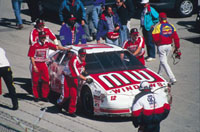
Shot
with a 600mm lens, autofocus has plenty of detail to grab
and keep the car in sharp focus while it was being pushed
into the pit area.
Photos © 1999, Jay Abend, All Rights Reserved
|
|
One of the most important
tips that I give aspiring photographers who own modern 35mm cameras
is to learn to use their cameras totally manually. That's right,
turn off the autoexposure and the autofocus, set the motor drive to
single frame, and use your eyes and your brain instead.
Don't get me wrong, I'm not one of these Luddites harking
back to the grand old days of Ikonta Bs and selenium cell light meters.
I'm paid to deliver a consistently great image to a client and
I'll use whatever tools are available. I own one manual focus
35mm system and one autofocus 35mm system. I tend to use both systems
in roughly the same manner. I prefer to meter things with a handheld
incident meter where applicable, and I like to focus for myself. That
doesn't mean that I take my own advice. I tend to leave my cameras
in the autofocus mode with Program exposure set so I can grab them and
fire off a few frames and expect decent exposure and focus without a
second thought. Since I once took some pretty nice pictures with Nikon
Fs and F-2s before auto-everything existed, it just didn't dawn
on me that I needed a camera that could focus for me.
|
| |
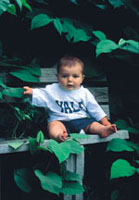
Shooting
wide open with a 200mm f/1.8 lens, the five zone focusing
system in the camera grabbed the leaves on the top of the
frame to focus on, leaving the child's face a bit
soft. Manual focus would have helped out.
|
|
When I first saw a press photographer
using a Canon EOS-1 with a 28-70mm f/2.8 autofocus lens I was just blown
away. I borrowed the camera for a minute and was dazzled by the focusing
speed and accuracy. Here was a tool that I really needed, I thought; so
I sold off a flight case full of Nikon F2s and F3s, Nikkor glass and related
accessories and bought the EOS program lock stock and barrel. I must admit
that the ergonomics of the EOS-1 and now the EOS-1N are truly wonderful,
and I really have learned to love this system, but I have relied on the
autofocus and autoexposure much less than I thought.
The press photographer who let me fondle his camera can really use as
many auto features as he can get, since in many cases press guys must
shoot well before they are comfortable with their exposure, focus and
framing. They bang away as best they can and rely on a combination of
determination, experience, talent and luck to get the image they need.
In cases where there is enough time to get the image, there are still
the issues of access to the site or subject, camera position and the difficult
to define "decisive moment" that makes routine documentary
photography inspirational. In the few instances where I have been thrown
in with the press guys, they've eaten me alive and got the great
shot while I was still jockeying for position. If I'm one of those
guys, I want a camera that can help me--even occasionally think for me.
I've had a chance to play with an early Nikon F5 and I am sure that
this remarkable camera will win over a lot of press guys who have jumped,
like me, to EOS.
|
| |
When
shooting details of clothing for a catalog, autofocus was
perfect. As the models moved around the set, focus stayed
spot on and I could concentrate on the clothing and the
client's needs.
|
|
Once I had owned my EOS gear
for a while and the newness of the system wore off, I took a good hard
look at page after page of transparencies that I had shot and realized
something very important: my work was no sharper on average than that
shot with my manual focus Nikon stuff. In fact I found a few instances
where the work was consistently out of focus, with a few in focus shots.
Did the autofocus malfunction? Was this technology over-hyped? Of course
not. The problem was that autofocus is dumb technology. Now, the engineers
who invented it are probably quite brilliant, but the resulting product
is just plain dumb. Aim it at the wall and it will focus at the wall,
even if you want some tiny detail in the foreground in focus. Newer multizone
focusing systems and Canon's great eye control focus are big improvements
over the center-only focus schemes of old, but there are still hundreds
of stuations where I feel that it is faster, easier and safer to focus
manually. In complex situations, figuring out a way to tell the camera
what to focus on may actually be more time consuming and more difficult
than grabbing the focus ring and doing it yourself.
I tend to use 35mm mostly for location work, especially for musical product
manufacturers who often assign me to shoot rock stars in concert. Even
the best autofocus system tends to get confused by the extreme contrast
between the performer and the black of the background, as well as the
colored lights that often hang from lighting rigs overhead. In some cases
the ambient light levels are quite low and the autofocus tends to hunt
back and forth; in other cases the autofocus locks in on the instrument
when I want the face in focus, or vice versa. I moved to autofocus especially
to help me in these difficult situations, but I soon learned that the
best way to focus was with my own eyes. I ditched the EOS standard matte
screen and installed split image rangefinder screens like my Nikons used
to have. Since then my focus looks better and my work looks sharper. In
situations where the performers are very well lit, especially on film
sets during video shoots, I leave the autofocus on because I find the
autofocus is better at continually refining the focus as the performer
moves around. Since I am usually shooting wide open, focus has to be spot
on, and the camera seems to do a better job than I can in those circumstances.
When I'm trying to capture two or three performers at once I always
shut the autofocus off so I can pick my focus point or even continually
shift the focus point as I shoot.
|
| |
From
this camera position I only had about 1/2 sec to shoot each
car as it came around. With autofocus on the camera couldn't
catch up. By manually presetting the focus I could grab
three frames every time the car came by.
|
|
Oddly enough, I love autofocus
in the studio. You would think that one of the places where you really
wouldn't need autofocus is in a totally controlled environment,
but I've found that when I shoot 35mm in the studio, whether for
products or people, I like to move the camera around and constantly change
perspectives. In the old days that meant continually rocking the focusing
ring back and forth trying to maintain constant focus. Since those days
I've discovered the EOS Custom Function 4 secret. (CF4 assigns the
autofocus function a button on the rear of the camera or on the motor
drive booster. The camera focuses only when you press the button rather
than the shutter release.) I can't live without autofocus in the
studio. As I move around I keep hitting the focus button on the camera
until I get a focus right and also until it "looks" sharp
to me, then I lay off the focus until I or my subject moves. This allows
me to focus on something in the foreground by tipping down the camera,
centering the object and automatically setting my focus. I then leave
the focus locked on the foreground and re-frame the shot, and shoot knowing
that the camera will not re-focus until I tell it to. The dumb technology
now borrows a little smarts from me and we're working as a team.
I find this preferable to the "press the shutter halfway"
focus lock technique, which must be repeated before every shot or the
camera simply re-focuses on the scene as it sees it, which may be on the
wrong object.
There have been hundreds of occasions where I have switched off the autofocus,
many of which surprised even me! On assignment at the Daytona 500 I found
that the "hunting" time of my long lenses was cramping my
style as the cars came around to my camera position. I could cut down
on the hunting time by presetting minimum and maximum focus distances
on the Canon 600 f/4 I was using but it still just seemed faster to me
to manually follow the cars. I found the opposite was true when photographing
the cars coming toward me. I've always had trouble obtaining the
right focus point when subjects are coming toward me, and my chromes sure
proved that I was routinely blowing it. When setup to shoot the cars three-wide
coming around turn four at Daytona, I was shooting with the 600mm f/4
and a 1.4 teleconverter for an effective 840mm f/5.6. This gave me almost
no depth of field to speak of. Focus was either spot on or I was fuzzy.
You would think that objects coming toward you would be easier to focus
on than objects speeding perpendicular to your position, but I have found
that I continually misjudge correct focus. With the autofocus on every
single shot was spot on. Very impressive.
|
| |
The
man climbing on the car to the left and the press photographer
with the yellow hat trying to get in front of my lens might
have fooled the autofocus, but since I was focusing manually
I stayed sharp on the race winner.
|
|
A lot of parents have the same

problem shooting their kids playing sports. Shoot a wide shot of the field
at infinity and everything's fine. Rack your lens out to 200mm to
catch your kid making a great play at second base and you're ready
to shoot before the lens has motored its way into focus. I thought the
speed and accuracy of autofocus would be a big help in such a situation,
but I can focus from 6' to infinity in a fraction of the time that
the camera can. Pros know all about this lag, both in camera reaction
time and human reaction time, and keep a small armada of cameras ready
and choose different camera/lens combinations to focus on different parts
of the field. A wire service like Associated Press will send a small platoon
of photographers to an NFL game, each person responsible for a different
athlete or part of the field. You can't cover everything, so you
increase your batting average by trying to anticipate action before it
happens and have your camera and lens pointed in the right direction,
focused and ready to go. This way if the play comes your way you've
got the perfect shot. If it doesn't, wait until next time.
The best and most impressive use of autofocus is the ability to hand the
camera to a total amateur and have some well-focused shots come back.
I often leave an EOS-1 body with 28-70mm lens and Canon flash laying around
the house for my wife to use to photograph the kids. While this is a pretty
formidable piece of pro gear, when set to the "P" Program
mode anyone can crank out roll after roll of fine looking shots. If I
were making gigantic enlargements of these family snaps I would surely
notice that in many instances the camera is shooting at f/2.8 and has
chosen to focus on something just in front of or behind the intended subject.
The focus isn't off by much, but it is off. The 4x6" prints
look just wonderful, but if this work was intended for publication it
wouldn't cut it. Since most nonphotographers have a difficult time
discerning accurate focus through the lens of an SLR, autofocus is a substantial
improvement.
One instance where I routinely shut off the autofocus is when shooting
with a very wide angle lens. Since SLR autofocus systems look for contrasting
horizontal and vertical lines, the more these converging lines and patterns
"pop," the faster and more secure the focus. Very wide angle
lenses have extremely wide depth of field, so the objects tend to appear
almost sharp even when the focus is off. When shooting at normal distances,
a typical 18mm f/3.5 lens tends to appear very sharp to the camera. I
have found that, when using a really wide angle lens up close, focus is
accurate, but for scenics and the like the camera doesn't seem to
"see" the foreground objects as clearly and the camera will
routinely hunt back and forth looking for focus.
The one problem with using modem autofocus cameras and lenses manually
is the lack of a good old-fashioned focusing ring. In the old days the
smooth, well-damped motion of the focusing ring was a measure of the quality
of a lens. Today, most optically fine lenses have thin polycarbonate focusing
rings that have very little damping. The result is it's quite difficult
to dial in the proper focus and keep it there, since the lightweight focus
rings are difficult to keep still. The rare examples are some of the pro
caliber lenses, especially the big pro glass like 300mm f/2.8 and 70-210mm
f/2.8 lenses. My Canon 300mm f/2.8 has a wonderful damped focusing ring,
perhaps as smooth as my old manual Nikkor 300 f/2.8 ED. Even some reasonably
priced pro glass can be quite smooth. I have a few Sigma and Tokina pro
lenses and their focusing rings are wide and quite nicely damped. My consumer
lenses from the same manufacturer seem to be a bit lighter and the focusing
is very "breezy," not as well damped as I would prefer. My
Canon 35-350mm lens has a nice focusing action, but it is a substantial
and heavy lens that just wears me out when hand holding for a long period
of time. I have become quite attached to the new version of the Tamron
28-200 zoom, but I've found the tiny non-rubberized focusing ring
to be a little difficult to manage. I love the lens anyway and make the
best of it.
Users of cameras that support older manual focus lenses have it easier.
You can still use your old heavy-duty lenses and focus yourself. With
my EOS system I'm limited to EOS only lenses. Of particular interest
to me is the Contax AX, which supports the excellent Carl Zeiss lenses
for Contax manual focus cameras and moves the camera back, rather than
the lens, to focus. For really long lenses you need to set the approximate
focus, and in the samples I've used you can use the focusing ring
yourself to assist the autofocus. I like this system a lot but I can't
switch camera systems every time something exciting comes along, or I
would have switched between Canon, Nikon and Leica about five times already.
The key ingredient in any kind of art form is to understand your medium
well enough to use it to your advantage and create work that fulfills
your vision. Since my art form usually means painfully sharp images, I
need to know when to let the technology do its stuff and when to do it
myself. By understanding when the camera is best suited to choose the
focus for me I can relax and rely on the autofocus to do its job. In those
circumstances where I know that I've had some focus problems in
the past, then I'm in the driver's seat. In the constant search
for maximum image fidelity, consistent focus is of paramount importance.
The next time you're out shooting for yourself or on assignment,
try comparing a roll shot with autofocus "on" and one "off."
See for yourself which approach yields maximum sharpness or adopt a combination
of the two. I think you'll find that each approach has a slight
advantage in certain circumstances, but find out for yourself!
|