Walk into a well stocked
photo dealer, or scan our mail-order ads, and you'll be overwhelmed
by the sheer number of cameras available today. Even when confining
the search to 35mm SLRs, you'll find over 70 listed in Shutterbug's
Photography Buyer's Guide. Ranging in "street price" from under $200
to over $2000, there's at least one to suit everyone from the snapshooter
to the hobbyist and the seasoned professional.
Because the majority of Shutterbug
readers are advanced photographers--or developing toward that level--I
selected the one autofocus SLR camera from each brand that is most likely
to meet most of their needs. These models are the cream of the mid-priced
crop, more affordable than their "professional" counterparts, but offering
most of the same advanced capabilities.
Glossary For All Camera
Specifications
MS: Multi-Segment metering; CW: Center Weighted; S: Spot Metering; PA:
Partial Area Metering; EC: Exposure Compensation; AEL: Autoexposure
Lock; AEB: Autoexposure Bracketing; P: Program; AV: Aperture Priority
AE; TV: Shutter Priority AE; M: Manual; DEP: Depth of Field Program;
FEL: Flash Exposure Lock; FEC: Flash Exposure Compensation; FEB: Flash
Exposure Bracketing; FEL: Flash Exposure Lock; HSS: High-Speed flash
Sync; SS: Single Shot AF; C(P): Continuous Predictive tracking focus;
ME: Multiple Exposure; PC: PC cord socket; DOF: Depth of Field preview;
DC: Diopter Correction eyepiece.
|
|
Contax N1
Now the flagship of the Contax line, the N1 has a new, larger N-mount
that's completely electronic and accepts only AF lenses. Most incorporate
an ultrasonic focus motor for silent, high-speed operation. With an adapter,
it will also accept Contax 645 AF lenses with full AF operation. The Contax
N1 has some truly unique features, too, such as fine focus bracketing
in manual focus mode. Set a custom function and the camera shoots three
frames, each with the point of focus at a slightly different distance,
one likely to be ideal.
The AF system has five focus
detection points arrayed in an unusual H-style pattern. They're ideally
placed for image composition as per the Rule of Thirds for off-center
subjects. To aid in fine focusing, the active point is illuminated in
red. The central point is an x while the outer points are on a diagonal;
the combination assures reliable focus with most any type of subject.
Automatic focus point selection is available, but you can also select
any focus point (or group of points) with the unique "joystick" control
on the camera back. An AF/MF dual focus button on the camera allows for
instant manual focus touchup without the need to switch from AF operation.
Contax offers a unique accessory,
a 1.5' square (digital) LCD monitor (FE-1) that can be attached to the
camera with a cable. You can preview composition and exposure for image,
in color or black and white, making adjustments until the picture seems
perfect. The FE-1 has a built-in shutter release so the camera can be
operated remotely. A data back is also available; it will imprint a great
deal of shooting data either on the first two frames or between frames.
The N1 is a large, hefty, and
handsome camera that appears to be built like a tank. A die-cast aluminum
alloy chassis provides exceptional strength. The body is very well sealed
(with o-rings, etc.) against dust and moisture for reliability in extreme
conditions. Some controls are traditional and all are large and well marked
for maximum ease of use.
Contax N1 Evaluation
Shutterbug Editor-At-Large Bob Shell has extensively tested this camera
and found it to be extremely well specified. He considered the N1 to be
highly effective in all respects, including its new five zone evaluative
meter. He also found its controls straightforward, quick to operate, and
logical. More importantly perhaps, the Carl Zeiss T* lenses for this camera
have an enviable reputation for superb optical and mechanical quality.
While there are only nine AF lenses so far, these should make owning this
Contax system highly desirable for the discriminating photographer.
Contax N1
Metering: MS (five zone), CW, S, EC, AEB, AEL
Operating Modes: P, AV, TV, M
Shutter Speeds: 1/8000 to 32 sec
Film Advance Rate: 3.5 fps
Top Sync Speed: 1/250 sec
Built-in Flash (GN In Feet): No
Autofocus Modes: SS, C(P); five point; spot AF
Other Features: 22 custom functions; DOF, ME, PC, DC
Dimensions: 5.9x4.5x2.7"
Weight: 28.4 oz
Power Source: One 2CR5
Comments: Focus bracketing; shooting data imprinting (accessory)
|
|
Canon EOS-3
Incorporating the most important features of the "pro" EOS-1 V, the EOS-3
is packed with advanced capabilities including reflex mirror lockup for
vibrationless high-magnification photography. Most impressive technically
are the 45 point autofocus system with seven cross-type sensors, substantially
upgraded Eye Controlled Focus point selection (ECF), and high-speed tracking
focus capable of keeping up with a 7 fps film advance rate, when the optional
PB-E2 booster is used.
The exposure system is extremely
sophisticated, with new Multi-Spot metering, 21 zone evaluative metering
system, 17 zone flash meter with E-TTL flash control, and more. With an
EX series Speedlite, the EOS-3 automatically switches into high-speed
sync to prevent ghosting (motion blur) with moving subjects and to allow
for wide apertures to be used in close-up photography on bright days.
Flash Exposure Compensation and AE Lock for flash are available, too;
use the 550EX, and you also get Flash Exposure Bracketing (FEB) and wireless
off-camera TTL flash, too.
Bearing a strong resemblance
to the EOS-1 V the EOS-3 is about the same size and sports similar controls,
mostly buttons plus two dials. All are extremely well marked, with a few
hidden behind a small door. Anyone familiar with the EOS-1 series models
will find the transition to an EOS-3 seamless. Lighter than the EOS-1
V, the EOS-3 is quite resistant to shock and moisture but has more glass-fiber
reinforced polycarbonate components. Still, it feels sturdy and hefty,
befitting a camera that's often used by pros as a backup to the EOS-1
models.
Canon EOS-3 Evaluation
Designed to entice the professional, the EOS-3 system will definitely
appeal to advanced photo enthusiasts, too, particularly those who want
the latest technology, extra features, and super fast response. Far more
than a series of high capacity computers, the camera's many options and
problem-solving capabilities offer great flexibility in real world photography.
Their additional creative options should augment the photographer's ability
to make exactly the desired images or to capture the decisive moment.
Canon EOS-3
Metering: MS (21 zone), CW, S, Multi-Spot, PA, EC, AEB, AEL
Operating Modes: P, AV, TV, M, DEP
Shutter Speeds: 1/8000 to 30 sec
Film Advance Rate: 4.3 fps; seven with accessory
Flash Features: Wireless TTL with some flash units; FEC; FEB;
FEL
Top Sync Speed: 1/200 sec; HSS with some flash units
Built-in Flash (GN In Feet): No
Autofocus Modes: SS, C(P); 45 point; spot AF
Other Features: 18 custom functions; DOF, ME, DC, PC
Dimensions: 6.3x4.7x2.8"
Weight: 27.5 oz
Power Source: One 2CR5; AA with accessory
Comments: Reflex mirror lockup; Eye Controlled Focus
|
|
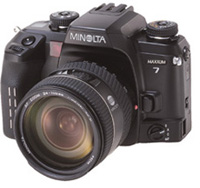
Minolta Maxxum 7
Over the past few years, the terms "unique," "innovative," and "state
of the art" have lost their true meaning due to overuse. Occasionally,
however, a manufacturer releases a product that deserves all those accolades.
The new Maxxum 7 and its accessories fall into this category, with technology
and features that earn it several "firsts" in the industry. Most significant
is the Navigation Display system: a 1x1.5" dot matrix LCD panel on the
camera back.
The panel provides a great
deal of data--including specifics about each of the 35 custom functions
in simple text--but you can ignore anything not of immediate interest
or scroll to other screens. The single most useful item for outdoor photographers
is the unique depth of field bar graph, available only with the new D
lenses. It provides specifics on the zone of sharpness at any aperture
and focused distance, the simplest and most effective system currently
available.
Other notable features include
a unique Smooth Trans Focus mode that produces defocused image areas without
a special lens, and exposure data memory for seven rolls of film. All
this may sound complicated, but the standard features of the Maxxum 7
are simple to understand and easy to access with oversized knobs and familiar
input dials. Other controls are adequately large and well marked, with
less frequently used controls hidden under a small door.
The new autofocus system is
impressive. Its unique "dual (x and +) cross-hair" central sensor and
eight others canted at various angles offer reliable focus on any type
of subject pattern. Any of the nine points can be selected with the rear
mounted thumb pad or you can simply set the camera for automatic focus
point selection. The active point lights up in red on the viewing screen.
Focus can be manually touched up when desired, a first in the Maxxum system.
Minolta introduced a new D-series
of AF lenses offering several advantages, including a distance encoder
for more accurate flash exposures with Advanced Distance Integration,
when using the built-in flash or the new D-series flash units. With the
latter and any AF lens, the Maxxum 7 offers flash sync to 1/8000 sec,
even in wireless off-camera TTL flash photography. Other flash options
include Flash Exposure Compensation and Bracketing, a first in any Minolta
camera.
Minolta Maxxum 7 Evaluation
There's a great deal more of course, including reflex mirror lockup and
35 custom functions. Considering its lengthy list of features--and the
exceptional performance of the autofocus and exposure systems--this camera
is highly competitive with some pro-level models, except for slower film
advance and fewer metal parts. Granted, some of the high-tech capabilities
do require a thorough study of the Owners Manual.
The innovative Navigation Display
system makes this a truly unique model that will initially attract younger
photographers and anyone who appreciates high-tech gear. However, even
long-time photographers should appreciate this camera because of its dependable
automation and versatility. These make the Maxxum 7 highly suitable for
effectively capturing the most difficult subject or situation.
Maxxum 7
Metering: MS (14 zone), CW, S, EC, AEL, AEB
Operating Modes: P, AV, TV, M
Shutter Speeds: 1/8000 to 30 sec
Film Advance Rate: 4 fps
Flash Features: Wireless TTL with some flash units; FEC; FEB
Top Sync Speed: 1/200 sec; HSS with some flash units
Built-in Flash (GN In Feet): Yes; GN 29
Autofocus Modes: SS, C(P); nine point; spot AF
Other Features: 35 custom functions; ME, PC, DOF, DC
Dimensions: 5.6x3.9x2.6"
Weight: 18.4 oz
Power Source: Two CR123A; AA with accessory
Comments: Eye Start automation; exposure data memory; dot matrix
LCD monitor; reflex mirror lockup
|
|
Nikon F100
A suitable alternative to the large, heavy, and expensive F5, the Nikon
F100 has become the camera of choice for numerous hobbyists as well as
many professional photographers. Featuring many of the same capabilities,
and very similar technology, the F100 sports less traditional controls,
reminiscent of those on many other Nikon AF bodies. The F100 is highly
shock and impact resistant, thanks to extensive use of lightweight magnesium
alloy in the chassis; it's also well protected against moisture and extremes
of temperature.
The focus point selector thumb
pad on the camera back was borrowed from the F5, and both models offer
Dynamic autofocus. The F100 has five focus detection sensors--three cross-hatched
and two vertical/tilted for reliable focus acquisition. High-Speed Tracking
and "Lock-On" are also available: the system continues to track the original
subject even if focus detection is momentarily interrupted. Tracking focus
is very successful with fast action subjects moving in any direction;
for lightning fast tracking, consider one of the AF-S (Silent Wave) Nikkor
lenses with an ultrasonic focus motor.
Few mid-priced cameras offer
more light metering options and overrides. The 3D Matrix metering system
is highly advanced. The microcomputer considers a complex array of factors,
including brightness, contrast, selected focus area, and distance to the
subject. Intelligent Multi Sensor Balanced Fill Flash is available, too,
as are Flash Exposure Compensation and Bracketing plus wireless off-camera
TTL flash (with an accessory) and high-speed sync with certain speedlights.
Nikon F100 Evaluation
The F100 includes all the capabilities that most photographers will ever
need. It offers impeccable autofocus, metering, and flash performance.
The diversity of Nikon lenses and accessories should satisfy every photographic
specialty; compatibility with manual focus Nikkor lenses (with some limitations)
is a bonus. Especially when equipped with one of the many AF Nikkor lenses
and an SB-28 Speedlight, the F100 should make your creative or technical
photography more effective, providing an excellent return on investment.
Nikon F100
Metering: MS (10 zone), CW, S, EC, AEL, AEB
Operating Modes: P, AV, TV, M
Shutter Speeds: 1/8000 to 30 sec
Film Advance Rate: 4.5 fps; five with accessory
Flash Features: Wireless TTL with some flash units; FEB; FEC
Top Sync Speed: 1/250 sec; HSS with some flash units
Built-in Flash (GN In Feet): No
Autofocus Modes: SS, C(P); five point; spot AF
Other Features: 20 custom functions; DOF, ME, PC, DC
Dimensions: 6.1x4.5x2.6"
Weight: 28 oz
Power Source: AA
Comments: Also accepts manual focus lenses
|
|
Pentax MZ-S
Because this is a brand-new model, a production sample of the MZ-S was
not yet available as we went to press. However, I did get a chance to
handle it extensively at the PMA show. Entirely different in shape and
controls than the older PZ-1p, the new camera is loaded with all the same
capabilities. However, it also takes advantage of more advanced technology
and entirely new controls.
The SAFOX VII autofocus system
is far more sophisticated, featuring six focus detection sensors instead
of a single wide area sensor. This is certainly preferable for off-center
compositions. The user can select any desired point--by pressing the AF
button and turning a dial--or allow the camera to do so automatically.
Apparently, its overall performance--including predictive tracking focus--is
also superior.
Other new amenities include
high-speed flash sync and wireless off-camera TTL flash with the AF360FGZ
flash unit, built-in data back for printing exposure data between frames,
and an illuminated lens mount index for convenience in low light. There's
also a feature not mentioned in Pentax literature: reflex mirror lockup
with the 2 sec self-timer. The top film advance rate is 2.5 fps. This
is a handsome camera with a unique, rounded style. Moderately small and
lightweight, its major components are made of light but rigid magnesium
alloy. The "direct-access" control dials and LCD data panel are slanted
backward so they're easy to see with a slight shift of the eye from the
viewfinder. Their operation should require only a quick review of the
Owners Manual, and overall, the MZ-S appears to be less complicated than
the PZ-1p.
Pentax MZ-S Evaluation
The MZ-S accepts manual focus KA and K-mount lenses with some limitations,
and they will even autofocus with an optional adapter. With a highly durable
body and full complement of capabilities and overrides, the MZ-S should
satisfy some professional photographers, although faster film advance
may be required by some. The PZ-1p was a highly capable camera, but the
MZ-S is even more desirable thanks to the additional features, more advanced
autofocus system, and larger/simpler controls.
Pentax MZ-S
Metering: MS (six zone), CW, S, EC, AEL, AEB
Operating Modes: P, AV, TV, M
Shutter Speeds: 1/6000 to 30 sec
Film Advance Rate: 2.5 fps
Flash Features: Wireless TTL with some flash units
Top Sync Speed: 1/180 sec; HSS with some flash units
Built-in Flash (GN In Feet): Yes; GN 39
Autofocus Modes: SS, C(P); six point; spot AF
Other Features: 19 custom functions; ME, DC, DOF
Dimensions: 5.4x3.7x2.5"
Weight: 18.3 oz
Power Source: Two CR2; AA with accessory
Comments: Reflex mirror lockup; shooting data imprinting; also
accepts manual focus lenses
|
|
Sigma SA-9
Still the only independent lens manufacturer to offer SLR cameras, Sigma
recently released their latest high-end model, the SA-9. This camera is
expected to be a price leader in its category, in spite of the wealth
of capabilities intended for serious photography. Resembling the earlier
SA-5 with a larger handgrip, the compact SA-9 sports an oversized film
drive selector knob and (conventional) shutter speed knob, a single command
dial, plus well marked exposure control buttons. Most functions appear
to be intuitive, making for simplicity of operation.
Although it uses the same single,
cross-type autofocus sensor as the SA-5, the algorithms have been upgraded.
In the low light of the PMA trade show, response was quick. According
to a Sigma rep, its tracking focus system has also been improved.
The SA-9 is also loaded with
virtually every capability and override, as noted in the specs. Some of
the most significant include reflex mirror lockup, eight segment evaluative
metering, built-in data back, and high-speed flash sync plus wireless
off-camera TTL flash with the new EF-500 Super flash. Its fully electronic
SA mount accepts any of the vast range of Sigma lenses, from 8-800mm,
adequate to satisfy most every need. Many of the newer lenses include
a Hypersonic Focus Motor (ultrasonic) for silent and fast operation.
Sigma SA-9 Evaluation
Because a test sample was not yet available, a full assessment is not
possible. However, I did test the earlier SA-5 and found it to be competent
in overall performance. With superior autofocus and more flash capabilities,
the SA-9 should be even more successful. A multi-point autofocus sensor
might have made it even more desirable, but Sigma cameras are designed
for pinpoint focus accuracy instead of a point-and-shoot approach to composition.
The SA series of cameras have all offered high value for the money, allowing
most anyone to be well equipped without blowing the limit on his or her
credit card.
Sigma SA-9
Metering: MS (eight zone), EC, AEL, AEB
Operating Modes: P, AV, TV, M
Shutter Speeds: 1/8000 to 30 sec
Film Advance Rate: 3 fps
Flash Features: Wireless TTL with some flash units
Top Sync Speed: 1/180 sec; HSS with some flash units
Built-in Flash (GN In Feet): Yes; GN 40
Autofocus Modes: SS, C(P); one point; spot AF
Other Features: DOF, ME, DC
Dimensions: 5.6x3.8x2.7"
Weight: 15.3 oz
Power Source: One 2CR5
Comments: Reflex mirror lockup; date back
Mid-Range AF-SLRs
All of the autofocus SLRs covered include numerous capabilities and advanced
technology, but study our specs closely for any features that are particularly
important to you. This should help narrow the field, allowing you to select
the models that would meet all of your current and future needs. Take
the time to check out each camera, to ensure that its controls and operation
seem logical and quick to you.
Manufacturers/Distributors
Canon U.S.A. Inc.
(516) 328-5000
www.canon.com
Contax Division of Kyocera Optics Inc.
(800) 526-0266
(732) 560-9221
www.contaxcameras.com
Minolta Corp.
(201) 825-4000
fax: (201) 423-0590
www.minoltausa.com
Nikon Inc.
(631) 547-8500
fax: (631) 547-8518
www.nikonusa.com
Pentax Corporation
(303) 728-0212
fax: (303) 790-1131
www.pentaxusa.com
Sigma
(631) 585-1144
fax: (631) 585-1895
www.sigmaphoto.com
|