| |
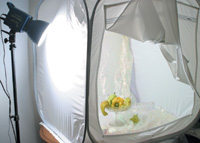
A
studio flash was positioned to the left and rear of the
set, with shimmering Mylar as a backdrop for these peppers.
The lighting inside the Lastolite Cubelite is quite soft.
There is some light falloff on the right, but nothing
that couldn't be corrected with a white bounce card.
Photos © 2003, Jack Neubart, All Rights Reserved
|
|
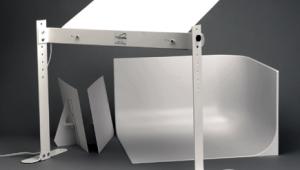
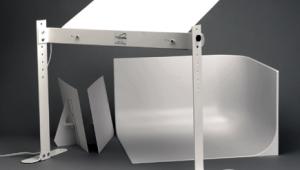
When it comes to lighting
tabletops, professional photographers often opt for the sweep table.
A sweep table looks like an oversized chair, but, instead of cushions,
it comes in an assemblage consisting of an upward curving, or
"sweep-back," milk-white Plexiglas sheet supported on a
frame that stands at a comfortable height for shooting. The idea behind
the sweep table is that light can come in on the subject from any of
many possible directions, including underneath. And because the background
sweeps up behind the subject, it is continuous, doing away with a sharp
horizon line intersecting the picture at some point. Also, the sweep
design allows the background to gradate, doing away with the need for
a graduated backdrop.
|
| |
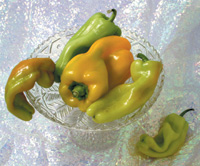
With
only the studio strobe, the lighting is harsh, with burnt-out
highlights and fairly deep shadows. Note the loss of definition
on the underside of the pepper hanging off the dish. Interestingly,
the Mylar has more color saturation here.
|
|
While utilitarian, sweep tables
have their limitations. They are often expensive, bulky, inflexible, and
not portable. They are not necessarily the best or most expedient solution
for tabletop subjects with shiny and highly reflective surfaces, unless
you don't mind all the added work that would be required in tackling
these problems. Simply stated, there is a simpler way to light some otherwise
difficult tabletop setups.
Enter Light Tents And
Cocoons
Available from various manufacturers, these devices surround the still
life set with a translucent white diffusion material. The resulting lighting,
whether from available light, flash, hot lights, or fluorescents, is relatively
soft and the all-white interior usually bounces back enough light to prevent
harsh contrast.
The typical light tent is conical, resembling a teepee, and is constructed
of nylon. It might require a separate support rod (not supplied with the
tent) at the top to hold it erect and in place. The cocoon, on the other
hand, is self-standing and rectangular, and constructed of a milk-white
Plexi-like plastic. There is also a hybrid design, which is also self-standing,
but cubical and constructed of nylon. The conventional light tent and
the hybrid design both collapse down to a flat, circular (pie-to-wheel-size)
shape convenient for carrying. The smaller conical light tents are perhaps
the most portable lighting solution, as well as being most economical.
Each design has its advantages, with some tradeoffs.
|
| |
The
Lastolite Cubelite is spacious and will accommodate larger
sets than a cocoon or conical light tent. One light was
enough to light these peppers, but a white fill card on
the right would have helped to reduce contrast further.
Caution: be careful not to position hot lights or powerful
strobes too near a nylon or plastic surface.
|
|
The Westcott Conical
Light Tent
This light tent very conveniently springs into shape from its collapsed
form, giving you a nylon, cone-shaped enclosure that some may find especially
suitable for soft lighting of small subjects indoors or out. Because of
its small diameter and restricted working space, the light tent may limit
what you photograph and some subjects may have to be photographed from
a higher camera angle than would be optimal. (Larger sizes may open up
additional options.) The Westcott 21x26" Light Tent I worked with
had a touch fastener opening that went from top to bottom. Because of
the confined space, I found it necessary to position the camera at a higher
angle, closing the tent flaps around the lens. Admittedly, the subjects
I chose for my comparison views worked better with a rectangular enclosure,
such as a cocoon, than with this type of tent, although using a light
tent did lead to a different take on things.
|
| |
These
ceramic figurines were lit by a studio strobe, from the
left. The RedWing Cocoon produces a soft light, without
glaring highlights or harsh contrasts.
|
|
Because of its upward tapering
design, the tent won't accommodate sweeping backdrops. That doesn't
mean that you can't fashion a usable solution. This tent has a touch
fastener opening at the apex--normally for the lens, for a straight-down
view. Instead, I used the top slit as an anchor point, pulling Mylar material
up through there, then draped the material around the subject.
While F.J. Westcott, the tent manufacturer, recommends ironing out wrinkles,
I chose to leave the fabric crinkly, since this tent would be opened and
packed away again and again. Besides, you won't have an iron when
using the tent in the field, so get used to the wrinkles. They didn't
seem to bother anything. You might even say it's a different wrinkle
on lighting.
|
| |
The
same light has a similar effect inside a conical light tent,
the key difference being the restricted working space resulting
in a higher camera angle.
|
|
The RedWing Plastic
Cocoon
The milk-white, Plexi-like material that forms the self-standing, quasi-rectangular
envelope, or cocoon, of the RedWing Cocoon 70 is a very efficient diffuser.
However, this device tends to be bulky, considerably heavier, and not
as portable as a simple light tent, rolling up into a cylindrical shape
that fits inside a duffel bag.
The RedWing Cocoon features four distinct sections, which must be fastened
together with touch fasteners and zippers. So it's a bit more labor-intensive
than a fully collapsible light tent. But it's fairly easy to take
apart and pack up.
Available in several sizes, the overall enclosure is roomier than the
conical light tent. And the sweeping backdrop and flat floor that are
integral components render this a largely self-sufficient studio accessory.
Because this is a semirigid material, not a pliable nylon, you can't
simply stick a lens through and close a zipper around it. Each lens opening
is a precut aperture, and that is one drawback: Dust can enter and the
holes allow the "outside world" to be reflected on shiny surfaces.
As a precaution, cover openings with white paper.
Because the bare floor is plastic, it reflects back what's being
photographed. If that bothers you, drape some fabric or other material
over the floor. By unzipping the side panels at the base, you can slide
a sheet of poster board through and use that as a backdrop. And because
the base is fairly rigid when assembled, this cocoon can be draped over
supports and be lit from underneath. In fact, the lighting possibilities
are practically endless.
|
| |
Take
away the light tent and the cocoon and you get a very harsh
picture. Highlights practically burn out.
|
|
The Lastolite Cubelite:
Self-Standing, Yet Collapsible
While some may call this a "light tent," the Lastolite Cubelite
is constructed of light-diffusing nylon fabric in a collapsible cube-shaped
design. Essentially, the Cubelite springs open and collapses like any
folding diffuser/reflector, which makes it eminently portable--while
occupying considerably more space when open. Opening it, I found, is a
much simpler chore than folding it back down to its original size, but,
with practice, it became easier.
On this design, there is a removable front panel that allows you to introduce
the various items into the set's interior. When opening or removing
this panel (which is secured by a touch fastener all around), make sure
to hold the cocoon firmly in place, or anything inside will go flying
as you try to "rip" apart the hook-and-loop material. The
front panel has zippered slits (vertical and horizontal) for the lens
to poke through.
|
| |
A
studio strobe was all that was needed to light a set of
ceramic figurines inside this RedWing Cocoon, which zips
open at the base to admit a red poster-board backdrop. Caution:
be careful not to position hot lights or powerful strobes
too near a nylon or plastic surface.
|
|
The very thin fabric efficiently
allows light to pass through, while at the same time bouncing light back
onto the enclosed subject. So, on the one hand you have a soft light;
on the other you have bounce light filling in shadows. Having said that,
the roomy interior, especially on the 3-foot model I used, does not reflect
light as well. That means bounce cards may be called for. On the other
hand, the spacious interior also allows you to set up black cards to pull
back some of the light and add subtle contrasts of tone. Larger cocoons
generally serve best with larger subjects. I found the 3-foot size a bit
much for my needs. Unfortunately, the 2-foot size wasn't available
in time for this story. That would have been my ideal choice.
The Cubelite provides clips at the rear to support a sweeping backdrop,
so you're not stuck with an all-white background all the time. Because
of the seams, an added backdrop is almost invariably a necessity. Suitable
backgrounds range from black velvet to poster board to roll paper cut
to size. I personally prefer shimmering Mylar, which may appear opaque
but is actually translucent. While you can light from the sides and back,
this type of cocoon does not lend itself to lighting from underneath--the
bottom is too pliable and will not support any weight on its own, unless
placed on a table.
Select models of the Cubelite may feature a removable bottom, making it
more tent-like in character. With such a design it's possible to
lower the structure over an immovable subject to isolate it from cluttered
surroundings.
Advisory: To prevent damage to a tent or cocoon, and avoid a possible
fire hazard, keep hot lights and high-wattage modeling lights, as well
as powerful studio strobes, clear of the fabric and plastic surfaces.
Moreover, excessive exposure to light may lead to discoloration of the
color-neutral materials.
A Guiding Principle
When it comes to translucent cocoons and light tents, follow this dictum:
The farther your light source is away from the diffusion surface, the
softer the light enveloping the subject inside. Put your light closer
to the surface, and the result is a harder, more contrasty light hitting
your still life.
Helpful Resources/Light
Tents & Cocoons: Where To Get Them (Or Find Out More About Them) Online
Note: The same or similar products may be sold under
different names.
· Bogen Photo Corp. (www.bogenphoto.com)
· Bowens International Ltd. (www.bowensinternational.com/pdf/table_top_studio_guide.pdf)
· F.J. Westcott Company (www.fjwestcott.com)
· Greenbatteries Store/EZCube (www.store.yahoo.com/greenbatteries-store/tabtopstudac.html)
· Lastolite Ltd. (www.lastolite.com)
· Plume Ltd. (www.plumeltd.com/cocoon.htm)
· RedWing (www.redwingphoto.com)
· R.T.S., Inc. (www.rtsphoto.com)
· Sell-It-On-The-Net.com (www.sell-it-on-the-net.com/online_store/Pro-line_cocoon_tents.htm)
|