


- REVIEWS
Camera Reviews 
More Reviews Mobile Reviews Photography Reviews - GALLERIES
- VIDEOS
- BUYER'S GUIDES

Street Smarts; The Savvy Consumer’s Guide To Pre-Owned, Collectible, And Vintage Cameras; Leicaflexes And Early Leica Rs
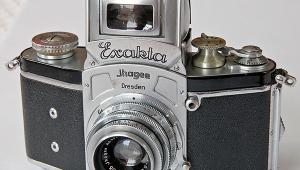
Adventurous souls and early adopters were shooting with 35mm SLRs (namely the Kine Exakta) as far back as 1936, but it wasn't until the late '50s and early '60s that 35mm SLRs really began to dominate the serious amateur and professional camera market. No other camera type offered the SLR's supreme optical flexibility and a penta-prism finder with eye-level, through the lens, parallax-free viewing and focusing. Nikon soon took the lead, introducing the landmark Nikon F in '59, a formidable pro system camera based on the well established form of the very successful Nikon S-series rangefinder cameras. Tokyo Optical Co. was in the fray with the Topcon RE Super, an early TTL-metering SLR by '63, and not much later, in '65, Konica announced the world's first autoexposure SLR, the Konica Auto-Reflex. With such a spate of technical innovation issuing forth from Japan, the Germans, then esteemed as the world's premier precision camera manufacturers, knew they couldn't afford to rest on their laurels--and they didn't.
 |
Unfortunately, when it came to developing new focal plane shutter, interchangeable lens, penta-prism SLRs, the two most venerable German camera companies, E. Leitz Wetzlar and Zeiss Ikon, proceeded with too much deliberation, an excess of caution, and insufficient speed. After much ado, both came out with SLRs that proclaimed, "Have it our way!"--turning the later but famous Burger King slogan on its head. In short, the Zeiss Contarex and the Leicaflex were idiosyncratic, essentially unrelated to their splendid rangefinder forbears, stupendously expensive, and not very technically audacious--cameras that may have pleased the engineers but didn't sell like hotcakes. On the other hand, they were exquisitely made heavy metal machines with superb optics that were bench assembled in relatively limited quantities, and that's why they make such fascinating user collectibles. The good news for collectors is that the current bear market in (most) film SLRs means that Leicaflexes and their cousins, early Leica Rs, are now a lot more affordable. If you're patient, you can snag a clean, operational example with a fine lens for not much more than a few hundred bucks--or about twice that much for a pristine example. (Contarexes are another story for another column.)
The original Leicaflex of '64-'68 (called the standard in retrospect) is certainly underwhelming in terms of features. It's an old-fashioned match-needle-metering SLR with a non-TTL CdS meter cell inset in the front of the penta-prism housing. And its focusing system is downright peculiar--the actual focusing image is confined to a smallish fine microprism circle in the center of the finder field. This is surrounded by a screen image that's quite bright but always in focus irrespective of the distance setting of the lens--it's sorta like a rangefinder! Oh well, at least it's got an instant-return mirror and meters at full aperture. Once you get past its foibles, there's no denying that this hefty, exquisitely made, gorgeously finished machine is extremely well-balanced and, with its rounded back and radiused front edges, it nestles very comfortably in your hands. The big knurled shutter speed dial at the wind-lever axis provides speeds of 1 second to 1/2000 sec plus B, which are read out in large, legible white-on-black numerals along the bottom edge of the finder, and there's a lollipop-shaped follow-pointer that you line up with the floating meter needle by turning either the shutter speed dial or the lens aperture ring.
 |
|
|
I was mildly disappointed (even back in the day when the Leicaflex debuted) that it doesn't have a ratcheted wind lever like an M-series Leica, but once you move the lever to standoff position the single throw is mercifully short and the action commendably smooth. One feature Leica M enthusiasts will love is the shutter release button inset in the middle of the shutter speed dial. Its location is ergonomic, and its action is superb--just about as buttery smooth as a well broken in Leica M. For the record, you'll find a ye olde mechanical self-timer lever and an honest-to-Pete mirror lockup lever on the front of the body on the right-hand side. The ASA/DIN dial under the folding rewind crank goes up to 3200, the hinged back is a hefty casting, and the camera is as magnificently finished inside as well--the oversized pressure plate is one of the nicest on any camera. The shutter is (what else?) a rubberized cloth focal plane that moves horizontally, which is why the top flash sync speed is only about 1/90 sec.
The Leicaflex standard pictured here is from the extensive inventory of Leica specialist Stan Tamarkin. Its serial number is 1118309, marking it as an early example, identifiable by a pie-shaped (rather than round) film counter cover and three screws in the tripod socket surround. The 50mm Leitz Wetzlar Summicron-R lens shown is of later vintage than the camera. It's a "two-cam" version, which added an aperture-indexing cam that couples it to the integrated TTL metering system in the Leicaflex SL, while retaining a second cam to maintain backward compatibility with older Leicaflexes. The original "one-cam" lens used a single cam to relay aperture information from lens to body.
The final iteration, introduced in '76, was a "three-cam" mount designed to couple to the autoexposure system of the new Leica R3 and to work on all Leicaflex bodies as well--the third cam is a stepped, black-colored affair located inboard of the chrome second cam. Note: Some later three-cam R lenses will only mount on Leica R bodies because they have a collar around the lens mount flange to prevent you from mounting the lens on Leicaflex bodies. The bottom line: When buying lenses for Leicaflexes, make sure they work on your body before consummating the deal. Oh yeah, I had great fun taking pictures with the original Leicaflex, and the results were technically superb, but when metering, you've got to remember that the external meter cell covers the angle of a 90mm lens, so it acts like a center-weighted meter with a 50mm lens, a full area averaging meter with a 90mm, and a spot meter of sorts with wide angles--and it's got parallax at close distances so point that cell directly at the subject!
| |||||||||
|

| ||||||||
- Log in or register to post comments






















 FEATURED VIDEO



Get the Latest Photo Tips, News & Reviews from Shutterbug!






| Camera Reviews Other Reviews | |
Mobile Reviews Photography Reviews Columns | |
News | |
Features | |
How-To | |
Resources |
 © 2024 Shutterbug
AVTech Media Americas Inc., USA
All rights reserved