| When the temperature outside
hit 100Þ on Sunday, I knew it must be time to write my annual "stocking
stuffer" column, in which I collect lots of goodies you can give
to your favorite digital photographer as holiday presents. The best stocking
stuffers are inexpensive, useful, and small enough to fit in a stocking,
but a few of this month's suggestions may be a little bit bigger
and cost a bit more than a New Beetle "Drivers Wanted" mouse
pad (www.vw.com).
Digicam Software
All most point-and-shoot digicam owners want is a simple way to import
images into their computer, fix a few simple defects, and either print
or share them with others via the Internet. If this describes you, run
out and get a copy of Jasc's After Shot Premium Edition (www.jasc.com).
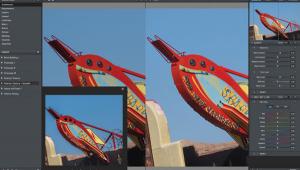
At first blush, the Windows-only After Shot 1.0 looks like one of the
many image browser programs out there and there are some obvious similarities.
Like a good image-base program, After Shot lets you organize images from
your hard drive or from a digital camera into albums and each photograph
can be assigned captions and keywords for later search and retrieval.
But there's a lot more here.
The program's Print Layout lets you make contact sheets or package-style
prints in preformatted ways or you can create your own. Click the Stitch
button and drag image files into a window to create seamless panoramic
images that are as good as any produced by Adobe Photoshop Elements, which
has the best stitching function available. Double clicking an image shifts
the interface to Edit and provides tools such as Crop, Rotate, and Redeye
Removal that include six different tools plus a list of tips. One of the
most pleasant surprises is Web Layout; click on one of the templates bundled
with the program and you can add color, pizzazz, and even animation to
your web site. After Shot will also let you produce slide shows that can
be transferred to CD or turned into QuickTime movies. Did I mention you
could add audio to an image file? You can also use all of the images in
a folder to create screensavers or designate one as wallpaper.
Plug-In Of The Month
The one Photoshop compatible plug-in that you need to stuff in your favorite
photographer's stocking is Alien Skin Software's Image Doctor
(www.alienskin.com).
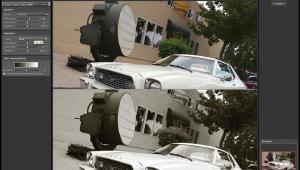
Those creative geniuses at Alien Skin have put their brains together and
come up with a collection of plug-ins that clean up funky images making
them look as good as they possibly can. Image Doctor removes blemishes
and defects, repairs overcompressed JPEGs, and replaces unwanted details
and objects. It does all this within a clean, easy to use interface. Users
can tweak effects in a dialog box that includes before/after toggle, command
menus, keyboard shortcuts, and unlimited undo capability. All you have
to do is use your image editor's selection tools, then correct large
or small areas in one pass. Here are some of the tools and what they do:
· Smart Fill replaces large objects and defects, combining the repair
with the background. It can remove signs and trash from landscapes, unwanted
tourists from vacation snapshots, and uninvited guests from party photos.
(There goes your mother-in-law!)
· Scratch Remover mends small defects and removes unwanted background
details. It also repairs scratches, folds, creases, and wrinkles found
in old photographs.
· Spot Lifter removes blemishes while preserving the texture and
detail of the underlying image. Spot Lifter is great for erasing skin
flaws or tattoos, as well as reducing dark circles, shadows, and wrinkles
around the eyes. Spot Lifter also removes imperfections such as watermarks,
stains, and dust. If you have Photoshop 7 envy because of the Healing
Brush, Spot Lifter does the same kind of job.
· JPEG Repair revitalizes overcompressed JPEGs, removing blocky
compression artifacts while retaining detail. Repairs can be made to an
entire image or smaller selections.
A 30-day demo version can be downloaded from the Alien Skin Software web
site.
How Big Is Your Monitor?
Unless you're Big Foot, this monitor won't fit in your stocking,
but you'll be glad to see it sitting under the tree--if you
have a really big tree. When it comes to screens, bigger is always better.
Right now I am working with the biggest and best LCD monitor I have ever
used, the Radius RAD-23 (www.kdsusa.com). Yup, it's a 23"
diagonal screen unlike Apple's 23" wide-format model that
is only 23" wide. With a native resolution of 1600x1200 (which my
Apple Power Macintosh G4 automatically set on boot-up) text was crisp
and sharp, lacking the color "fringies" often seen on large
LCD monitors.
The RAD-23's on-screen color wasn't bad either, but I calibrated
it using Pantone's ColorVision Spyder and its OptiCAL software (www.colorvision.com).
This software is easy to use and by following on-screen instructions,
the display went from very good to spectacular in a few minutes. Working
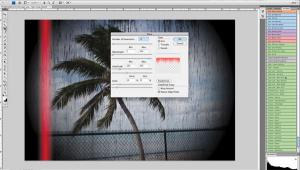
in Adobe Photoshop, I was able to scatter palettes and control panels
across the screen while looking at full-sized images. Better yet, I was
able to place an 8x10 image next to another to compare before and after
enhancements. (It's all too easy to forget how good the original
was and get carried away making "improvements.") The Radius
RAD-23 is also an amazing way to make PowerPoint presentations. At 60
lbs it weighs more than an LCD projector but the display quality is stunning
for small group presentations where image quality is critical.
New Year; New Memory Card
Format
The handwriting has been on the wall for some time for the Wheat Thin-like
SmartMedia Card: It was obvious there were more cameras, especially digital
SLRs, using CompactFlash memory and CompactFlash had the potential to
create larger--more pictures, please--capacities. Instead of
giving in, the creators of SmartMedia put their collective heads together
and have given us yet another memory card format: The xD-Picture ("eXtreme
Digital") Card. This may be the smallest storage format yet--comparable
in size to a penny. A card measures 0.79x0.98x0.07" and weighs less
than 1/10 of an ounce and has the potential for up to an 8GB storage capacity.
The xD-Picture Card is designed to minimize power consumption, save battery
life, and provide fast read/write capabilities for faster digicam operation.
A 16 or 32MB card can record data at 1.3MB/sec. A 64MB card or higher
can record data at 3MB/sec and both offer a read speed of 5MB/sec. Initially,
Fujifilm xD-Picture Cards will have 16MB, 32MB, 64MB, and 128MB capacities,
with 256MB planned for later this year. This combination of tiny size
and large capacity will allow Fujifilm (www.fujifilm.com), Olympus (www.olympusamerica.com),
and others to produce smaller and lighter digital cameras and both companies
plan to offer cameras compatible with the xD-Picture Card for this holiday
season. PCMCIA and CompactFlash adapters will also be available, allowing
use of xD-Picture Cards in a variety of cameras and other devices from
multiple manufacturers.
Epson Ink Jet Printer
Competition is a wonderful thing. When manufacturers began hyping the
advantages of individual ink cartridges, Epson (www.epson.com)
tested the concept on its office printer line such as the C80 and won
both user praise (my wife Mary uses one at her new job) and accolades
from the computer press. Epson's graphic arts printers, like the
mondo cool Stylus Pro 5500, have always used individual carts, so it's
no surprise to see a desktop photo-quality printer from the company using
the same idea. The Stylus Photo 960 is a six-color 2880dpi printer that
uses individual ink cartridges. For people who care about this sort of
thing, the Stylus Photo 960 delivers a two-picoliter ink droplet, which,
as I write, is the smallest in the industry, and more precisely renders
fine details like individual hair strands. The printer includes a roll
paper holder, auto cutter accessory, and even a sample 4" roll of
paper for making borderless 4x6" prints. The Stylus Photo 960 will
also print borderless 5x7s. Interface is USB 1.1 and works with all of
the usual computer suspects. Like me, you're probably asking: Where's
the wide
carriage version?
A Stylus In Your Stocking
Belkin Corporation (www.belkin.com),
who makes cooler computer accessories than just about anybody, has come
up with the ultimate PDA (Personal Data Assistant) accessory. The Belkin
Penlight Stylus is small enough to fit into a stocking, is inexpensive
(costs less than $10), and has a high coolness factor. When PDA users
need a little extra illumination, they can check their screen while saving
precious battery life by shining a bright white LED light onto the screen.
With a simple turn of the "twist on" power switch, the light
from the Stylus reduces eyestrain and extends the life of the PDA's
battery by avoiding the heavy power draw from their PDA's backlight.
It also has a fine point making data entry easier than the standard stylus.
The Belkin Penlight Stylus might be the ultimate low-light photographic
accessory for checking dials and your digicam's LCD panel at low-light
levels such as sunset and sunrise. It's compatible with Palm V,
m130, m500, m515, i705; Handspring Visor, Prism, Platinum, Pro, Neo; as
well as some HP, Samsung, and Toshiba PDAs.
Lastly, I would like to thank all of the readers I met this year at the
Shutterbug Digital Photo Workshops and all of those who took the time
to send me e-mails or letters. I wish all of you a most happy holiday
season.
|