|
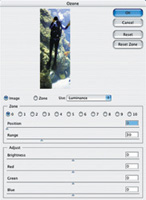
Ozone from Digital Film Tools
(www.digitalfilmtools.com)
takes the spectrum of image values and divides them into 11 discrete sections--let's
call them zones. Each zone is twice as bright as the previous one. Ozone
allows you to adjust the color and brightness of each zone independently
until you've created a new, dare we say it, "previsualized"
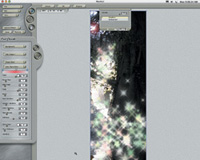
image. Light, also available from Digital Film Tools, lets you add natural
light as well as simulate camera filters such as Mist and Fog, and glow
effects. You can also add light patterns from virtual windows, doors,
leaves, and abstract patterns (can you spell kookoloris?) from a built-in
pattern library. It's worth the $75 it costs for that one feature.
LaserSoft Imaging (www.lasersoft.com)
now offers SilverFast DC 6 for medium format digital camera backs. The
software has been adapted for use by digital photographers and combines
a Virtual Light Table with SilverFast Ai's image handling and JobManager's
functionality. The Virtual Light Table offers file browsing, directory
overview, EXIF info, organizing, searching, sorting, drag and drop into
work area, placing images into virtual directories, and saving into new
directories. But wait, as they say on TV, there's more. The software's
editing and processing capabilities include the ability to edit file names,
input comments, drag images into JobManager, transfer images into SilverFast
for processing as well as the ability to print contact sheets of the directory
or work area or images as well as single, high-resolution images. SilverFast
DC 6 includes special camera features such as Color Temperature, Exposure
Control, and Red-Eye-Tool. Other features of SilverFast DC 6 include Selective
Color Correction with Multi-Layers and Masking for handling complex images;
ACR (Adaptive Color Restoration), which brings back faded colors and normalizes
oversaturated colors; SC2G, a sophisticated function for converting color
images to gray scale; and GANE, a tool for eliminating grain and noise
while preserving image detail. SilverFast DC 6 supports RAW data formats
of Nikon D1; Canon; Kodak DCS, DCR, and ProBack; Fuji; Olympus; Minolta;
and Sigma. It will be available for Mac OS 9/OS X and Windows.
|
|
Software For Imagemakers
Roxio's (www.roxio.com)
Windows-only PhotoSuite 5 Platinum image enhancement software is designed
to make photo editing simple and fun with automated tasks, pro-level image-editing
tools, creative projects, and Easy CD Creator burning technology, all
integrated into one program. Step by step instructions allow you to immediately
begin transferring, organizing, archiving, editing, and sharing photos
with family and friends on CD or Video CD. The new Easy CD & DVD Creator
6 Platinum is the only Windows-based integrated software suite that lets
you capture, edit, manage, and burn photos, videos, music, and data to
CD or DVD.
MatchLight Software (www.matchlightinc.com)
is a product that Managing Editor Bonnie Paulk had seen and passed on
to me. The real purpose of the program is to match the lighting in any
location scene with one shot in the studio so the images can be composited;
the program itself does not do the compositing, as a representative told
me, "then it's up to the designer." But what MatchLight
will do is let you shoot outdoors and by placing a target in the shot,
be able to exactly match that lighting in the studio. If you've
already shot a product and want to drop it in the scene, you can shoot
that target in your studio shot and the software will go on the web and
find a stock background that will perfectly match the lighting. Insanely
cool? Maybe not, but for the studio photographer who is a perfectionist
this is a must-have tool.
If you were wondering where all the software geniuses who created Kai's
Power Tools went, look no more. Lifescape Solutions' (www.lifescapeinc.com)
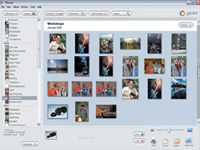
Picasa is the neatest bit of software I've seen in a long time.
After you install it, Picasa cruises your hard drive cataloging your images
and creating albums full of image files. These are displayed on the left-hand
side of the screen as an Album List. The right side is an album view,
the left is a thumbnail view, and you can drag and drop to rearrange them.
If you select an image, and click Edit Picture, you can crop, fix redeye,
and enhance the photograph. The Share function lets you print, e-mail,
build slide shows, or order prints online. This is the best program that
offers these functions that I have ever seen. Yes, Picasa is another Windows-only
program, but when I asked a representative if they were going to do a
Mac OS version he didn't look at me like Dracula being shown a crucifix
before dinner, like many other companies when I ask the same question.
"We're working on it," he said, and I believe him. Apple's
free iPhoto has scared lots of developers away from this market segment--that's
why there is no Mac OS version of Adobe Album--but although I've
recently learned to stop worrying and love OS X I still don't like
iPhoto even half as much as Picasa.
Pop Quiz: Sony makes? You got it, TV sets. Minolta makes? I'm sorry
you're wrong. Minolta makes software, at least that's what
they were trying to convince me at PMA. Minolta's DiMAGE Messenger
(www.dimagemessenger.com)
is a kind of e-mail package that lets users connect text to specific portions
of digital images, share the combination with others via e-mail or printed
copy, and invite comments from the recipient in a few steps. I know Microsoft
Outlook does a lot of this stuff, but hey, give it a try.
Jasc Software (www.jasc.com),
one of the grand dames of Windows-based digital imaging, is offering a
public beta version of Paint Shop Pro 8 from their web site. If you have
not tried the awesome under $100 imaging program, download this beta version
and give it a try. Jasc has abandoned some of its previously quirky interface
elements to provide a more straightforward but still not Photoshop-like
enhancement experience. Nevertheless it is a wonderfully capable program
with legions of fans. For users who want something simple but still amazingly
flexible, Paint Shop Photo Album is one of the best--maybe the best
programs in its class. I was totally knocked out by its predecessor, After
Shot, and Album looks like it will be even better for users who want to
organize and share their images, including the creation of a CD that will
play on your home DVDplayer.
|
|
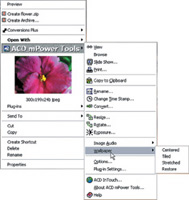
ACDSee's mPower Tools
(www.acdsystems.com)
makes Microsoft Windows more photo friendly by performing standard management
tasks on over 50 image file types without the need to open additional
applications. Key features of the product include a dockable media bar
that can be hidden and accessed via hot keys for fast searching by camera
metadata and other details, quick access to pictures, and the ability
to drag and drop files into programs such as Photoshop and Paint Shop
Pro. A right-click menu enables editing, printing, sharing, and managing
of photo and media files, including previewing images, video, and audio
files and performing batch functions such as re-size, rename, rotate,
convert, adjust exposure, change time stamp, and print. ACDSee's
mPower Tools allows fast viewing of thumbnails or full-size images in
Canon RAW, Adobe Photoshop, Kodak Photo CD, AVI, QuickTime, and many other
file formats from within Windows. I'll update you on this product
in a future Digital Innovations column.
PhoTags (www.photags.com)
lets you insert active captions and keywords into JPEG images without
altering the file format. This means you can add captions, borders, keywords,
or any graphic element to photographs and allows those elements to be
displayed to any recipient who can open a standard JPEG file. The user-friendly
software will let you create searchable catalogs without using complicated
publishing and database programs. PhoTags features search capabilities
from anywhere within Windows (yup, it's yet another Windows-only
product) with predefined and user-defined fields, and unlike many programs
provides the ability to retain original digital camera photo information
even after editing.
E-Book Systems' (www.ebooksys.com)
FlipAlbum is finally available for the Mac OS. The current Windows version
of FlipAlbum is 5.0, but the Mac OS version was launched at 3.0. At $39.95
it is one of the best ways to organize images but this version does not
support writing to CDs. Why not? For Windows users happily making CDs
with FlipAlbum 5.0 Professional, you'll be glad to know that E-Book
Systems is shipping a Shopping Cart plug-in that will let people order
various prints from your images directly from the CD to your studio via
e-mail. This looks like a wonderful way to help make wedding print and
album sales and is a $39.95 add-on.
Memory Cards
Remember Farace's Law #256: No matter how many memory cards you
own, you won't have enough to shoot the next insanely cool image
that's right in front of your camera. SmartDisk's FlashTrax
is a handheld portable device for offloading and storing digital images
and music, in case you care about MP3. It can store high
resolution images transferred from any flash memory card onto the built-in
30GB USB 2.0 hard drive and displays them on a 3.5" folding LCD
that outperforms tiny on-camera screens. You can change the image, zoom
in, zoom out, and scroll, or choose a slide show function, all without
a computer. The $499.99 FlashTrax includes a rechargeable lithium ion
battery and more than 7000 compressed audio files can be stored and played
back through the built-in speaker, headphones, or external speakers.
Speaking of memory cards, Lexar showed me prototypes of the 2GB and 4GB
CompactFlash cards that are speed rated at 32x, something they clearly
demonstrated to me and Editor George Schaub by capturing images with cameras
that can take advantage of these speeds, such as Kodak's DCS Pro
14n. The cards allow you to produce more "throughput"--as
the computer geeks call it--or more frames per second, as we shutterbugs
prefer. Not a memory card, but a cool storage device to keep in your pocket,
Lexar's new JumpDrive Secure is the kind of portable storage device
that Arnold Schwarzenegger would take into the field in his Hummer. Password
protected and covered partially in rubber armor, this rugged device will
be available for Mac OS and Windows users, with bundled security software,
in capacities of 64, 128, and the manly-man 256MB capacities.
What's the difference between a Memory Stick and a SD (SecureDigital)
or MMC (MultiMediaCard) card? The Memory Stick is a little longer. What's
the difference between a Memory Stick Duo and an SD? I don't know
but I'm sure a reader or somebody from Sony will explain it to me.
After muddying the Memory Stick waters (see Shutterbug, April, 2003) with
Duo, and the white MagicGate Memory Sticks for car audio and consumer
electronics that are not compatible with the purple Memory Sticks, Sony
unleashed Memory Stick Pro and they even got the nice people at Lexar
and SanDisk to buy into this madness. Memory Stick Pro borrows from MagicGate
technology and is "the evolution of ultra portable IC recording
for music and video applications."
And one last word about memory cards. In a previous issue, I speculated
that ultimately it would boil down to two kinds of cards, something really
tiny (and it looks like SecureDigital will be the winner based on what
I saw at PMA) and CompactFlash, which will remain the pro's choice.
SimpleTech (www.simpletech.com)
offers a fast ProX CompactFlash card capable of a write speed of 4MB/second
and for photographers who have cameras such as the Nikon D1X and Kodak
DCS Pro 14n that can take advantage of that speed, it's a wonderful
tool for the fast-moving pro. However, I get lots of e-mail from readers
asking what to do about all this. Here's what I tell them: If you
can afford it and your camera takes advantage of these fast cards go for
it, but if they don't, do as I do and buy the cheapest, biggest
cards you can find.
Manufacturers/Distributors'
|