Peter McDonough is concerned
with perception; not the physiological aspects of perception, but rather
how the eye sees and converts its image, what people see and what they
don't see of a given subject. Quoting the Italian psychiatrist,
Roberto Assagioli, McDonough says, "`Eyes we have but we
see not.' On this I have based my photography."
Since truth is often a relative term in photography today, McDonough
has challenged the boundaries of traditional photography. Using a process
he calls Tri-color, he has questioned not only the perceptual content
of his subject, but its reality. These are not cooked up images. They
are based on nature, on those things our eye does not see, and it is
McDonough's aim to make us aware and present them to us as art.
The result is a personal and somewhat disquieting mark. Midge Batelle,
director of the Driskel Gallery at the School House Center in Provincetown,
Massa-chusetts, where McDonough had a show last July, says, "McDonough
is a photographer's photographer and his sensibility is really
beautiful. He knows so much about the medium from the historical perspective
as well as the technical aspects and everything that goes into photography
in general, and his work is constantly evolving."
McDonough's story began in the 1960s while he was looking through
a Kodak publication and came upon something called a Harris Shutter
that could be made out of poster board. It was basically a primary red
filter, primary green filter, and a primary blue filter, arranged vertically
on a strip of cardboard with a holding piece that enabled it to fit
over the front of the lens. By putting the shutter on time and dropping
the filters down so there would be three separate exposures, anything
stationary would be rendered normally while any movement would be seen
in one or more of the three colors. "It stuck in my mind for years,"
McDonough recalls. "I had been taking the cliché shot forever--the
soft, velvety water running over the rocks. They were pretty pictures
but they didn't have any life. There was something I wasn't
seeing.
"I had gotten to know an area in Woodbridge, Connecticut, near
my home, where I had been panning for gold. (My $100 expenditure brought
me roughly 15 cents worth of gold.) It was a beautiful place with quartz
all along the banks and I found some areas where the water had eddied
after the spring rush. I liked the way the light played on the water
and began to photograph, using a Mamiya Super 23, which is a view camera
with a ground glass back. I could use 21/4x31/4 holders in it or put
on a film back that would take everything from 15/8x21/4 to 21/4x31/4,
depending on the back I mounted. The camera is a designer's dream
and has a little bit of everything from a range finder on the top to
interchangeable lenses. Above all, it is still portable. I had bought
it used in the early '90s and it has become my toy. Once I found
it, I simply took it to my playground."
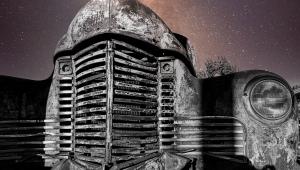
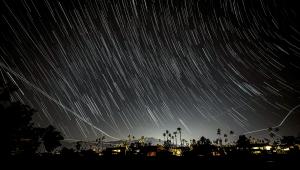
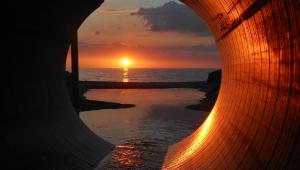
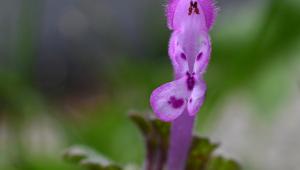
The Tri-color has brought a surreal look to McDonough's photographs.
Since the images are based on a kind of scientific reality they provide
us with a new awareness of how color in a moving area such as water
or a passing cloud may change. Using Fuji Velvia film because of its
saturation and the beauty of its neutral grays, McDonough begins photographing
by taking a meter reading of a site and setting his aperture and shutter.
He then puts on a 25 red filter, snaps the shot, takes it off, and follows
the same procedure with a 58 green and a 47 blue filter. On the tripod
everything is stationary so the elements of the shot remain constant
and in registration throughout the three exposures. Using the 6x7 back
on his camera, he brackets, seeing what works best, and says that he
has found that the best saturation and representation is usually about
a quarter of a stop more than the meter reads. If it is a 250th at f/11,
he sets it between 9.5 and 11 for all three colors.
"Often the actual scene I saw before me, while pretty, was not
exciting," McDonough says. "But when I got it back it was
an explosion of color. For example, in one photograph the stationary
rocks and the ice were rendered normally, while the fast moving stream
eddying around the rocks and the sun filtering through the hemlocks
and creating a dappled light on the water, rendered each exposure differently
on the film. What determined the color was the constantly changing shape
of the water moving under the red expo-sure, then gathering speed and
density as it moved over the rocks during the green and blue exposures.
Where they were similar, the colors blended."
With most 35mm cameras the shutter is not engaged until the film is
advanced and you can take just one exposure, but with the Mamiya, McDonough
can manually cock the shutter to advance the film, making a series of
exposures. "By using the Tri-color exposures I am able to see
the potential of a scene and where I can expand my artistic expression,"
he says. "It has gotten me to wondering about what else I am not
seeing. Obviously, what we see with our eye is so fantastically different
from what we see with our brain. That things are upside-down is obvious,
but things are also out of focus and edges aren't sharp. If I
used my eyeball as a lens and took a picture, I would have this round
image that is only sharp in the center and is reversed, a single element
lens. But my brain corrects it and sharpens it. Now what else does it
do? What else is missing? Maybe quite a bit.
"When I look at a great photograph and realize its simplicity
I wonder how to attain it. A lot of things can be distracting from a
photograph and I did not see that when I first started out. After photographing
for five years I saw that a, b, and c did not belong in the picture.
Ten years later I could see that a, b, c, d, and e did not belong. I
can now approach a scene and know what is intrinsic, what transcends
the common and simple subject, takes it out of context, and makes it
into something totally different. Though the subject remains the same,
what I am perceiving changes--the changes are within me. What this perception
tells us is what belongs in an image--it is basically a feeling that
a photographer has--it is the goddess that charms us. In this work I
am forcing these changes and coupling them with what I have learned
about making a good photograph. I am hoping it will not be like one
I have made before and perhaps it will even be more expressive."
The photographs introduce a new aspect of time for us, ceasing to be
just a 250th at f/11 and becoming rather a progression, a continuance
that expresses itself in the blending and addition of color and provides
movement to a two-dimensional, stationary photograph that would normally
appear static. McDonough controls the subtlety of the color and the
quality of light with the shutter. A low-light situation with a longer
shutter speed tends to blend the colors into pastel shades and will
be more muted than a short exposure taken at a 1/250 sec that offers
color in a snappier and sharper way with no blending.
"These decisions must be made in advance," McDonough says.
"Will I shoot in broad daylight with lots of sun for a dramatic
effect or do I want the more stationary rocks to appear surrounded by
soft, muted color, a velvet that subdues? Do I want the color to take
over the photograph with a spectral explosion? It's a kind of
photographic sleight of hand, though it differs from the false and often
garish hues that we see in some computer-generated images. It's
not a Star Wars thing, though it can be overkill if not done carefully.
Nature here is the focus, the camera documenting what our eye may not
see but that really does exist. The added dimension can sometimes be
a total bust and other times there is a view I never imagined. It adds
just enough mystery to presume there is something else going on. The
wind and turbulence becomes visible and enchants our senses.
"Remember what Bob Dylan sang about," McDonough quips--"`those
not busy being born are busy dying.' So I keep exploring new possibilities,
enhancing what I already know and moving forth. And like a rock in a
pond--you start somewhere and go on from there--it's a series
of ripples."