| |
The
sun is behind this single tree in an open field during
early summer, which is nice because there are still
warm days and cool nights, creating the crisp, colorful
mist. After a year of visiting Worthington Valley, I
discovered that the best times for this type of situation
was early spring into early summer and early to mid
September. This is the first subject I photographed
with my Hasselblad XPan several months earlier. In this
scene, the single tree, the openness, mist, supporting
hill line, and exploding sun behind the tree all came
together. This is a frequently visited photo venue for
me. This is only one of many excellent photo opportunities
within a very short distance from each other. But, one
only learns that from visiting a location many times
during all four seasons!
|
|
Early on in my career, as
an instructor with The Great American Photography Weekend workshop company,
I had the privilege of teaching with some of the greatest nature photographers
in the world. One of the first things that I learned was from Pat O'Hara
who made it a point to revisit the same location many times. I didn't
fully understand why until I started photographing frequently in a local
area known as Loch Raven near where I live. John Shaw says, "The
first time I visit a location I take pictures, the next time I make
photographs." The point being that it takes at least a visit or
two to get past the visual excitement of a new location and to calm
down and look objectively at more of the material provided at a location.
The first time at a venue, I tend to look for scenics, large views of
an area. Subsequent times I begin to "look smaller," in
other words start looking down at flowers, leaves in the water, reflections,
small abstract patterns, and the way light affects smaller scenes.
|
| |
|
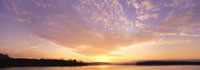
If you live close to a reservoir, marsh, or any open water
area, start scouting it out. Anytime you have open water
and open sky, very cool things can happen at sunrise and
sunset. I have been to this location numerous times. When
the water level falls because of lack of rain, one can
walk out on the newly created (and temporary) shoreline
for great sunrises, but only in winter at Loch Raven (January,
February, and March). As spring approaches, the sun moves
farther north (to the left) and rises from behind the
opaque tree line. The scene loses its symmetry. This was
a perfect XPan shot because of the huge triangle formed
by the clouds. The 30mm lens brought it all in. |
|
Different Time & Light
As you revisit a location throughout the year you notice how light falls
at different times of year; you notice recurring climatic situations
and when they are likely to occur, like fog, cloud patterns, and "god"
rays through the trees. In other words, the more you visit a photo location,
the more your mind relaxes and your vision opens up. You stop thinking
about it as just a local fishing hole and begin to look at it as an
image rich photo location.
Although I travel from Nova Scotia to the Everglades annually, a great
many of my best images were made close to where I live, which is not
anywhere exotic. I live in Baltimore, Maryland. Ten miles north of Baltimore
is a local reservoir called Loch Raven and about 15 miles north of Baltimore
is an area called Worthington Valley. To quote Jay Maisel, "It's
not about going to new places, it's about seeing with new eyes."
That quote is on the tip of my thought process every time I return to
a place to photograph. The pictures are inside of you. How many times
have you seen someone's work from Utah or Hawaii that was pretty
average? I've seen work from students and other photographers
who manage to find the same bad light and weak compositions in far off
beautiful places that they find here at home!
|
| |
The
valley is horse country and is loaded with great fence
lines and horses. Early summer brings out the golden grasses
and small white and yellow flowers to add a graceful note
of color to the fence line perspective. This image was
made the same day as the tree image from about the same
camera location (across the street). When the sun got
a bit too hot for the tree and began to flare, I turned
around and noticed the tremendous golden color of the
fence and flowers. I've been here many times and
with the differing qualities of light that can occur in
a misty open field, but this is my favorite image from
here. The incredible depth of field is a function of the
Nikkor 85 tilt shift lens.
|
|
There are probably more good
local ponds, lakes, waterways, state parks, and nature centers in your
area than you're aware of. Just look on any city map and you'll
see green areas designating state, county, and municipal parks. Check
them out!
Remember: The location doesn't make the picture--you do!
All images shot on Fuji Velvia film and scanned for publication using
the Nikon Super Coolscan 4000.
Tony Sweet is a professional photographer, lecturer, workshop instructor,
and author living in Baltimore, Maryland. Visit his web site: http://tonysweetphotography.com. |