| |
For
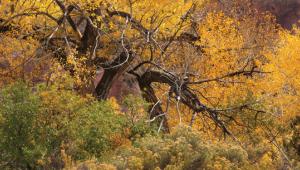
this shot of MIT, I brought the 4x5 view camera. With
a rain storm coming in fast, I instead grabbed the Mamiya
RZ67. By using slow Fuji Velvia rated at EI 40, a massive
Davis and Sanford tripod, and a cable release, I got a
shot that printed just as well as a 4x5 sheet of film.
Photos © 1999, JayAbend, All Rights Reserved.
|
|
One of the claims often heard
when talking about medium format cameras is, "With this camera
you can get practically 4x5 quality." How realistic is that claim
anyway? Let's face it, a 4x5 sheet of film has over three times
the total real estate of a 6x7cm frame. In addition, view cameras have
swings and tilts that can bring more of the image into focus than the
traditional, fixed plane, rollfilm camera. Medium format cameras, of
course, have tremendous operating advantages over view cameras, especially
portability, through lens viewing, vastly reduced film costs, and easy
focusing. The problem has always been the quality compromise.
Today we have the benefit of some tremendous film stocks, ultramodern
medium format cameras that handle like 35mm cameras, and ultrahigh resolution
drum scanners that can create huge files from a modest piece of roll
film. Can you really get 4x5 quality from medium format? The film advances
that have improved medium format quality have also improved large format
quality, but a well-done medium format shot done today can definitely
equal a large format shot done several decades ago.
While modern emulsion advances and computer designed lenses have done
a lot to increase the quality of medium format images, ultimate quality
is still down to the photographer. A casual approach to taking pictures
will still result in mediocre quality, while a really meticulous photographer
can produce stunning results.
Trying to be creative all the time can sometimes result in pushing the
technical considerations into the back seat. I have to constantly remind
myself what it takes to produce medium format shots that rival 4x5.
Here is my check list of things to worry about when it comes to creating
really knockout medium format results:
Top Notch Gear--It makes sense that to really produce sharp and well
saturated images you need a well designed lens, accurate focusing, and
a super flat film plane. There is no better bargain than a well used
Hasselblad 500CM, but I have to admit that my aging 'Blad gear
is nowhere near as sharp and accurate as a brand new 503 with new lenses.
Besides the contrast advantages that '90s multi-coating offers,
camera manufacturers have continued to advance viewfinder brightness,
film plane flatness, and lens flange to film plane accuracy.
|
| |
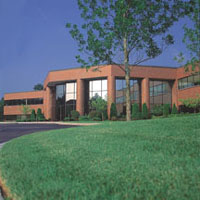
I
thought I would need large format swings and tilts for this
corporate exterior. By keeping the camera level, I was able
to avoid keystoning the building, and a short Gitzo tripod
made the image tack-sharp.
|
|
I first became aware of the
really important advances in camera manufacturing when I bought one of
those neat Fuji rangefinder cameras. My GSW-690 is a pretty fast handling
camera that I thought would come in handy for location grab shots. On
one particular assignment I shot Tom Hamilton, the bass player from the
rock group Aerosmith, on location. I fired off about seven or eight rolls
of Velvia in my battle-hardened Hasselblad with chrome 50mm lens. Just
for fun I shot one roll with the Fuji, really just to see what the film
would look like.
When I finally got the film back from the lab, I threw the chromes down
on the light table and started to look at the results. When I got to the
images taken with the Fuji I was stunned. Even to the naked eye it was
clear that the rangefinder camera produced a clearer, slightly more contrasty
image. Through the loupe my 6x6 film looked good, but the 6x9 film was
tremendous. Shadows had detail, highlights were crisp, and the entire
image was tack-sharp. The Hasselblad images were okay, but when compared
side by side there was just no comparison.
The next day I called my local pro camera house and told them of my results.
After he explained to me all of the advances that the various camera makers
had made in the past 20 years, he offered to loan me any brand new medium
format SLR of my choice to compare to my old gear. I picked up a new Hasselblad
503 body with a fresh 80mm lens. I set up a little still life in the studio
and shot one roll with each camera--the loaner and my own gear. When the
film came back from the lab the results were just as amazing. The new
camera and lens produced much greater sharpness, contrast, and saturation,
without sacrificing highlights or shadow detail. The lesson--good equipment
is crucial.
Super Critical Focus--Most of us take focusing for granted.
With autofocus SLRs and bright, contrasty screens in our cameras, we're
used to snapping the image into sharp focus and assuming that we're
in focus. A larger camera with a longer, slower lens makes focusing a
little harder. I like to remove the viewfinder from my Mamiya RZ67 and
focus directly on the screen with an 8x loupe. It takes a little longer,
but it assures me of sharp focus. When shooting people it can be a bit
tougher. I have found it very hard to rely on focusing aids like split
image rangefinders in medium format cameras. I tend to focus on the plain
area of the screen, especially in low-light.
Accurate Exposure--One of the really great advantages
medium format has over 4x5 is film cost. You can bang off a roll of 10
or 12 shots for about the price of four sheets of 4x5 film. Since the
per-image price is about 1/3, it pays to dial in the absolutely correct
exposure by bracketing like crazy. While some like to bracket 1/2 stop
in either direction, I like to bracket in 1/2 stop increments down one
full stop and 11/2 to 2 f/stops over. Since transparency film tends to
need a little bit of overexposure to add some detail in the shadows, I
cheat a little more on the overexposure side. If you're one of those
who has always heard that a little bit of underexposure creates a more
saturated slide, be aware that this advice pertains mainly to slide presentations
made with a projector and a screen. For making a print on paper, underexposure
is usually death. For four color reproduction it is even worse, which
is why most pros rate Fuji Velvia at EI 40, even though its ISO is 50.
I tend to rate ISO 100 Provia at 70 in daylight, 80 with studio flash,
and close to 50 in very flat light.
Perfect Processing--The most important thing any piece
of film needs, whether roll film or sheet film, is the perfect soup. I
still do all of my own black and white work, and can attest that if your
developer is even a few degrees out of whack you can ruin everything.
While you would think that E-6 processing is usually a pretty stable thing,
I have found that most labs have their machines setup to be extremely
consistent from batch to batch, yet different labs can be wildly different.
I still like to run a test roll through a new lab or process a "clip
test," a portion of a roll. Then I can decide how to process the
rest, whether to push or pull the exposure to make my work look its best.
Some labs have E-6 runs that look a little warm, others a little cool.
Color balance is hard to settle on without buying up a large batch of
one emulsion of film and using the same lab every time. Many photographers
FedEx their location film back to their home lab, just to utilize the
E-6 run that they are accustomed to.
When it comes to black and white work, I routinely use 21/4 film for large
black and white prints, where 10 years ago I would only use Kodak Pan-X
in a 4x5 view camera. Now I really like Ilford Delta 100 processed in
Ilford developer, but my favorite combination of all time has to be Ilford
Pan-F in Agfa Rodinal at 1:50 dilution. Done correctly this is nearly
seamless, and I can make very large prints that easily surpass the results
I used to get from 4x5.
Rock Solid Support--You would be amazed at how much image quality
is eroded by camera movement or subject movement. Even if things don't
look obviously blurry, through a good loupe you can see that the details
are not sharp. Like most pros I own a veritable forest of tripods, from
tiny Gitzos to massive Davis and Sanford studio jobs. While hand holding
a medium format camera is possible, I always try and lock it down where
possible. I travel with two or three portable Gitzo tripods with solid
ball heads. In the studio I use either the largest Bogen tripod I own
or my ancient D&S behemoth.
If I must hand hold the camera, especially if I am walking around, I'll
want to shoot with flash to freeze the action. Even the slowest flash
system is way faster than the fastest shutter speed on your camera, so
using flash will always freeze a moving subject. Of course, a little bit
of movement will still blur the edges of a subject slightly if there is
enough ambient light, so it's always possible to determine how much
ambient light will affect exposure.
The Bottom Line--My job is to consistently deliver great
looking images. When I first started out that meant 8x10 and 4x5 sheet
film. Anything less was a compromise, as far as I was concerned. Over
the past few years I have upgraded my medium format gear, my lighting
gear, my choice of film stock, and my approach to creating images. Now
I shoot mostly medium format film, even for jobs that will run very large.
If you're trying to squeeze the most performance out of a rollfilm
image, you can forget about bargain cameras, film, or tripods. Dedicating
yourself to improving the quality of your pictures means acquiring the
right gear and film stock, learning how to use it correctly, and methodically
checking and rechecking your setup every time. Superduper quality from
a medium format camera is possible if you take all of these factors into
consideration and work at it on every shoot.
I have met too many really good amateur photographers who invested in
a ton of medium format gear and been less than thrilled with the results.
I have tried to explain to them the amount of effort that must go into
getting predictably excellent results. In photography as everything else,
there is no free lunch. Expending just a bit more energy and using the
right tools can produce some super looking medium format pictures. |