


- REVIEWS
Camera Reviews 
More Reviews Mobile Reviews Photography Reviews - GALLERIES
- VIDEOS
- BUYER'S GUIDES

PMA 08; Hot New Digicams Page 2
Other High-Tech Functions
Features such as face detection and image-enhancing options in Playback mode have been common lately. Thanks to additional R&D, today's technology is more sophisticated and adds some entirely new benefits. Fujifilm's new Face Detection 3.0 function in the (12MP) FinePix F100fd boasts a "360° detection range" that's effective even if a person is looking up or down or is in full profile. Other useful Face Detect options include automatic redeye reduction and Portrait Enhancer that minimizes fine lines and blemishes for smooth skin tones. This family-oriented camera ($379 MSRP) with a stabilized 28-140mm zoom, 2.7" LCD, and 1/1.6" Super CCD HR also offers a Wide Dynamic Range option and ISO levels to 12,800 in 3MP resolution (to 3200 at 12MP).
 |
|
|
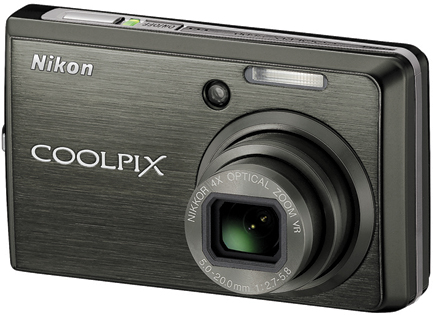
Nikon's (8MP) Coolpix P60 ($229 MSRP) with a stabilized 36-180mm zoom is equipped with an electronic viewfinder for great framing accuracy; this is a first in a digicam without a 12x or longer lens. Nikon also included automatic Face Priority, Red-Eye Fix, and D-Lighting to improve contrast and highlight/shadow balance. Their (10MP) Coolpix S600 ($299 MSRP) has an Active Child AF mode that can identify and then track a moving youngster, while the (10MP) Coolpix S550 ($229 MSRP) provides Blink Detection (a warning for images including a person who blinked) and Smile Detection (the camera takes a photo only when a person smiles). You can even preset the extent of the smile you want from level 1 (subtle) to 5 (a large grin) before the camera will automatically snap a picture. (These digicams employ a 1/2.33" CCD.)
 |
|
|
 |
|
|
 |
|
|
All of the new Canon Digital ELPH models--including the (8MP) PowerShot SD1100 IS ($249 MSRP) with stabilized 38-114mm zoom--are equipped with a new Motion Detection feature. When the camera determines that a subject is moving, it calculates the lowest ISO level that will provide an adequately fast shutter speed for a sharp photo and makes that setting automatically. This helps to maximize the odds of getting blur-free photos without excessive digital noise. Canon's 4th generation Face Detect mode instantly finds a face and optimizes focus, exposure, flash, and white balance; the camera then magnifies the face on the 2.5" LCD, allowing for a quick visual confirmation. Auto redeye fix can also be set in Capture mode; only red eyes--not other small red areas--will be modified.
 |
|
|
Canon also provided a sneak preview of three additional 10MP Digital ELPH models, with an optical viewfinder, PureColor II LCD, ultrahigh refractive index/aspherical lens, an enhanced stabilizer plus the technology discussed earlier. The SD790 IS ($349 MSRP) with a 3" LCD and the slimmer (0.8" thick) SD770 IS ($299 MSRP) with a more typical 2.5" LCD include 19 Shooting modes and a 35-105mm zoom. My own favorite was the SD890 IS model ($399 MSRP) with 2.5" LCD and 18 Shooting modes. While it's only 1.08" thick when turned off, this camera boasts a 37-185mm zoom, the longest in the Digital ELPH series, with super macro capability for great versatility.
Sony's (10MP) Cyber-shot DSC-W170 with a 1/2.3" CCD, stabilized Carl Zeiss 28-140mm zoom, and 2.7" LCD takes face detection another step forward. This slim (0.9"), family-oriented camera ($299 MSRP) features a Smile mode but also adds Adult and Child Face Detect options. It will find the right type of subject in order to optimize focus, exposure, white balance, and flash. The DSC-W170 also includes a Dynamic Range Optimizer for better highlight/shadow detail and Intelligent Scene Recognition that sets just the right Program mode. If you decide to make your own settings instead, the camera will take the photo that you want. But when using the Advanced iSCN mode, it will also snap a second image, using its own preferred settings; later, simply select the one that you prefer.
 |
|
|
| |||||||||
|

| ||||||||
- Log in or register to post comments



























 FEATURED VIDEO



Get the Latest Photo Tips, News & Reviews from Shutterbug!






| Camera Reviews Other Reviews | |
Mobile Reviews Photography Reviews Columns | |
News | |
Features | |
How-To | |
Resources |
 © 2024 Shutterbug
AVTech Media Americas Inc., USA
All rights reserved