


- REVIEWS
Camera Reviews 
More Reviews Mobile Reviews Photography Reviews - GALLERIES
- VIDEOS
- BUYER'S GUIDES

photokina Special Coverage; Digital SLR Cameras
 The digital SLR category continues to grow. Several manufacturers introduced new models during the photokina show; Canon, Panasonic, and Sony had unveiled their new entries sometime before the European trade show, so they are not included in this report. In any event, it's clear that the 10-megapixel or higher resolution category is becoming the norm in all types of D-SLRs, although the Sigma and Fuji cameras--employing unconventional sensor types--have created heated debates as to their actual resolution. That's not surprising of course, because the resolution provided by the previous models were hot topics as well. We'll be testing the new cameras when production samples become available and will then provide some evaluation about their capabilities.
With specifications that boast the highest resolution of any recently announced D-SLR, the Sigma SD14 employs a new Foveon X3 sensor with 14 million photodiodes stacked in three layers. Although there are only 4.69 million pixel locations, the X3 sensor incorporates three huge photo receptors at each of those sites. (In principle, oversized photo receptors are capable of superior light sensitivity for wider dynamic range and lower levels of digital noise.) According to the company, that translates to an effective resolution of 2652x1768x3 pixels or 14.1 megapixels. While the native output size is approximately 2652x1768 pixels, the Super High quality capture mode can generate an image file with 4608x3072 pixels.
 |
|
|
Aside from the higher resolution, this is a more desirable camera than the earlier Sigma SD10, for several reasons. These include a larger 2.5" LCD screen; JPEG recording options (in addition to raw capture); a larger, brighter viewfinder; a more durable shutter mechanism; a lithium ion battery; improved AF sensor with five detection points (including a cross-type point); faster continuous shooting ability (3 fps for six full resolution JPEGs) plus a built-in flash. The sensor in the SD14 body is equipped with a dust protector screen; if dust adheres to that component, it should not be visible in the images because the protector is far enough from the sensor that the dust specks should be totally out of focus. In terms of features, this is a very well equipped camera with all of the modes and overrides expected by even the serious photographer. (List price: $1999.)
Fujifilm's new FinePix S5 Pro is also a high-resolution model with an unusual sensor, the Super CCD SR Pro, an improved version of the sensor used in the S3 Pro. It employs the same double pixel technology with 6.17 million S (normal) pixels plus 6.17 million R (highlight detail) pixels. The specs indicate 12.34-megapixel resolution, although there are only 6.17 million pixel locations. Many published test reports of the S3 Pro indicated "better resolution than typical for a 6-megapixel D-SLR," roughly equivalent to the resolution expected from an 8+ megapixel camera. Nonetheless, the S3 Pro produced excellent image quality and the S5 Pro should be even better with its upgraded CCD and improved low-pass filter to minimize moiré and digital noise while providing more shadow detail. The new Real Photo Processor Pro engine should also provide benefits, including wider dynamic range and more sophisticated noise reduction processing.
 |
|
|
Other benefits over the S3 Pro include an entirely new body (based on the Nikon D200) with faster autofocus; i-TTL flash; improved metering; raw+JPEG recording; ISO levels to 3200; a larger buffer; lithium ion battery; and compatibility with LAN/WiFi accessories. Because the FinePix Pro cameras are preferred by many wedding and portrait photographers, the S5 Pro offers extra dynamic range presets and Film Simulation Modes for improved skin tone reproduction. Note, too, that Live Preview (for up to 30 seconds) is now available in color as well as monochrome and that Face Detection Technology has been added. The latter is useful after taking a shot, allowing the photographer to zoom in and check facial details such as closed eyes, focus, and exposure on the 2.5" LCD monitor. (Price not yet set; should be available by March 2007.)
The second Fujifilm model demonstrated at photokina was a more specialized camera. Designed strictly for infrared photography, the FinePix S3 Pro UVIR targets the law enforcement, science, and medical professions but is also highly suitable for fine art applications. This is essentially an S3 Pro, with the Super CCD SR II sensor, but omits the IR/UV cutoff filter; that allows the camera to record light beyond the visible spectrum. Mount a special opaque filter on the lens and visible light is blocked while IR and UV wavelengths can still reach the sensor. Live Preview, in monochrome, for up to 30 seconds, remains available. My colleague Joe Farace will provide a review of this unique new D-SLR in a future issue of Shutterbug with a discussion as to its suitability for fine art applications. (List price: $1799.)
 |
|
|
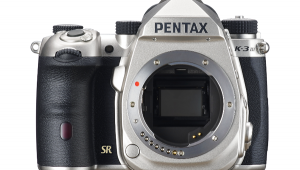
A 10-megapixel camera using a conventional CCD sensor (with a new anti-dust coating), the Pentax K10D boasts impressive features for a D-SLR with a minimum advertised price of $900. These include a well sealed, weather-resistant body, in camera Shake Reduction system that works even with manual focus lenses plus a Dust Removal system. (The latter, a first for Pentax, is not ultrasonic; it shakes dust off the sensor using the movements of the CCD-shift Image Stabilizer.) The K10D should provide excellent image quality with its new Real Image Engine processor that employs fast DDR2 memory. Note, too, that the K10D is the first Pentax model that will be compatible with the new DA* lenses, with ultrasonic focus motors, to be available in March 2007.
 |
|
|
| |||||||||
|

| ||||||||
- Log in or register to post comments


































 FEATURED VIDEO



Get the Latest Photo Tips, News & Reviews from Shutterbug!






| Camera Reviews Other Reviews | |
Mobile Reviews Photography Reviews Columns | |
News | |
Features | |
How-To | |
Resources |
 © 2024 Shutterbug
AVTech Media Americas Inc., USA
All rights reserved