| |
Black and white adds
to the surreal look of the Eiffel Tower seen twice,
once in reality and once in reflection. (Nikon F4, 20mm
Nikkor.)
Photos © 2002, Jack Hollingsworth, All Rights Reserved
|
|
Black and white travel photography?
As a category, I don't think it exists. My clients aren't
calling for it; my stock agency isn't asking me to supply it.
But it represents about 10 percent of the shooting that I do, and I
do it because I enjoy it. And sometimes I can sell it.
I might set out on a "black and white day" at the end of
a trip or an assignment--a day devoted to black and white simply
because I want to see how creative I can be in black and white; or maybe
I'm just feeling particularly artistic that day. So I'll
leave the color film behind and go black and white. More often I'll
be carrying an extra camera body just for black and white, and when
that's not possible--when I have to lighten the travel load--I'll
have black and white film in my bag.
My clients end up seeing the results because I include black and white

photos--as prints, slides, or contact sheets--in the work
I hand over to them. "That's really nice," is often
their response to the fine-art look of the images, and they often end
up using the photos--in their annual reports, employee publications,
or on their web sites. In fact, I'd say that almost every commercial
job I've shot in the past two years has included black and white
photographs in the delivery.
|
| |
|
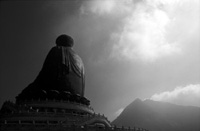
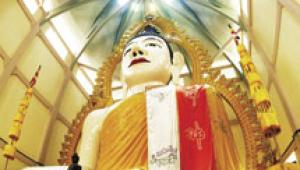
An off-center, contrasty scene that includes the statue
of Buddha on Lantau Island, Hong Kong. (Nikon F4, 28mm Nikkor.)
|
|
Photoshop It?
I've found, though, that if I ask clients ahead of time if they
want black and white images included in the job, they'll say,
"Oh, if we decide we want any black and white we'll just
take the color slides into Photoshop and strip out the color."
That's the response of someone who's naive about black and
white photography. Taking the color out is nothing like shooting a black
and white photograph and making a print. You don't get the tonal
range, the subtleties, all the things we love about black and white
photography. So I don't ask, I just shoot (and for black and white
I shoot either T-Max 400 or Ilford HP5).
|
| |
|
I had color film in the camera when I first saw this Buckingham
Palace guard, but I realized it was a composition made
for black and white. (Nikon F4, 300mm Nikkor with a 2x
tele-converter.) |
|
Chances are your travel photography
is going to be vacation-related rather than for a commercial assignment.
And I've got a feeling that in most cases, trying to suggest that
you shoot some black and white is going to be a tough sell. You want
to bring back those bright, colorful images, and rightly so. But don't
assume that just because color film is in the camera, it's the
right film for every picture. Some subjects, scenes, and even cities
are made for black and white.
And sometimes the weather is made for it, too. A rainy, foggy, or overcast
day is perfect for black and white. Think of Paris or London on a rainy
day. If you've got black and white film with you, you couldn't
ask for anything more.
In A Monochrome Mood
When I'm traveling and I'm in a black and white mood, I
look for subjects with a lot of dark or shadowy areas; or ones with
a lot of white, bright areas. But it's more likely that I won't
be looking for a black and white subject; rather, it finds me, like
the photograph of the Buckingham Palace guard, where half the frame
is his black hat. I was shooting color that day, and took that picture
in color and then thought, wait a minute, that's a black and white
photograph! Sometimes, then, color reveals black and white. All you
have to do is think about the mood you can capture and the impact of
the photograph if you make it in black and white.
|
| |
|
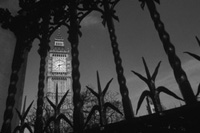
Everyone who comes to London photographs Big Ben, but
I've found that familiar landmarks take on unique
looks when pictured in black and white. (Nikon F4, 28-70mm
Zoom-Nikkor.) |
|
When I started to plan this
column, I thought about where my affinity for black and white comes
from; what the source might be of my "black and white" sensibility.
I'm not sure this is the total answer, but those of us of a certain
age grew up watching black and white television shows and movies. One
of my favorite films is Casablanca. I thought of all those espionage
films I've seen and how black and white perfectly expressed the
mood of the story. And, of course, I started out in photography when
a darkroom was truly a dark room and not a computer monitor and the
latest version of Photoshop. I think also of how some of the great photographers
used black and white--like the atmospheric views of Paris by Brassai,
the photojournalism of Eugene Smith, and the great slices of American
life from the cameras of Walker Evans and Paul Strand.
All the photos you see here were taken with my 35mm camera, but no matter
what equipment I'm using--from the Nikon F4 to my Hasselblad
XPan, Linhof 612 and 4x5 or my Mamiya RZ67, there's black and
white film always nearby. So, black and white travel photography? Well,
I think of it this way: travel photography is my business, and isn't
it nice that it gets me to places where I can shoot black and white
photographs.
|