| |
Most
people know about photographing children from their level,
but Harris took this photo of the granddaughter of a former
teacher from an even lower angle. "I didn't
want to take just a baby picture." (Minolta X-700,
28mm lens, Tri-X 400.)
Photos © 1999, Judah S. Harris, All Rights Reserved
|
|
Judah S. Harris tells this
story about one of his photos: "I had just bought a new Bogen
tripod, and I went out in the Olympic National Forest area in Washington
to photograph with it. I left my rented car down on the road. I wanted
to photograph nature, and I certainly didn't want the car in the
picture. But as I was heading away from the car, I turned around."
What he saw was a picture waiting only for the taking, and the resulting
dramatic black and white photograph was not only an artistic success
but also a commercial one. It's been used as a book cover (with
a little manipulation, Harris' rented car became a trooper's
cruiser) and in a gatefold magazine advertisement (where, with the application
of a bit of digital magic, the rental's place was taken by a BMW).
"It's something I always do, turn around while I'm
walking," Harris says. "I think it's a good idea for
all photographers--don't just explore different angles, but turn
completely around."
And when he turns around, it's likely he'll find something
of interest to photograph. In fact, it's the range of his subject
matter that's often the first thing a viewer notices about Harris'
work. Where most photographers tend to choose an interest--landscapes,
interiors, children, architecture, or even the broader range of, say,
nature or travel photography--Harris' photographs are, literally
and figuratively, all over the place. "I photograph things that
appeal to me and that interest me," he says. As an example of
just how wide-ranging his interests are, there's this from our
conversation: "Arizona tea makes these wonderful bottles, and
I peel off the wrapper and cleanup the adhesive and suddenly I've
got something I can work with and interpret in my own way."
|
| |
Taken
in Harris' room at an old New Jersey hotel. "I
woke up and saw it--the sun coming across the pillows just
that way. I wanted something that seemed simple but with
a story to it: who sleeps here?" Later it became the
cover of the Random House book, "Falling," John
Taylor's memoir of his marriage and divorce. (Minolta
X-700, 70-210mm zoom, Panatomic-X ISO 32 film--"discontinued,
but I had some in the freezer.")
|
|
"In my own way"
is the key. If scope of subject matter isn't the first thing you
notice about Harris' photos, then vision is. As a photojournalist,
fine art and commercial photographer, Harris' curiosity and creativity
combine with opportunity to produce images that are perhaps as much about
him as they are about the subjects he chooses to photograph.
"I photograph life," Harris says. "Now, I realize that's
a pretty general statement, but I'm very much fascinated by people,
by places, by the drama of life. My work is about realism."
An observer might not entirely agree with that. Certainly what he photographs
exists in life--the car and the woods were there, just so--but his compositional
choices, arrangements, angles, and use of light and shadow put a creator's
stamp on everything. Harris' photographs are far from record shots;
it might be said that the reality in his photographs is his reality.
And, in fact, Harris believes that one of the reasons people find both
commercial and artistic interest in his photographs is their reaction
to the personal perspective portrayed in the work.
"I believe I have a heightened sensitivity to people and my surroundings,"
he says, "which I'm sure I was born with and which also develops
over time. So when I'm walking around and exploring with the camera,
things start to happen or I facilitate them inside the frame. I would
have to credit serendipity for a lot of things, but someone who's
a good photographer increases the chances of accidents or serendipity
happening by being aware, being attuned to situations."
|
| |
Harris
had been photographing in an Istanbul street when he peeked
inside an old apartment building. "I saw the staircase
and went inside, then came back with my tripod. I went to
all the floors looking for interesting angles." (Minolta
X-700, 28mm lens, T-Max 100.)
|
|
Another reason a person might
question Harris' statement that his work is about reality is the
fact that for much of his work, he chooses black and white film. Artistic,
yes, but real? After all, we see the real world in color.
But Harris maintains that black and white is perfect for the reality of
what he chooses to photograph. "A lot of my work is about the human
drama, about people, about interactions between people, about the shapes
around us. It isn't about what color jacket someone is wearing or
whether the grass is really green. It's about gesture, expression;
about the shapes of things..."
He stops just short of saying that in most cases and for most subjects,
he simply finds black and white more dramatic. "I'm implying
that in terms of the human drama, if we see black and white, it stops
us for a moment. We look at it differently." In a sense, then, black
and white says, "Pay attention."
Harris has shot black and white in 35mm, medium format, and panorama.
He has also photographed with a Holga, which is essentially a souvenir
(if not a toy) camera. "It's a more modern-day Diana,"
Harris says, "with a plastic lens, two fixed f/stops--f/8 or f/11--and
a 1/100 sec shutter speed."
|
| |
"I
kept moving around to put the tree in just the right place,"
Harris says. "I didn't want it touching a building."
The photo was subsequently used to illustrate an article
on the Op-Ed page of "The New York Times." (Holga
camera, T-Max 100.)
|
|
Harris markets his photographs
for editorial illustrations, book covers, advertisements, and stock; he
also sells them as fine art. Commerce, however, was not the original intent.
"Initially photography was a hobby, an avocation," he says.
"Then, in 1990, I put together a portfolio and started knocking
on doors. There was no thought that I need a profession, so I'll
be a photographer. The goal was to be true to my photographic vision and
then see if I could find an audience receptive to it.
"I think it's good
to be attuned to what the commercial needs are. I keep in mind that this
or that might make a good photograph for the cover of a book, but what
I most want to do is to keep photographing things that are of interest
to me."
And what's of interest to him has done very well in the marketplace.
For a year and a half he's been aggressively marketing his work
for book covers. "I have 78 Art Directors at publishing houses on
a list, and a few times a year I sent them laser copies of my images to
remind them of me and my work. As they come up with titles and see what
they're about, they can look through my photos and see if anything
fits." Recently five of his images were used on a series of softcover
reprints of Elmore Leonard novels.
|
| |
"A
photographer has to put enough into a picture to engage
the viewer, so the longer the viewer looks, the more he
gets," Harris says. For this image, taken downtown
in New York City, Harris kept moving to center the lamppost
over the water tower; then he got a plane going by. (Holga
camera, T-Max 100.)
|
|
Harris' 35mm camera is
a Minolta X-700, which is likely to be fitted with his favorite lens--a
28mm--and loaded with either Tri-X 400 or T-Max 100. Computer manipulation
is not out of the question for the future. "I want to learn more
about Photoshop," he says. "As a realist I don't want
to go around changing a lot of things, but the other reality is that I
can take these tools and use them in my own philosophy. I can be a realist
and want to document real life and still go ahead and contrive something
with Photoshop that might still allow me to be true to my realism."
If there's one thing Judah S. Harris is not interested in, it's
putting any limits on himself or his work. "The tools don't
make people artists, but an artist can create with a number of tools."
|
| |
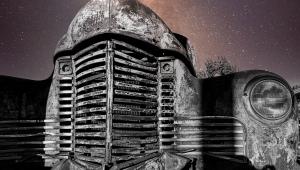
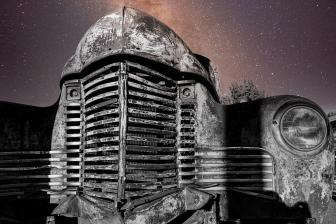
Harris
left his car down the road, wanting to photograph only
nature. Then he turned around. "Luckily, I'd
rented a white car." (Minolta X-700, 28mm lens,
T-Max 100.)
|
|
|
| |
Early
morning regulars at the Montross Pharmacy, Winterset, Iowa.
On assignment, Harris went to Madison County "in search
of the pictures that Robert Kincaid might have taken today...Although
"The Bridges of Madison County" is only a story,
the locale is real [and] I wanted to capture a sense of
the place and the people." (Minolta X-700, 28mm lens,
T-Max 3200.)
|
|
|