Cool new technology to make
photography easier for first-time digital camera users was evident at
this year's PMA. Three major players in the digital imaging field
made presentations worthy of owning their latest products.
Redeye Gone?
One of the biggest problems facing the beginner camera user is redeye
on pictures taken with flash. This doesn't only apply to digital,
though the solution we're going to describe does. With the manufacturers
making smaller and smaller cameras, the flash and lens are getting closer
together. Some cameras have a small pop-up flash to try and separate
it from the lens, but redeye is still there.
Nikon, in its latest release of NikonView 6, has incorporated an automatic

redeye reduction. In the demonstration we were given, the program was
able to detect the eyes of a boy wearing a bright red shirt, and automatically
eliminate the redeye, making the picture look extremely natural. The
approach Nikon is taking is, redeye--so what? Shoot all the flash
pictures you want and it'll fix itself afterward. The technology
is based on pattern recognition from Pixology. If the eyes aren't
detected automatically, switching over to manual mode lets you draw
a circle around the eye. Clicking within the circle eliminates the redeye.
|
|
Exposure Woes Gone?
Another major problem facing compact digital camera users is the tendency
for highlights to be overly light (digital photographers refer to it as
blown out) and not hold detail. Fuji, always on the cutting edge of digital,
has created a new "Super CCD SR" chip that is said to capture
both the highlight detail and shadow detail, expanding the dynamic range
of pictures taken with one of their new digital cameras. Formerly, photographers
who were used to shooting transparency film had less of a problem, as
they understood how to expose for a "highlight bias" and the
exposure they made in their digital camera would be the same as they had
previously used in their film cameras. But with this new technology, well-exposed
photographs are within the reach of any level of camera skill. It will
be interesting to see if Fuji is going to incorporate this new technology
into their professional line of camera bodies.
Organizer's Dream
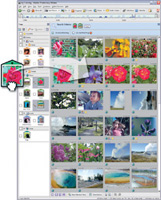
Adobe's Photoshop Album (Windows-users only) revolutionizes the
way people organize and sort their photos for sharing. This is the software
for people who are new to digital photography and don't understand
the inherent problems of image organization. After all, most people keep
their photos in a shoe box under the bed. Well, Adobe looked under many
beds and figured out a way to take those photographs out of the shoe boxes
and sort them in albums so they can easily be sorted and browsed.
Clearly, this program is for the average inexperienced user but has many
sophisticated features. After a 15-minute demonstration, we could easily
see how many digital camera users could benefit from its ease of sorting
photos from their hard drive on the fly. You can easily sort photos by
the date they were taken. Let's say, for example, you went to Paris
for two weeks last year and have all the photos, along with the photos
from the week you spent in London first. You can easily create a folder
for the specific range of time you spent in Paris and see all your Paris
photos as thumbnails at one time.
You can create folders for sorting and tags (keywords) within folders.
Photos can be assigned more than one tag by selecting them and dragging
the tag onto them. And, in searching, multiple tags can be specified so
that photos can be selected that fit more than one label simultaneously,
making it easy to narrow down the search until a particular photo, or
group of photos, is found. And, in keeping with Adobe's image-editing
excellence, you can select a thumbnail and have it open in your favorite
editing program.
It gets better. As soon as you select a photo for editing, a duplicate
is created and the original never gets touched. In the preferences, you
can specify standard smaller sizes as the default for e-mail and, for
selected images, duplicates are created and sized for e-mail and automatically
dropped into your default e-mail program as an attachment, ready to share.
We wonder when someone will make digital life as simple for working professionals.
Manufacturers/Distributors'
|