| |
1
Photos © 2002, Ingrid S. Krampe, All Rights Reserved
|
|
When Cassandra Hunter, an
aspiring model, came to me to commission a variety of location and studio
images for her portfolio, it seemed like a good opportunity to review
some basic lighting principles, as well as BKA's (Brandess-Kalt-Aetna)
LancerLight Series AC/DC Lights.
I shot the session digitally with the FinePix S1 Pro, Fuji's first
generation 3.4 million pixel sensor array Super CCD, which has a maximum
6.1 million pixel output, and variable ISO ratings from 320-1600.
On Location
For the location part of the session, I chose the front porch of the
Crawford W. Long Museum in downtown Jefferson, Georgia. The reasons
were simple: I needed something close to the studio in order to do all
of the work in a single session. I had recently completed some work
for the museum, so it would be easy to get permission from the board
to use the space. And most importantly, the front porch of the museum
faces south/southeast. At 4:30 in the afternoon (in February), the length
of the porch running east/southeast to west/northwest would (weather
permitting) be bathed in glorious warm directional light, which would
look awesome on Cassandra's light cocoa skin. Without any additional
effort, the porch also provided some interesting contrasts--a formal
looking black and white setting with a wonderfully rustic, chipped paint,
turquoise-blue bench.
|
|
Although the
weather held up fine, Cassandra (with makeup artist in tow) showed up
almost an hour late, significantly reducing our window of opportunity.
To maximize the location so late in the day, I positioned Cassandra along
the interior wall and worked fast, using the silver side of a 36"
Photoflex LiteDisc reflector to direct some of the dwindling light onto
her face as the sun began to slide down and toward the back of the building
(#1).
I saved the full-lengths for last, using the reflector to create drama
by emphasizing the face as the rest of the porch slid into shadow. Some
light burning was executed on the final prints to add to this effect (#2).
On location, all of the images were shot at a dismal maximum aperture
of f/5.6 with shutter speeds as slow as 1/30 sec. Although I only had
one rather slow Nikon Nikkor 35-80mm f/5.6 lens that worked with the Fuji
S1, the size of the Super CCD in relationship to the optics provided a
more appropriate 52-120mm range. I need to add here that I was grateful
that the optimum comparative ISO value of the Fuji S1 is 320.
|
|
The Lighting Setup
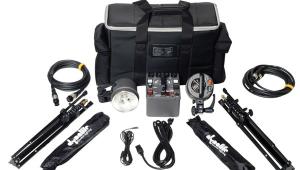
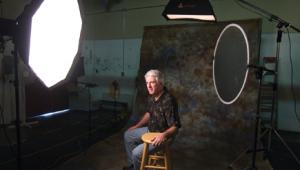
I based the studio session on a standard four-light setup, including a
main light, a fill light, a hair or accent light, and a background light.
For the main light, I used an Excalibur SPC1600 AC/DC light with a standard
reflector positioned at a 45Þ angle, camera left. I used the same
model for fill, positioned directly behind and above the camera, fitted
with a 37" Octagonal EZ-Softbox (SP-SP-SOFT370). Other than the
extremely easy setup of the SP-SOFT370 (it opens like an umbrella), this
softbox comes with two layers of touch fastener-attached baffles to adjust
light quality and intensity. The hairlight, a SPC920 AC/DC fitted with
a SPSnoot 920, was positioned behind the subject camera right to add accent
and dimensionality as needed. An SPC147 AC/DC with a SPBarn 100 functioned
as a background light, low to the ground and behind the subject. All of
the AC/DC series are monolights (do not require a heavy power pack) and
were easy to set up. Not all of them had modeling lights or adjustable
modeling lights. (For more information, go to the "Equipment List"
or go to www.bkaphoto.com.)
Although I did not use these lights on location, they are portable and
could have been used in any number of configurations on location with
either Quantum Turbo or Lumedyne High Voltage Cycler Battery Packs.
|
|
Short Lighting
Short lighting (narrow lighting) is often used to narrow a broad face.
In this scenario, the main light is placed on the side of the face that
is turned away from the camera. However, rather than positioning Cassandra
to face camera left and into the designated main light, I turned off the
main light and moved the fill 45Þ to the right.
By doing this, the SP-SOFT370 functioned as both the main light and the
fill, softening all of the shadow area on the front of her face, save
the soft loop shadow from Cassandra's nose. Its close proximity
to the subject provided texture for her hair without spilling onto the
far right side of her cheek, which remained in shadow. The catchlights
ended up just a bit more centered than I would have liked, but overall
it was a quick, easy solution to accentuate a beautiful oval face. If
her skin had been paler, I would have opted for more shadows and facial
modeling, but in this case I put a significant amount of emphasis on the
eyes and mouth (#3). In fact, throughout the session I found that in most
instances a close ratio between the main and fill light provided the most
flattering results.
All of the images in the studio were exposed between f/8 and f/11 with
the exception of the "Easy Set Lighting" shots, in which the
aperture was maxed-out at f/5.6 for some selective focus effects.
|
|
Sidelighting
While sidelighting is generally used to profile facial features, it tends
to be tough on skin because it accentuates all sorts of blemishes and
undesirables. In the old days it was also referred to as hatchet lighting,
because, if placed properly at the same height as the subject, it exposed
half of the face in complete darkness.
In the studio, I chose to modify the sidelighting--still using the
previously designated fill (SP-SOFT370) as the main light, positioned
high and to the right of the subject. I simply asked her to turn her body
toward the camera and lean forward. The high angle of the light was enough
to light both eyes and keep the left side of her face in shadow. I absolutely
loved the impact of Cassandra's eyes and mouth in this image, but
was at odds about the shadow it placed in her midsection (#4).
|
|
Hollywood (Butterfly) Lighting
I prefer Hollywood lighting for most glamour-style portraits, because
of the way it contours the center of the face and mouth. To do this, I
returned my fill light to its starting position and then turned the original
main light (with standard reflector) back on and placed it at a camera
angle directly in front of and slightly above the subject.
Notice how the light creates a small symmetrical shadow (butterfly) below
the nose and lip. The high position of the main light also put shadow
on her neck, minimizing some of the problems there, although I had to
be careful not to place the light so high that it would create undesirable
"bags" under her eyes. You'll notice that I turned the
accent light back on to add accent and depth to the image (#5).
|
|
Broad Lighting
Broad lighting is probably my second favorite lighting for model photography.
In this scenario, the main light is placed on the side of the face that
is facing the camera. I had to remove the background light for the full-length
portraits, but kept the accent light on, although I should have controlled
it a bit better to keep some of the spillage from her left shoulder. Without
the background light, I also had to contend with some shadow on the background
(#6).
In portraiture, the most important light in any setup is the main light,
because it is designed to imitate the sun. It should be the only light
to place shadows on the set. All other lights are designed to fill (soften)
shadows caused by the main light or to add accents. If I had a bigger
studio, I probably would have opted to move Cassandra forward away from
the background, but shooting her full-length in my space limited the choices.
As photographers, we learn to work with the limitations of equipment,
space, and subject matter and try to select the best solution in every
scenario. I did not want to shorten the lens to a less flattering position,
and looking at the final image, the soft shadow may just have added a
certain amount of dimensionality.
|
|
Easy Set Lighting
For the final leg of the session, I decided to have some fun with Cassandra
and allowed her to move about the set freely without the need to move
the lights. Especially with inexperienced models, it is amazing how much
more you can get out of a session if an uninterrupted spontaneous flow
can be achieved.
I used only the 37" Octagonal EZ-Softbox for this segment of the
session. By simply backing it up I provided even light distribution over
the entire set. Because the very soft diffused light was a little flat,
I removed the outside baffle to add a little punch to the images. The
results were a variety of pleasing "personality" portraits
(#7).
Note: The images in this article
were in varying degrees enhanced in Photoshop 6.0.
Equipment List
Camera: Fuji FinePix
S1 Pro
Lens: f/5.6 35-80mm Nikon Nikkor
Main Light: BKA LancerLight Excalibur SPC1600 AC/DC light with
a (SP-SP-SOFT370) 37" Octagonal EZ-Softbox
a. Adjustable (Full, 1/2, 1/4) flash and modeling
b. Guide Number 110 (ISO 100)
c. Flash output 160 ws
Fill Light: BKA LancerLight Excalibur SPC1600 AC/DC light with
a standard reflector
a. Adjustable (Full, 1/2, 1/4) flash and modeling
b. Guide Number 110 (ISO 100)
c. Flash output 160 ws
Hairlight: LancerLight SPC920 AC/DC with a snoot (SPSnoot 920)
a. Adjustable (Full, 1/2, 1/4) flash
b. Nonadjustable modeling lamp
c. Guide Number 92 (ISO 100)
d. Flash output 100 ws
Back Light: LancerLight SPC147 AC/DC with barn doors (SPBarn 100)
a. Adjustable (Full, 1/2, 1/4) flash
b. No modeling light
c. Guide Number 140 (ISO 100)
d. Flash output 100 ws
Reflector: 36" Photoflex LiteDisc
Background System: Bogen AutoPole
Computer: Apple G4 Titanium laptop, 500MHz
Portable Storage: IBM 1GB hard drive
|