It's something that
I would never have dreamed of...visiting Moscow and getting paid
to do it! But that's what happened. And I still feel as if I'm
living the dream. How did it all come about? Just by my deciding long
ago that "good enough" wasn't! I went about my career
always trying to be the very best that I could be. No matter what the
cost, I would never settle for less. Then, one day I found that by always
seeking the best I had become a teacher in the industry, one who used
the latest technology.
For a guy who was once dubious about getting involved with computers,
I think that I'm pretty good now, working with three computers
at my desk (when I'm lucky enough to spend a few days at home)
and being totally involved with the digital revolution. Why not? It's
through my love for photography and in particular my explorations into
digital imaging that I'm being invited around the world to share
my excitement with others. Such was the case when I recently went to
Russia to be a part of Moscow's PhotoForum 2003.
It was mid-April when I went to Moscow. It rained and snowed just about
the entire time I was there. Yet, there was always an exciting warmth
in the air that made this a trip of a lifetime. Everyone expected me
to spend two days lecturing to 100 or more photographers who were thinking
about entering the field of digital portraiture. Instead, I found myself
teaching more like 250-300 photographers each day--photographers
who were no longer "thinking" about it, but who were beginning
to realize that this was their future. They filled the seats and aisles
and were seated everywhere else, including on the stage where I was
demonstrating.
When they walked into the meeting room they were greeted by the sound
of some upbeat American music that I had prepared as a means of warming
them up. That was quite a surprise to them, but not as much of a surprise
as my display of 16x20 prints that I had recently prepared for WPPI
competition. Around the room I had displayed digital photographs that
were all created within the past year. They had never seen a collection
of portraits with such variety and emotional appeal. Although they didn't
say much, I could tell from their reaction that they were in a state
of shock.
I didn't know what to expect from the photographers in Moscow.
I certainly didn't expect the warmth, excitement, and love that
I received from just about everyone with whom I came into contact. Even
though my heritage was originally Russian, I had never learned the language.
Through photography (and the assistance of Nadir Chanyshev, an accomplished
commercial photographer and a great American/Russian translator) I was
able to make myself clearly understood and my feelings felt by my entire
audience.
I had models who were exceptionally beautiful. I found their makeup,
hair, and wedding gowns to be exceptionally gorgeous. What a pleasure
it was to see wedding gowns that were unique and not strapless. For
my first program I was given two lights to use. No problem. A main and
a fill would work for me. I brought my own backgrounds and posing stools,
however, because I was afraid that I might not be able to find them
in Russia.
The resulting photographs, projected on the screen as I was creating
them with my new Canon EOS 10D, amazed everyone. By exposing for my
main light and keeping my fill light two f/stops less I was able to
consistently demonstrate how technical proficiency can come through
every time. I stuck to the basics--one lighting pattern, two poses
(Basic and Feminine), and three camera positions (Full Face, Two-Thirds,
and Profile)--and I nailed it every time.
My lens of choice for the portraits was Canon's 28-135mm Image-Stabilized
lens.
|
| |
Photos
© 2003, Monte Zucker, All Rights Reserved
|
|
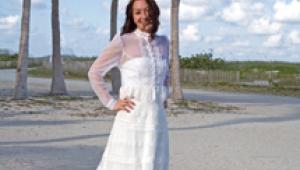
My first bride was sensationally
gorgeous. Her gown was incredible. Her "look" was breathtaking!
I photographed her alone and with a male model in poses that were not unique
to me, but mindblowing to the Russians.
As I always do, I began with the finished portrait in mind, so all I had
to do was to mold my subjects into what I wanted. It's a technique
that I developed and refined by studying for over 10 years with my mentor,
Joe Zeltsman. I have practiced those techniques relentlessly for the past
three decades. I first determine the facial angle and pose that I want to
record of my subject. Then, I place my main light approximately where it
would have to be for that facial angle. Next, I determine the shoulder position
necessary to support that angle of the face...and the rest just falls
into place. The audience was amazed at how easily it was all accomplished.
Of course, I had had years of practicing this technique. There was no guesswork
involved.
For this first picture I placed the main light at a 135Þ angle to
the camera, knowing that I was going to light his profile and split-light
her face. Then I positioned my reflector on the same side, so that it would
both reflect light onto the shadowed side of her face, while at the same
time block the main light from flaring into my lens. When I began working
with my models I seated her with her shoulders facing directly into the
camera. I leaned her forward toward the lens and slightly to her left. (In
the Feminine Pose, when the face turns to one side, the body leans to the
other.) I then seated the groom so that his face would be slightly higher
than hers.
I turned her face so that I would see the Two-Thirds view of her face through
my lens, placed his profile over her face and it was there! The background
is Zuga Green, created by Denny's Backgrounds. My primary background
is green because it compliments everyone's skin tones and recedes
in photographs, making it secondary to my subjects.
|
|
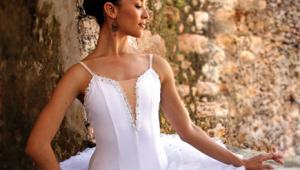
My second model that day had
such a unique look about her, I felt as if I were in the company of a
princess. She was breathtakingly gorgeous in her gown of pink and white.
I photographed a whole series of portraits of her, beginning with my favorite
3/4 length seated bride.
With both of my hands I carefully took hold of her head, lifted her to
her fullest height and leaned her forward toward her knees until she must
have felt as if she were falling over. The portrait that appeared on the
screen, however, looked simple, elegant, and very pleasant. The audience
spontaneously broke into applause.
|
|
On the second day of my classes
I photographed my third model. By this time I had acquired a third light
that I used to glaze over the edge of her right cheek and to light the
background for better separation than I was able to achieve the first
day. My "gold leaf" background was something that I had retained
from my studio days in Maryland. It was painted for me by The Backgrounders.
She was so refreshing, I felt as if she had just stepped out of the shower
and come to me radiant with the warmth of the sun that was missing outdoors.
I demonstrated the three camera positions of a subject--Full Face,
Two-Thirds, and Profile. She was breathtaking in all three.
|
|
My two-day program went especially
well. I could tell that everyone was pleased by their reactions throughout
both of my presentations and by the fact that afterward they all wanted
my autograph and to be photographed together with me. It was my pleasure.
I had to literally be pulled from the room, so that the room could be
prepared for the next speaker.
On the way back to my hotel, the Katerina, it dawned on me that I had
not made a single photograph outside of the classroom. I would have nothing
to show where I had been or what I had seen. The main reason I hadn't
taken any touristy pictures was that the weather had been so bad. Even
though it was still raining that night I asked my driver to stop a few
times when we passed some of the lit-up landmarks.
With the ISO of my camera set to 1600 it was possible to hand hold my
camera and create several really neat photographs. I opened my lens all
the way, used Aperture Priority and saw that I was shooting at 1/60 sec.
I could handle that just wonderfully.
I selected this camera position both to get the composition of the towers
and to eliminate the nighttime lights that were lighting the building.
Although the high ISO created a slightly grainy look, I felt that the
effect added to the picture. At the same time it was giving me the opportunity
to bring home a few snapshots from my trip to Moscow. For all I knew at
that time, these would be the only pictures that I would have the opportunity
to take during my brief stay there.
|
|
The next day the weather broke
for a short time (the rain and snow had lightened up, not disappeared)
so one of my new Russian friends, Roustam, offered to take me shopping
for souvenirs and to show me some of the local highlights that I could
photograph.
He took me to Red Square. I had heard of it all my adult life, but just
had never thought that some day I would be visiting there. Upon arriving
there I was awestruck by the beauty of the famous church that I had photographed
the night before. I was again thrilled at the sight of this church with
its enchanting rooftop shapes. It wasn't very colorful in the grayness
of the day, but I photographed it anyway for fear that I would soon leave
Moscow without many pictures.
Later in my hotel room, I selected the sky in Photoshop by using Select/Color
Range, deleted it and replaced it with a sky that I had photographed in
Florida that seemed to go with the red rooftops. To keep the sky in color
harmony with the church I created a blank layer on top of the photograph,
changed the mode of the new layer to Overlay (at about 10 percent Opacity)
and created a colored filter over the entire image with a color that I
took from a part of the sky. It worked.
|