


- REVIEWS
Camera Reviews 
More Reviews Mobile Reviews Photography Reviews - GALLERIES
- VIDEOS
- BUYER'S GUIDES

Lightning Strikes; The Photography Of Tom Willett And Jeff Smith
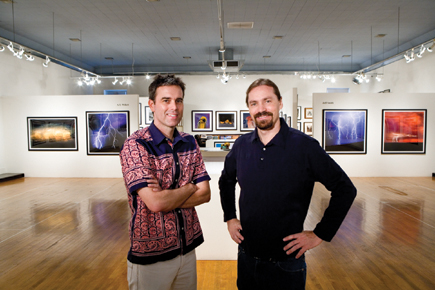
A. T. (Tom) Willett and Jeff Smith are commercial photographers whose clients
include Humana (insurance), Getty Assignments, Tucson Guide, More Magazine,
the Arizona Public Service (APS), and the University of Arizona. The duo met
more than 20 years ago while attending Pima Community College in Tucson.
Both moved to the small city when they were young (Willett from Illinois and
Smith from Massachusetts), and both were mesmerized by Arizona's monsoon
weather pattern, which is often quite dramatic. Separately, they each developed
a passion for photographing the powerful lightning displays that typically accompany
the storms. And so it was no surprise that they eventually began working together.
 |
|
|
"The skies were really dramatic and made a big impression on me as a kid," Willett remembers. "I lived on a ranch at the base of the mountains where we'd get huge storms coming in off the Santa Catalina Mountains. The power and the energy of the thunder and lightning makes an impression on you one way or another. If you're afraid, you stay in the house; if not, you're out there."
 |
|
|
Trial And Error
Photographing lightning is both a trick and a skill which has involved lots
of experimenting over the years. "There's still a lot of trial and
error," Willett notes, "especially in the beginning of each season
because we haven't seen lightning in nine months. The first few storms
we'll under- and overexpose images, depending on how close we are to the
lightning and how intense it is.
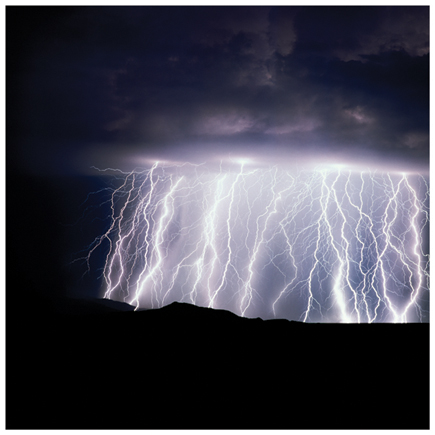
"A proper exposure can be anywhere from f/2.8 to f/16 for the aperture,
which is the most important thing for exposure. We constantly make judgment
calls for f/stops and balancing time exposures for available light."
 |
|
|
"There's no magic formula," Smith adds. "But at the
same time, it's best to start at f/5.6 or f/8, and then work on time exposures
based on whether you're in or outside the city and how bright the city
lights are and/or if there is a moon, etc. If we're in the city, exposures
can be 2-3 minutes. If we're in the desert without moonlight, we can shoot
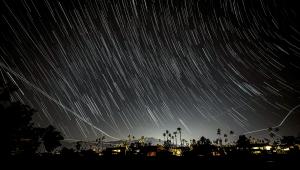
a much longer exposure up to 8 minutes (which can also capture star trails,
even behind the clouds)." The duo suggests counting the lightning bolts
as they come down and after you've counted 7-10 bolts, close the shutter
and move on to the next frame.
The photographers usually set up 6-8 cameras on tripods using different exposure
settings. "We use really stable Gitzo tripods, which we highly recommend,"
Willett states.
 |
|
|
Smith adds, "Some of them we've been using for 25 years; they're
the best quality tripods for this type of work. We use both the carbon-fiber
and older metal models. Out there in the elements, they get wet and dirty. We've
never had a Gitzo collapse on us in a big storm."
Getting Started
The duo suggests setting up a camera with a wide angle lens first. "If
you start wide," Smith explains, "you're bound to get a bolt
of lightning in your frame. If the bolts are more consistent in one area, you
can hone in on it. The highest quality lens will give you the sharpest image.
If you're using a plastic camera, that can be interesting, but you'll
never get that super-sharp bolt that you see with your eye. To your eye, it's
all amazing, but it does matter what kind of camera and capture medium you're
using."
 |
|
|
Both photographers prefer to shoot lightning storms on film (Fuji Velvia 50)
but recently started shooting digitally as well. "Many photographers shoot
fast film thinking they'll capture the lightning, but we recommend shooting
time exposures with low ISO film." Willett and Smith also prefer color
transparency film because, they note, negative film is harder to print and always
has more grain. "But if that's all you have in your camera when
the lightning strikes," Willett says, "shoot it."
Smith explains, "We've never used push or pull processing. There
are so many different intensities of lightning on one roll that if you try to
mess with one, you can ruin others. You just don't know what you're
going to get until you look at the film. The latitude the film has and the quality
of the scans still beats anything [digital] that's out there, but we're
always looking for new technology.
 |
|
|
"Some people would be shocked at the quality of the gear we take into the field, which includes Nikons, Canons, Hasselblads, and large format Pentax cameras, all of which can get wet, blow over, etc. We want the highest quality results."
| |||||||||
|

| ||||||||
- Log in or register to post comments


























 FEATURED VIDEO



Get the Latest Photo Tips, News & Reviews from Shutterbug!






| Camera Reviews Other Reviews | |
Mobile Reviews Photography Reviews Columns | |
News | |
Features | |
How-To | |
Resources |
 © 2024 Shutterbug
AVTech Media Americas Inc., USA
All rights reserved