


- REVIEWS
Camera Reviews 
More Reviews Mobile Reviews Photography Reviews - GALLERIES
- VIDEOS
- BUYER'S GUIDES
Konica Minolta DiMAGE Z3; First Z-Series Digicam With IS Plus New High Tech Features
All Photos © 2004, Peter K. Burian, All Rights Reserved
Konica Minolta DiMAGE Z3 Quick Look
· 4 million effective pixels
· CCD-shift Anti-Shake function
· $499 US street price
Further Information
Konica Minolta DiMAGE Z3
http://www.konica.com
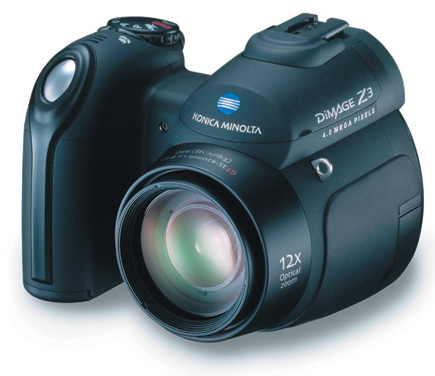
In Konica Minolta digital cameras, I generally prefer to work with the high-end A-series DiMAGE models because they're loaded with all of the latest technology. But recently, the company released a Z-series model that's every bit as desirable. The 4-megapixel DiMAGE Z3 incorporates a wealth of high-tech features that make it a fine choice for serious shooting. These include a newly developed 35-420mm (equivalent) optical zoom, the latest processor for great speed and image quality, a new Rapid Autofocus system and the Anti-Shake function that acts as an image stabilizer for sharper photos.
 |
|
|
|
 |
|
|
|
|
A moderately large camera with an oversized handgrip that allows for a firm grasp, the Z3 is lightweight for a model with such a long optical zoom lens. Surprisingly, the LCD monitor is quite small (1.5") but it provides a clear, crisp, contrasty view. Although loaded with capabilities, the camera is easy to operate, thanks to the well-marked analog controls that minimize the need to access the electronic menu. In addition to the usual buttons for flash, macro, exposure compensation, delete, and menu selection, there's a large mode selector dial with 11 options. The electronic viewfinder (EVF), common in all digicams with a long lens, provides a bright view, great framing accuracy, and full data on camera settings.
Valuable Technology
While exploring the Bluegrass Country in Kentucky, attending a baseball game
and a county fair, I made hundreds of images in order to test the usefulness
of the technology packed into the DiMAGE Z3. The powerful APO GT zoom lens includes
two aspheric elements, a low dispersion glass element plus multi-layer coatings.
Essential in a wide angle to super telephoto lens for superior image quality,
these measures correct optical aberrations (flaws), distortion and flare. Even
photos made at the 420mm equivalent exhibit high edge-to-edge sharpness, particularly
at f/8, the optimal setting. Some purple fringing is visible in scenes with
ultrahigh contrast, but that's typical for a camera with a long, built-in
lens.
 |
|
|
During a pro baseball game one evening, I used the long focal lengths for
tight shots of distant players. With most cameras, I would not have been able
to get sharp telephoto shots without using a high ISO setting for fast shutter
speeds. The Anti-Shake function, previously available only in some A-series
DiMAGE cameras, certainly came in handy. It allowed me to shoot at ISO 100 for
superior image quality--with minimal digital noise--until after sunset.
This unique system employs sensors that detect the direction and speed of camera
shake. The data is sent to a microcomputer that shifts the entire CCD sensor
to compensate for camera movement, providing a two to three shutter speed step
advantage.
In practical terms, the Anti-Shake function allowed me to consistently make
blur-free images at 1/100 sec (instead of 1/400 sec) at the longest focal length.
Even a 1/45 sec exposure produced some critically sharp photos. Like any image
stabilizer, the CCD-shift system does not compensate for subject movement. Hence,
much faster shutter speeds are required to freeze any motion, calling for a
higher ISO setting in action photography. Still, the Anti-Shake feature is a
valuable amenity that makes this camera particularly desirable.
 |
|
|
The new Rapid Autofocus system is billed as "the fastest in its class."
The system consists of lens drive function that moves focusing elements twice
as fast as in previous Z-series models plus ultra fast data reading from the
CCD sensor. That, plus the passive five-point AF sensor (the type used in SLR
cameras), made the Z3 very quick and reliable in outdoor shooting. Focus acquisition
was almost instantaneous. The Continuous AF system is quite advanced too, featuring
true tracking ability for follow-focusing on a moving subject. Surprisingly,
it always produced unsharp images of static subjects but worked quite well with
trotting horses, for example.
Of course, shooting a series of action images is easier said than done. That's
because the view through the electronic viewfinder--and the external LCD
monitor--blacks out momentarily between frames. This common problem, (not
unique to this camera), makes it difficult to keep a moving subject properly
framed when trying to shoot a series of images. Digicams with an optical viewfinder
would be more useful for such photography, but they do not include the long
lenses required for distant subjects. The ideal solution is an SLR camera with
a telephoto lens, but not everyone wants larger/heavier/more expensive equipment.
 |
|
|
| |||||||||
|

| ||||||||
- Log in or register to post comments















 FEATURED VIDEO



Get the Latest Photo Tips, News & Reviews from Shutterbug!






| Camera Reviews Other Reviews | |
Mobile Reviews Photography Reviews Columns | |
News | |
Features | |
How-To | |
Resources |
 © 2024 Shutterbug
AVTech Media Americas Inc., USA
All rights reserved