| |
Here
it is in all its glory--The Kiev 60 Export. (Domestic
version says KNEB in Cyrillic.) If there's a more
affordable way to get into a complete medium format system,
I don't know what it is.
|
|
Last month we took a look
at the anachronistic Kiev 88 medium format camera. A contemporary camera
like the ancient Hasselblad 1000f, the Kiev 88 mostly is thought of
as "cheap." If ultimate quality is your goal, look somewhere
else. If the most quality image for your money is your bag, then the
cheaper-than-cheap Kiev 88 and its more expensive rebuilt cousin from
Kiev USA and the thoroughly rebuilt Hartblei cameras from Kalimex in
Czechoslovakia are definitely worth a look. If $350 for a medium format
camera with interchangeable backs, metered prism, interchangeable lenses,
and 120 roll film capability is still too much, then how about a 120
rollfilm camera for under $200? While folders and TLRs from China have
always been inexpensive, their lack of interchangeable lenses, meters,
and any sort of basic ergonomics makes them difficult beasts to master.
Still looking for an affordable rollfilm camera that can actually take
some pictures? Say hello to the Kiev 60, a giant and robust reworking
of the late, great Pentacon 6. For those of you who don't remember
the Pentacon 6, it was an East German 6x6cm SLR that was basically an
upsized Pentacon 35mm camera. The Pentacon and its kissing cousins the
Praktisix and Praktica 66 were best known for their swift handling,
their East German Zeiss lenses, and their film advance problems. Since
the fit and finish of the East German factory never approached that
of the West German manufacturers like Rollei and Contax, the pro-oriented
Pentacon 6 cameras never really caught on with the pros in the U.S.A.,
but were used by many professionals in Eastern Europe. The Pentacon
6 was also the main "space camera" of the Rus-sian space
program until frustrated cosmonauts began buying and smuggling Hasselblads
aboard their spacecraft. Not surprisingly, the U-krainian camera industry,
which was also a contractor to the Soviet military chose the Pentacon
as the paradigm of medium format versatility, and offered up a copy.
While the Pentacon 6 was certainly a sleek looking camera for its era,
today it looks a little dated. How-ever, compared to the Kiev 60 it's
a virtual Porsche design project. While the Kiev 88 resembles an ancient
Hasselblad, the Kiev resembles the Pentacon 6 and then adds some tricks
of its own. The original version was called Kiev 6C and sported the
unusual combination of a right-handed film advance and a left-handed
shutter release, and offered 120 and 220 capability by means of a switch
and movable pressure plate. This camera copied the film advance of the
Pentacon 6 very accurately and suffered from the consequences, proving
to be unreliable.
|
| |
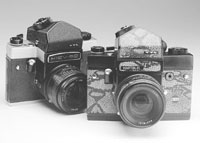
Kiev
60 compatible Pentacon 6 and modern variant Exakta 66 MOD
III. Using the same breech lens mount, you can mix and match
bodies and lenses with abandon. The new Exakta is actually
a rather well finished, robust camera.
|
|
After the fiasco of the 6C,
designers at the Arsenal Factory went back to work and came up with the
Kiev 60, which omits all of the troublesome mechanisms of the Pentacon
film advance at the price of slightly uneven frame spacing. The Kiev 60
feels quite a bit heavier than a Pentacon 6. While this makes it a bit
more difficult to handle, it really doesn't feel all that bad in
your hands. The first oddity is the placement of the shutter release.
Rather than putting it on the top plate of the camera, like most SLR manufacturers,
Pentacon (in their 35mm Praktica cameras as well as on the Pentacon 6
series) and Kiev place theirs on the front of the camera, angled 45°
up. It looks weird, but works just fine. The second oddity is the uncoupled
meter. Good luck working this thing reliably. Besides the fact that they
always come through from the factory uncalibrated, the little dials have
a habit of moving on their own, making it necessary to always check your
film speed and maximum aperture setting on the dial before taking a reading.
While the 6C offered both metered and non-metered prism finders, none
of us has seen any prism finder for the Kiev 60 without the meter.
Weird stuff aside, it's a pretty normal camera. Roll film loads
easily; the polished stainless film guides actually look fairly well done;
and the large plastic tip on the film wind crank makes the long 220°
throw somewhat palatable. Lenses bolt on with an oversized breech lock
system, and once mounted they are on quite securely. The biggest surprise
is the viewfinder--it's bright, contrasty, and shows just a little
less than 90 percent of the frame. Since the standard Kiev 60 kit comes
with waist and eye-level finders, you're pretty much ready to roll
once the box is unpacked. The eye-level prism is remarkably normal, and
is actually quite a bit brighter than many pricier medium format cameras.
The standard focusing screen is a typical split-image rangefinder, and
it works quite well. Since the Kiev 60 sports a cloth focal plane shutter,
the lenses don't need leaf shutters. This means that most Kiev and
Zeiss lenses for this mount are very fast. In other words, you should
be able to actually use the split-image rangefinder with almost every
lens that fits this camera.
OK, we've got our Kiev 60 out of the box, loaded with some Fuji
Velvia--what now? The Kiev 60 kits all come with an Arsat or Volna 80mm
f/2.8 lens. Some are marked with a red MC for multi-coated, but even those
without the markings seem to be multi-coated these days. The camera and
lens are finished to about the same level of quality. While they're
made of metal and seem relatively sturdy, the level of fit and finish
is well below that of any other consumer product currently available in
America or Europe. The satin finished silver body displays a coarse finish;
the leatherette is a shiny vinyl; and the body and lens markings are often
poorly engraved and often only partially filled with paint. On several
brand-new 60s we noticed copious amounts of contact cement that had oozed
out from the edges of the leatherette, which had never been cleaned off
at the factory. The serial number on the rear of the body is stamped unevenly
and on several of our samples at a sloppy angle. The whole effect of the
little finish flaws is a mess of a camera when compared to any fine piece
of optical equipment.
|
| |
The
Hartblei 456 is a 6x4.5cm version of the Kiev 60, reworked
by Hartblei in the Ukraine. Sold by Kalimex in Czechoslovakia,
these are reworked, fairly slick versions of the raw Kiev
cameras. If you can deal with a long-distance purchase,
they have some fun cameras over there in Prague. While our
black enamel and snakeskin version is a bit much for my
taste, you can custom order any cosmetic treatment you wish
without breaking the bank.
|
|
That said, it's a pretty
cool camera. Forget all the flaws, because the Kiev 60 has one thing that
no other medium format camera has--inexpensive lenses. Since the whole
point of buying any interchangeable lens medium format camera is to give
the photographer the option of using different lenses, most beginning
medium format shooters soon learn that even a bargain camera can be almost
useless if the lenses are too expensive. While an old Hasselblad 500C
may be a viable alternative to a budget camera like the Kiev, even old,
beat up leaf-shutter lenses for the Hassy can be expensive. Consider these
comparisons: a well used, single-coated chrome barrel 150 f/4 Zeiss Sonnar
for a Hasselblad might sell for $800-$1000, while a 150 f/2.8 Kaleanar
for the Kiev 60 can often be had for under $300 new, and under $200 used.
A clean used 55mm lens for the Pentax 67 has no leaf shutter and thus
is priced accordingly at under $500 at most dealers. The 45mm Mir for
the Kiev 60 can be had brand-new from many sources for under $250.
When you talk about extreme glass, then the Kiev really shines. Fisheye
lenses for medium format cameras are notoriously big, heavy, and expensive.
Well, the Kiev Arsat 30 sure is big and heavy, but it sure isn't
expensive. You can find these for under $600 from the Kiev-fixers like
Kiev USA, or around $200 from the factory direct guys like Mikhail Fourman
in Atlanta and Gennady Kaplan in L.A. Like long telephoto glass? How about
a blazing fast 250mm f/3.5 Jupiter lens for $250? (And I've seen
them for even less.) If you want affordable lenses and an affordable body,
for medium format the Kiev 60 is the place to be. Now of course affordable
is only a bargain if you can actually get decent results, so can you?
The answer is a decided yes and no. Yes, you can get terrific pictures
from these cameras and the Ukrainian lenses. Sharp, contrasty, punchy
transparencies that look just as good as those from cameras costing thousands
more. You can also ruin roll after roll of pricey transparency film. You
can have images that are filled with flare, wacky uneven frame spacing,
even frames that "kiss" and overlap each other. You can bemoan
your uneven exposures, your repeated light leaks, and the ghostly fog
that seems to cloud any picture with a bright object in it. In short,
you can regret that you ever laid eyes on one of these things.
|
| |
The Arsenal Factory is not known for their surgical precision.
Oozing glue like this sample, mis-cut vinyl and sloppy engraving
are part of the Kiev experience.
|
|
So, how can you ensure the
good results and banish the bad ones? First of all, the Kiev 60s that
are shipping today are better than those made in the late 1980s. Frame
spacing is more consistent; film door light seals are better; the shutter
glide is smoother; and many have the mirror chambers partially flocked
to eliminate internal glare. However, there is no such thing as a brand-new
Kiev 60. The factory in Kiev stopped making them years ago when the inventory
reached a tremendous level, and they've been selling the 1994, 1995,
and 1996 bodies since then. (Whether or not the factory will resume production
once the inventory is depleted is unclear, so Kiev 60s may be in short
supply by the time this article appears.) Since you never know which year
camera you will receive when buying new, and used Kiev 60s are a risky
enterprise at best, here are some tips for making these beasts take good
pictures reliably:
· Fight Glare. Most of these cameras will come through with absolutely
no internal flocking, and the flat black paint used to coat the mirror
chamber has a slight sheen. This can fog your images with a ghostly flare
which seems to be coming from the lens, but actually is the light bouncing
around the mirror chamber. You can reduce or even eliminate this problem
by flocking the chamber yourself. I purchased a sheet of 2mm camera flocking
and carefully cut out pieces that would fit. The results have been dramatic.
· Be Methodical. This equipment is just not sturdy enough to take
a real beating. Careless film loading, jerky film winding, or rough handling
will result in a jammed or broken camera, or inconsistent results.
· Double Check. Unlike a modern Canon EOS or Nikon F5, there's
nothing on this camera that is automatic or even terribly dependable.
Double and triple check your lens mounting, your meter settings, and your
focus. If you're not super careful, you'll be awfully disappointed.
· Consider Spending More. Af-fordable is affordable, but sometimes
a few hundred dollars can make your life a lot easier. Consider having
an inexpensive Kiev 60 upgraded by Kiev USA. This will guarantee accurate
frame spacing, elimination of flare, and much smoother film winding.
|
| |
All of the Zeiss lenses made for the Pentacon 6 cameras
as well as the new Schneider lenses made for the Exakta
66 will fit the Kiev 60 and work perfectly. This dead mint
Zeiss 50 f/4 Flektogon cost me $300, and outperforms the
somewhat battered 50mm Distagon on my Hasselblad 500 CM.
|
|
Even better you might want
to consider buying a new camera from Kiev USA or a modified Hartblei camera
from Kalimex. Besides the obvious benefits of an inexpensive body and
less expensive lenses, the biggest advantage of owning a Kiev 60 is to
use the excellent family of Zeiss Jena lenses designed for the Pentacon
6 cameras. While the older single-coated lenses are available very inexpensively,
you'll probably want to do what I did and buy only the late model
all black multi-coated lenses from the 1980s. I bought the 50 f/4 MC Flektogon;
the 80 f/2.8 MC Biometar; the 120 f/2.8 MC Biometar; the 180 f/2.8 MC
Sonnar; and the huge 300 f/4 MC Sonnar. All of this Zeiss glass was found
used in excellent condition with the original cases and caps. My total
outlay for the entire family of lenses was around $1500, which is pretty
good for five high quality Zeiss lenses. Unlike the Ukrainian bargain
lenses, the Zeiss glass is beautifully finished, has the silky smooth
focus one would expect of pro-quality gear, and produces sharp, contrasty
images. With a Kiev 60 body and a handful of Zeiss lenses, I figured that
I would go out and buy every Ukrainian lens, new or used, I could find.
(Since I had heard that some would be in short supply soon) I picked up
the 30mm fisheye; the 45mm Mir; the 65mm f/3.5 Mir; the 120 f/2.8 Vega;
the 150 f/2.8 Kaleanar; and the 250 f/3.5 Jupiter. My total outlay for
the entire lens kit was a paltry $975.
I know that many of you are thinking, "He's spent a couple
thousand dollars for this stuff?" Well, it's a good point.
By the time you buy into all of the interesting lenses you've spent
some real money. Since I already have full kits of Hasselblad and Mamiya
RZ equipment, I was simply looking to add some focal lengths that I don't
own and rarely use. For a couple of grand I now have nearly every extreme
and in-between focal length for those weird assignments. It seemed like
a good investment to me. The affordable Ukrainian and Zeiss lenses are
a good thing, and a Kiev 60 owner with a well-flocked body, carefully-calibrated
meter, and nerves of steel can produce stunning images. However, using
this camera can be quite difficult. First of all, there's the flash
synch problem. One of the things that makes this camera inexpensive is
the lack of an expensive leaf shutter in each lens. The Kiev 60 sports
an archaic 1/30 sec flash synch, which all but eliminates any kind of
outdoor fill flash activity. (Although I've gotten away with 1/30
at f/16 with Fuji Velvia at e.g., 40 and 3200 ws worth of flash.) While
the camera has shutter speeds from 1/1000 down to 1 sec, slower shutter
speeds are difficult due to the brutal mirror slap. Standard Kiev 60s
do not offer any sort of mirror lockup control, though later model Kiev
60s offer the mixed blessing of a two-stage mirror prerelease. Press the
shutter button halfway down and the mirror flips up, continue the pressure
and the shutter fires. With a deft touch you can easily release the mirror
first, then fire the shutter, thereby totally eliminating mirror shake.
This is a mixed blessing because you can't turn it off. Action shots
become a problem because even a swift press on the shutter releases the
mirror early, resulting in a split second before the shot where your vision
is obscured. To those who plan to use the camera mostly on a tripod (like
me) it's a must-have. For you handheld guys, it might be tough to
live with.
So there's the basic system: the Kiev 60 body with various levels
of refinement according to year of manufacture, the inexpensive Ukrainian
lenses, and the slightly more expensive Zeiss lenses. My experience has
been that the Ukrainian lenses can be excellent, but sometimes a lens
comes straight from the factory with a misaligned element or misshaped
diaphragm blade. The Zeiss lenses for the most part are excellent, but
still a hair softer than modern Zeiss glass as found on Contax, Rolleiflex,
or Hasselblad gear. (Given the price disparity it's to be expected.)
For my own work I really needed a medium format fisheye, a long 250mm
or so tele, and a shift lens for corporate architecture shots. I filled
those holes with Ukrainian lenses, buying the 30mm Arsat, the 250mm Jupiter,
and the 45mm Hartblei PCS. I figured that I'd use the Pentacon body
in front of clients, since the Kiev 60 just plain looks too funky. Real
world usage proved the Pentacon too difficult to focus and too delicate
for pro work.
Bob Shell suggested I look at the Exakta 66 III, which is distributed
by Cambridge Camera Exchange in New York. I arranged for a loaner of an
Exakta 66. And when it showed up it looked totally different from the
Pentacon 6, upon which it is based. It looks heavy-duty, rugged, and thoroughly
Germanic. The Pentacon sized body is covered from head to toe in black
enamel and gray rubber. It feels large but manageable in your hand, and
the rubber is soft and grippy. My example came through with the giant
coupled meter prism, but since my goal was to use it mostly with non-coupled
Ukrainian lenses, it wasn't of much use. The viewfinder of the Exakta
has been improved over the Pentacon series and shows almost the entire
image area and used stock Rollei focusing screens which are among the
brightest available. The prism finder of the Exakta is comparable to the
Pentacon--dimmer than most but showing decent contrast. In fact, almost
everything on this camera looks like someone took a Pentacon 6 and recovered
it in rubber. The truth isn't that far off. Though the Exakta 66
is a totally revamped Pentacon 6, it's still a Pentacon 6. There's
still the longish 220° film advance, the front mounted 45° angle
shutter release, and the painfully slow 1/30 sec flash synch. That said,
it's a really seductive camera, and everyone thinks it looks cool.
Given that a brand-new fully warranted Exakta 66 Mod III with excellent
Schneider Xenotar normal lens and standard prism can be had for around
$2000, it's still a very reasonable deal. Frankly, I want one.
While my lust for the slick Exakta 66 goes unfulfilled until the piggy
bank has a few more nickels in it, I figured that I would turn to those
Euro camera hot rodders, Kalimex. They offer the full line of stock Kiev
cameras and lenses, rebuilt Kievs of every ilk as well as the thoroughly
redesigned and recovered Kiev cameras renamed Hartblei. The Kalimex sales
manager sent off a wildly reworked Kiev 60 called the Hartblei 456. Hartblei
has reworked the stock Kiev 60, re-machining many pieces; upgrading components;
adding their patented mirror brake mechanism; and changing the film advance,
frame counter, and viewfinder to reflect the 6x4.5cm aspect ratio. Our
sample was finished with an excellent black enamel trim and a well-done
covering of leather printed with a bizarre snakeskin pattern. (Standard
black leather is available.) That horrible giant Kiev 60 logo has been
replaced with even more faux snakeskin and a tiny Hartblei logo. The mirror
chamber of the Hartblei 456 is beautifully flocked, and the lens mount
breech lock sports the word Hartblei engraved on its surface. While the
snakeskin finish is a little disconcerting, the overall effect is of a
well finished, solid camera. While our Kiev 88 based Hartblei 1006 sported
our only well calibrated meter of the group last month, the meter on our
sample 456 was off by two f/stops. A quick turn of the jeweler's
screwdriver and we were back on track.
A similar camera called the Kiev 645 is available from Kiev USA. Shell
has one and has been very satisfied with the results and loves getting
16 exposures on a roll. He feels it makes a lot more sense than a Kiev
60 because he was always cropping 6x6 images into a 645 rectangle anyway,
and shoots the majority of his photos in the vertical format.
The rectangular format may seem odd on a camera of this type, since the
frames run across the roll in the portrait format. In other words, when
you hold the camera up to your eye you're composing a vertical frame.
To get a landscape style horizontal frame you need to turn the camera
on its side. It's the exact opposite from a 35mm camera or a Pentax
67, so it takes some getting used to.
The camera comes with a Hartblei 80 f/2.8 MC lens, but it looks like a
stock Arsat 80 f/2.8. (Except for the snakeskin focusing ring honest!)
The mirror brake mechanism and lockup lever work beautifully, and give
you relatively complete control over the action of the mirror. I shot
some film at dusk and in the evening with longish shutter speeds, and
chose the Hartblei first for this very reason. The total package is really
quite nice. The camera comes in a nice little cordura bag, and when I
was out shooting, people seemed genuinely curious about the giant snakeskin
camera. All of these features and cosmetics do add to the price however.
While a stock Kiev 60 can be had in the US at many sources for under $200,
a Hartblei from Kalimex will set you back anywhere from $280 to $420,
given the options you choose.
Overall I'm having a lot of fun with these Pentacon/Kiev/Exakta/Hartblei
cameras and lenses. In some cases I've bought the most inexpensive
things I could find, warranty and reliability be damned, and in others
I've paid a few extra bucks for the privilege of buying an inspected,
tested, and repaired unit. I can really recommend these cameras, with
a word of caution: buy the newest body and lens you can find, and insist
on a flocked body or flock it yourself. Carefully check your frame spacing
first with a roll of outdated film, and recalibrate your meter. If you'd
like a camera that has had the bugs worked out of it, by all means buy
a Kiev 60 or 645 from Kiev USA, who offers the full Kiev 60 kit completely
rebuilt for only $390 (the Kiev 645 is more). If you're the adventurous
type and like to receive interesting packages from overseas, I can heartily
recommend the surgically altered Hartblei cameras from Kalimex in Prague.
It's not the greatest gear in the world, but for medium format work
it clearly is the most affordable. Next month we'll go into life
with Kiev, including lots of hits and misses from my several months of
Kiev shooting.
|