


- REVIEWS
Camera Reviews 
More Reviews Mobile Reviews Photography Reviews - GALLERIES
- VIDEOS
- BUYER'S GUIDES

Innovations You Have To See To Believe! Page 2
A long way down-market from there, but still very entertaining, were such products as the PixPen, which accepts a rolled-up 21/2x13/4" photograph inside the transparent barrel of a ball-point pen--a bit like the old "naughty" swimsuit pens, but without the disappearing swimsuit. Both the PixPen and the MagnaFrame come from Cottage Mills in Wisconsin; the MagnaFrame is a set of six magnetic frames and eight ball-bearing magnets. Use the magnets to hold the frames together in a variety of ways: it's that simple. Add more sets for more choices. Then there's the Rocking Baby-Doll from DCK Image Co. Ltd. There's a choice of six cartoon figures, 2 or 3" high, with oversized heads coupled to a little battery-powered rocking movement. The idea is that you cut out the head from a suitable picture and stick it on the rocking head. It's probably a great present for a doting grandmother but it would rapidly drive me mad. There's no US distribution for these yet: an opportunity for somebody?
 |
|
|
Then there was the jewelry from Memory Maker, essentially an update of the old photo-locket idea but with bracelets: one which should do very well is a charm bracelet to which pictures of new friends can be added while those who have fallen from favor can be subtracted. For fridge-o-philes, The Magnet Source (Master Magnetics, Inc.) showed both a peel-and-stick magnetic backing for photographic prints and an ink jet-printable magnetic substrate.
 |
|
|
Crossover Markets
Another noticeable trend was crossover products from other markets: craft, scrapbook
making (I refuse to use the ghastly neologism "scrapbooking"--I
scrapbook, thou scrapbookest, he scrapbooks...) home storage, mountain climbing,
and more; the last two are mentioned in Frances Schultz's piece on camera
bags. Art Deckle, described earlier, is a good example but the traffic is not
all one way: for example, Just Normlicht told me that woodworkers have embraced
ISO standard light enclosures to match stains and veneers. There is probably
as much money to be made in finding new uses for old products as in making new
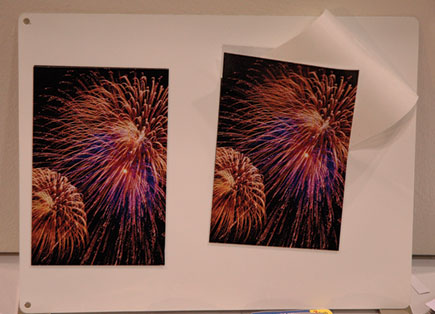
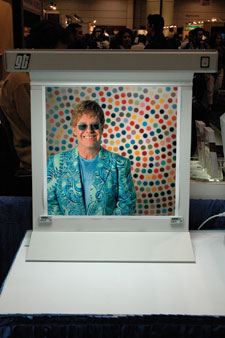
products to meet old needs, though the new 20x20" light enclosure for
camera clubs, made by GTI, should make it easier for judges to compare competition
entries and for the audience to see what they are talking about. And Gagne,
Inc., noted for their Porta-Trace light boxes, managed a crossover within the
industry by linking two light boxes, one above pointing downward and the other
below pointing upward, to create the "Porta-Studio."
 |
|
|
Digital Accessories
People are still trying to work out ways to see the miserable little LCD screens
on the backs of cameras and two of the best products I saw were a magnifying
glass in a hood and a superb little snap-on folding hood for the Nikon D70 which
replaces the substantially useless Nikon snap-on cover. The former was an OEM
manufacturer looking for a home but the latter is available at $29.95 from the
Hoodman Corporation. I couldn't get one at the show but I have ordered
one.
Still in the realm of digital accessories, the ExpoDisc is back. This looks
like a push-in opaque filter with a smooth side and a dimpled side. Originally
marketed as a way of turning a through-lens meter into an incident light meter,
it is now sold primarily as a means of getting the best possible white balance.
Now there is a new version, the Digital Warm Balance Filter, which not only
gives a white balance but adds the equivalent of an 81A filter for portraiture.
At $109.95 for one that fits the 18-70mm zoom on my D70 it's about 3x
the price of the old ExpoDisc but it's even more useful: I came home with
one.
 |
|
|
Digital Binocs And More...
Of course there are lots of electronic products at PMA and there is always some
overlap in who discusses what so one of our other reporters may also have covered
some of what follows in their PMA reports.
An intriguing product which left me somewhat puzzled was true digital binoculars
from Sightwave. With 10x optical zoom plus 22x digital zoom they offer a truly
impressive 220x zoom range and the 3 lux minimum illumination is good, too;
but when it comes down to it you are looking at a low-resolution (480x234) liquid-crystal
digital image and paying $599 for the privilege.
Much more expensive at $1695 list, but also much more desirable as far as I
am concerned, were SkyHawk binoculars with 25x and 40x magnification and 100mm
objectives. The price includes a tripod and dolly, and the quality is excellent,
just as you might expect from a military design used by Chinese border guards:
ideal for spotting Tibetan refugees fleeing the glories of communism, but also
ideal if you merely have a house with a good view.
 |
|
|
To return to electronics, DxO Labs had some brilliant new software for improving the quality of images from picture phones. These are the guys who designed the software that "fakes out" lens aberrations and sensor artifacts for most modern digital SLRs, resulting in significantly better image quality from exactly the same equipment. DxO Optics Pro 2.2 is the latest version, and it now includes the DxO Raw Engine which was formerly available only as an add-on option.
 |
|
|
DxO argue very convincingly in a White Paper available on www.dxo.com that because there are severe space limitations in a mobile phone, there is much more scope for improvements via software than via either lens improvements or trying to cram more pixels onto very small chips, with the attendant problems of noise and heat. This is a product that any sensible camera-phone manufacturer will build into his phone (it can't be installed afterward by the user, unless you have your own research lab) and I was very impressed indeed by the image quality they extracted from a deliberately underexposed picture. I don't believe for an instant that camera phones will ever replace real cameras for the enthusiast but I can well believe that they will take a significant bite out of the snapshot market.
 |
|
|
Another impressive digital product was the latest Minox multimedia device, the Mobi DV: 3-megapixel still camera, VGA video camera, voice recorder, and MP3 player with half a gig of on-board storage (Secure Digital card) and space for a spare second card. From the front it's about the size of a packet of cigarettes (remember cigarettes?) but only about a quarter of the thickness. At only $249 this would be the perfect notebook for covering photo shows and for many other applications. Amazingly, it hasn't been well received by camera stores. To me, this is the equivalent of saying, "Yes, we want to go out of business. Please send all our customers to Wal-Mart."
 |
|
|
This prompts my last observation on the PMA Show in particular and the photo
business in general. It sums up a good deal about where photography may go if
we are not careful. On Tuesday evening, the last full day of the show, Frances
and I stopped at the Ming Court a few blocks from the convention center for
some of their excellent sushi. At the sushi bar we found ourselves sitting next
to a school photographer from the Midwest. He said, "Wal-Mart has had
a terrible effect on us. Not the way they have killed all the mom-and-pop businesses
by moving the shoppers out to the malls and destroying the town centers, but
by changing school photography from a creative, enjoyable people business to
a picture factory. We no longer turn out good pictures. We turn out acceptable
pictures, as cheaply as possible, to compete with their studios. And it's
no fun anymore."
Manufacturers/Distributors'
addresses can be found on page 176.
| |||||||||
|

| ||||||||
- Log in or register to post comments
























 FEATURED VIDEO



Get the Latest Photo Tips, News & Reviews from Shutterbug!






| Camera Reviews Other Reviews | |
Mobile Reviews Photography Reviews Columns | |
News | |
Features | |
How-To | |
Resources |
 © 2024 Shutterbug
AVTech Media Americas Inc., USA
All rights reserved