|
When you think about really
long, really fast glass, you naturally think of 35mm. I have owned both
Hasselblad and Mamiya RZ systems for years, and the longest lens I own
is a 180mm. I'm like most shooters--I think of compact and
portable 35mm as the long lens sports format, and 21/4 as the normal lens,
studio strobe kind of system. Then I got hold of the Hasselblad Zeiss
Telephoto Power Pack!
The Hasselblad Zeiss Telephoto Power Pack is not some sort of new battery
power system. It's the bleeding edge of medium format telephoto
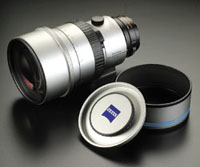
lens technology, consisting of a robust Carl Zeiss 300mm f/2.8 "Tele-Superachromat"
T*, a Zeiss APO-Mutar 1.7x tele-extender, a couple of filters, and a big
impressive flight case to hold it all.
|
| |
Cornerback
Tony Scott tries to make the 2002/2003 Patriots team.
This image was shot from about 80 yards away, and is
super sharp--so sharp that I can clearly see the
"NFL Equipment" logo on his shorts--just
to the right of the number 39.
Photos © 2002, Jay Abend, All Rights Reserved
|
|
When the box arrived from
Hasselblad U.S.A. I was both intimidated and impressed. I've never
handled such a large and impressive piece of glass on a Hasselblad body,
and just putting the whole thing together took a few minutes. The lens
and tele-extender are part of the FE series, and require a 200-series
Hasselblad body. Since these lenses have no leaf shutters they require
a focal plane shutter body. As with most things Zeiss this is a remarkably
well-crafted item. Fit and finish are beyond reproach. The silver finish
seems to glow, all of the markings and engravings are crisp and clear,
and the large blue "Zeiss" logo brings a smile to the face
of any certified equipment nut. Even the tele-extender is a typical
Zeiss piece, its large "Made In Germany" label carefully
engraved into the body of the lens.
While I can see this lens winding up as a very, very popular rental
item among most fashion photographers (at close to $22,000 I'm
not sure it will be on the "must-have" list of too many
pro shooters), Hasselblad assured me that there are sports shooters
going with this lens. Really? Sports guys using Hasselblad bodies with
giant 300mm f/2.8 monster lenses with 1.7x tele-extenders? Really?
|
| |
Linebacker
Larry Izzo tries to cool off during a hot training camp
session. I was really, really far away for this shot,
but the 300mm f/2.8 and the 1.7x tele-extender brought
me this close. Not quite as sharp as the other image taken
without the extender, but this is still plenty crisp.
|
|
I had to find out. I'm
sort of a studio guy, with the weekly location shoot, usually in an office
building or factory. Mine is the world of carefully controlled conditions,
beautifully lit scenes and plenty of time to study the Polaroids. Sports
guys have to shoot first and ask questions later. To really put this beauty
through its paces I gathered up my kit of Hasselblad bodies and lenses
as well as my EOS D60 and 1D bodies, my 70-210mm L and 300mm f/2.8 L lenses,
and enough Fuji Provia 100 film to cover me and packed up the car.
Since I did this test in late August I figured I'd head down to
world champion New England Patriots training camp in Smithfield, Rhode
Island. Unfortunately for me the temperature was forecast to top the 100Þ
mark, with plenty of steamy New England humidity to boot.
Setting Up Shop
Once I arrived I set up shop. The first thing you notice about this rig
is that it definitely draws attention. Forget about sneaking into an event
with this beauty--I was immediately spied by a PR guy and had my
credentials checked. Once I passed muster I was allowed to shoot. Shooting
football, even practice football, is all about position. You've
got to be mobile, so I bolted the 300's sturdy tripod block to a
Bogen monopod and slung it over my shoulder. Once I got to where I needed
to be I set up both my 300mm f/2.8 EOS "L" lens and the Zeiss
300mm.
|
| |
The excellent
Zeiss APO-Mutar 1.7x extender turns the 300mm into a fire-breathing
500mm f/4.8 lens. Unlike most tele-extenders, this 1.7x
has almost no effect on image quality.
|
|
"What the hell is that?"
asked a local photojournalist. "Why, this is my Zeiss 300mm f/2.8
APO with 1.7x APO-Mutar extender on a 203FE body with PM 90 prism,"
I casually remarked. Impressed, he shrugged and walked away. Needless
to say, when I staked out a position the print journalists cleared a space
for the guy with the prettiest lens.
First I shot with the EOS bodies. Of course, the luxury of the EOS autofocus
lens on the speedy 1D body is undeniable, but after banging off a few
hundred AF shots with the 1D, switching to the Hasselblad viewfinder was
a revelation. Holy cow, this thing is bright! After shooting with the
D-SLR, the film-based Hasselblad and the remarkable lens was way bigger,
way brighter, and with much more contrast. While there is no autofocus,
the 203FE body has excellent and very accurate autoexposure, and manual
focusing is a breeze. The 300mm f/2.8 has probably the sweetest and most
well damped manual focus ring, and a surprisingly short throw. The result
is that images snap into focus with startling clarity.
Hasselblad has really done their homework on this lens. The satin finish
silver barrel stayed extremely cool in blazing 100Þ sunshine. The
included metal screw-on lens shade is really tough, and should protect
the huge front element should you drop it or bang it into something else.
(Hey, it happens.) A really nice touch is the tripod collar, which has
the same quick-coupling plate featured on all Hasselblad camera bodies.
Got a quick release attachment? Just pop the lens on and it's rock-solid.
I shot several hours with this lens, both with the tele-extender and without.
Without it the lens is super bright and the viewfinder image is ultra-crisp
and contrasty. With the extender things get a bit darker, since you've
now got a whopping 500mm f/4.8 lens. My test rolls of Fuji Provia 100
all looked very good. Exposure was spot-on, whether I was shooting into
the sun or with the sun over my shoulder. Even with the tele-extender,
images looked very contrasty and colors were bright and very saturated,
a bit of a departure from my nearly 20-year-old Zeiss glass.
|
| |
The internal
filter slot makes it simple to insert ND or colored filters,
rather than cart out Frisbee-sized chunks of glass to
cover that front element.
|
|
Through The Loupe
Looking at the entire shoot through a strong loupe revealed a couple of
things. First of all, this is one sharp lens. Second of all, a 500mm f/4.8
shot wide-open at 1/1000 sec has seriously shallow depth of field. The
sharpness is quite impressive. I found the lens to be just as sharp corner-to-corner
as my 35mm EOS lenses, and in fact quite a bit crisper, even wide-open,
than my older T* lenses. With the tele-extender sharpness is affected
very little. Wide-open there is some noticeable corner softness, but it
disappeared after stopping down just two stops. The lens is also remarkably
resistant to lens flare. Since some of the great sports images are shot
with strong backlighting, this is really important.
Comparing the film images shot with this amazing lens set with digital
images shot with Canon glass it is clear that film, especially big medium
format film, still has a look that is hard to reproduce. I found the Hasselblad
chromes to be very, very rich and pure, with crisp edges, solid blacks,
and sublime colors. Certainly for magazine reproduction this rig is a
serious contender.
Although this is one of the most expensive lenses in the world, the $21,290
Hasselblad Zeiss Telephoto Power Pack will find an audience. While most
great medium format systems offer a 300mm f/2.8 APO lens, Zeiss has crafted
perhaps the best lens of its kind in the world. While slick handling AF
systems from Mamiya and Contax may seem like a more natural fit for the
sports photographer, the reliability, robustness, and image quality of
the Hasselblad system continues to make Hasselblad the camera to beat
for professional photographers.
I loved the week I had with this exotic and desirable lens system. There
are several shoots a year where the 300mm lens would be useful for me,
even though I rarely shoot anything that moves very quickly. The combination
of the long reach, sharp images, and vivid viewfinder are hard to resist.
While it may be on a lot of wish lists, the lucky few who get to own this
lens system will surely be proud of their investment.
For more information, visit Hasselblad U.S.A.'s web site, www.hasselbladusa.com.
|