| |
| Essential
Lighting Kit PG30ELK from Photographer's Warehouse includes
three 100ws monolights, two air-cushioned 8 ft tall light
stands, one short backlight stand, two white bounce-in
umbrellas, and a set of barn doors for $499 or $599 with
case. |
|
Correct lighting is the key
ingredient to producing any photographic image worth a second glance.
Outdoors you don't have much control over the light other than
to possibly use some type of reflector, diffuser, or flash fill. But
indoors, when only artificial lighting is used, the photographer controls
all of the lighting. The light can be placed high or low, close for
strong and direct light, or diffused for soft, wraparound lighting.
Normally two or three or more lights are used in a studio situation
to better bring out the features and/or textures of the subject. Purchasing
the lights for a new studio can be a challenge and costly, but it can
be done on a tight budget of under $1000 if you are careful and choose
properly. Selecting a studio light kit can be the best way to start
out.
Actually, quite good pictures
can be made in a studio using one main off-camera studio light by itself,
possibly combined with a white card reflector to soften the shadows.
However, the usual recommendation for the basic studio lighting kit
needed for normal portrait or commercial subjects is three or four light
units. Each should have a tilting adjustment for a light head and a
light stand. You will also want to get either a flash or ambient light
meter (the latter is needed for incandescent hot lights) to determine
the correct exposure.
Typically, the lights will
have equal intensity or power, though the third light often can be weaker
since it is normally used as a background or hairlight. Depending upon
the subject/situation, the background light might have a short stand
since it is often placed 2-3 ft off the floor to illuminate the background
only. But, for some types of portrait lighting it's often suggested
that the third (or hairlight) be placed on a higher stand and be directionally
controlled by an add-on device called a snoot, which confines the coverage
to a smaller circular area of the hair, thus does not spread over the
subject's shoulders.
|
| |
Premium
Lighting Kit PG40PLK from Photographer's Warehouse includes
two 105ws and one 100ws monolights, two air-cushioned
8 ft tall light stands, one short backlight stand, one
white bounce-in umbrella, one large softbox, and a set
of barn doors for $695 or $795 with case.
|
|
Studio Flash Setups
Studio flash AC units are normally one of two different major types. Some
smaller flash heads are powered by a master power pack that either sits
on the floor or is housed on the base of the stand. One power pack can
provide the juice for up to four flash heads, but they must be hard wired
to the pack. All controls are found on the pack for on/off, power level
adjustment, etc., but this type of flash can often run $500-$1000 per
flash, as it's intended for professional heavy-duty studio situations.
The other flashes are AC powered monolights (that is self-contained power
supply/light unit combination), where both the power supply and light
head are housed inside one relatively compact unit that fits onto the
top of a light stand.
Many firms offer reasonably priced
monolight flash kits consisting of two or three lights along with a stand
for each light, and often some light modification devices such as umbrellas,
softboxes, barn doors, snoots, etc. These kits are often packed inside a
sturdy corrugated cardboard box, a soft fabric container, or plastic case.
This type of case is very handy for location photography.
Strobe And "Hot" Lights
Most photographic lights today are daylight-balanced electronic flash
units, though incandescent, continuous output hot lights have regained
popularity. Incandescent lights usually are balanced for use with tungsten-balanced
color films. If daylight film is used filtration is needed to obtain proper
color balance. Electronic flash units produce cool, very bright light
that balances with all daylight color films. In addition an electronic
flash does not become excessively warm when left on for a length of time.
Hot lights do become quite warm when left on. This can make some subjects
uncomfortable. If you're photographing any type of perishable food,
hot lights can shorten the length of time you can leave the product on
the set "cooking" under the lights.
|
| |
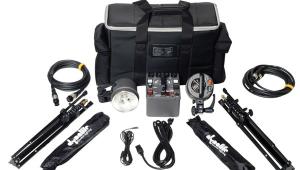
From JTL
Corporation, the TL-265 Light Kit contains two JTL Versalight
J-110 105ws and one S-45 45ws background slave monolights,
two tall and one short light stands, white and silver
umbrellas, snoot and barn doors, and a carry bag for
$510.
|
|
Battery Vs. AC Power
Moderately priced studio electronic flash units are primarily AC powered
models for several reasons. The initial cost of DC batteries, especially
rechargeable batteries, can be prohibitive. Additionally, very few battery-powered
units have a modeling light, an important feature for accurate visual
placement to achieve the proper lighting for both portrait and commercial
studio subjects. Battery-powered lights also have much smaller diameter
reflectors (for easier portability) and tend to take longer to recycle
and recharge to full power for the next picture. This can be a decided
limitation in a fast-paced portrait shooting session, such as when taking
fashion pictures.
Modify The Light
Raw electronic flash units (that is, a flash tube with only a small reflector
to direct the light toward the subject) are adequate for some subjects,
but produce strong, harsh, point-source lighting with sometimes objectionable
strong, deep shadows. This is why for glamour, portrait, and some commercial
subjects, diffusing each of the lights is usually preferable. This light
modification is typically accomplished by attaching a translucent umbrella
in front of the light, which diffuses the light as it goes through the
white material.
Other umbrella reflectors usually
have a metallic or reflective white surface into which the light is directed
then bounced back toward the subject (e.g., the light head is pointed
away from the subject into the reflector). Nearly all electronic flash
units have a built-in slave electric eye, which will sense when the master
flash is fired, and in turn will fire along with the other units, all
in perfect synchronization with the master flash. Thus only the master
flash, normally positioned near the camera, has to be connected to the
camera via a sync cord to fire when the shutter is tripped. This saves
having excessive wires cluttered around the light units other than the
AC power supply cords.
The larger, more expensive
electronic flash units typically have a small circular flash tube with
a modeling light bulb in the middle and a built-in cooling fan. This type
of flash often accepts interchangeable reflectors, which can alter the
spread of the light output for different subjects. Some lights have a
wired or infrared remote control with which you can adjust power level
and turn the flash on or off from a distance. This can be a decided advantage
when the light is placed inside a large softbox high off the studio floor.
This type of equipment, however, is considerably more expensive, so it
does not fit into the budget category of this article.
|
| |
Also
from JTL Corporation, the DL-600 Starter Kit contains
two powerful JTL Versalight 300 monolights, two tall
white and silver umbrellas, both a light case and stand
carry bag for $740.
|
|
Monolights
The more moderate-priced monolight flash units often have a larger diameter
head with four smaller straight flash tubes, non-interchangeable reflectors
and use convection cooling. This type of flash usually has a respectable
light output GN arrived at by combining the light from four small tubes
fired in synchronization to produce a larger amount of total output. This
light is not as directional as the light from a single flash tube and
reflector, but if used with a diffusion device it will yield a light pattern
very similar to the light pattern produced by a diffused single tube flash.
Lighting Kit Startups
Photographers wanting to equip their first studio with electronic flash
lighting can do this easiest by purchasing a self-contained kit with most
of the components needed for most situations. Several two, three, and
four light kits are available from a number of firms. Kits from several
firms normally include two or three monolights with built-in tilting adjustment
stand clamp, 10 ft long AC power cords, one 10 ft PC tip sync cord for
the main flash, two adjustable height stands that extend to 7-8 ft and
one shorter background stand, plus two umbrellas and a set of barn doors.
The actual kit components vary with each firm. For instance, some kits
include a softbox and some have an air cushioned stand.
Once you get started with lights,
what else might you need? To properly equip any studio you will also need
some background paper, which is available in many colors in 107 wide
(or wider) by 12 yard long rolls. If narrower rolls are needed they can
either be sawed into two 4.5 ft long rolls or sometimes purchased in narrower
53' by 12 yard rolls. Single and multiple pole background stands are available,
or the paper can be just tacked to the wall. For some subjects you will
need a soft material for background such as background in a bag offered
by several firms. Either a tripod or a wheeled studio stand will be a
major asset since for most subjects you will not want to move the camera
about much.
So, with a kit of lights and
a few other accessories, you can have a business or home studio ready
for use anywhere AC power is available in minimal time for minimal bucks.
Manufacturers/Distributors
Adorama Inc. (Adolite, Flashpoint)
(800) 223-2500
(212) 741-0052
fax: (212) 463-7223
www.adorama.com
Bogen Photo Corp. (Elinchrom)
(201) 818-9500
fax: (201) 818-9177
www.bogen.com
Brandess-Kalt-Aetna Group Inc.
(SP Studio Systems)
(847) 821-0450
fax: (847) 821-5410
www.bkaphoto.com
Britek Photo Inc.
(800) 925-6258
www.britekphoto.com
Calumet Photographic Products (Balcar)
(630) 860-7447
fax: (800) 577-3686
www.calumetphoto.com
Dyna-Lite Flash Equipment (Comet)
(800) 722-6638 (980) 687-8800
fax: (908) 686-6682
www.dynalite.com
Imaging Concepts International
(Bowens)
(880) 446-5565
www.bowensinternational.com
JTL Corp.
(714) 670-6626
fax: (714) 670-8836
www.jtlcorp.com
Mamiya America Corp. (Profoto)
(914) 347-3300
fax: (914) 347-3309
www.mamiya.com
Norman Enterprises, Inc.
(800) 787-8078
(763) 537-3601
fax: (763) 537-2852
www.photo-control.com
Novatron of Dallas
(214) 388-4857
fax: (214) 381-5317
www.novatron.com
Paul C. Buff Inc.
(800) 443-5542
(615) 383-3982
fax: (615) 383-0676
www.white-lightning.com
Performing Light (Hensel)
(212) 727-3067
www.hensel.de
Photogenic Professional Lighting (Medalight)
(330) 758-6658
fax: (330) 758-3667
www.photogenicpro.com
Photographer's Warehouse
(800) 521-4311
fax: (330) 758-8010
www.photographerswarehouse.com
R.T.S. Inc. (Multiblitz)
(631) 242-6801
fax: (631) 242-6808
www.rtsphoto.com
Sinar Bron Imaging (Broncolor)
(908) 754-5800
fax: (908) 754-5807
www.sinarbron.com
Speedotron Corp./The Morris Co.
(312) 421-4050
fax: (312) 421-5079
www.speedotron.com
Sun Star Strobo USA, Inc.
(888) 999-4598
fax: (732) 536-6906
www.sunstarstrobo.com
Visatec
(973) 227-7320
fax: (973) 227-3249
www.visatec.com
|