


- REVIEWS
Camera Reviews 
More Reviews Mobile Reviews Photography Reviews - GALLERIES
- VIDEOS
- BUYER'S GUIDES
Field Accessories For Digital SLRs; While Perhaps Not Top Priority, These Items Can Really Come In Handy
Being a gear head at heart, I'm not really happy unless my backpack is overflowing with neat photo equipment. However, while most of the photo gear used in the field is apparent and readily available, there are some lesser-known products that seem to earn their keep fast. Some are for very specific shooting situations or environments while others never seem to be used until you are in the middle of the woods and you need a specialized lens or accessory. And some only surface when you see another photographer standing next to you getting the shot that your lack of that one item causes you to miss. Let's start with specialty lenses.
Tilt And Shift...For Landscapes
While out photographing Crystal Lake in the western part of Colorado, the leader
of our workshop group casually opened his case and attached a tilt-shift lens
to his Canon. As conditions were perfect for mountain reflections, no one took
the time to query the leader on why he would use this lens for this general
type of photograph. After talking with him, the reason became obvious.
 |
|
|
For one thing, because the movements of this lens mimic a view camera, the
lens can be shifted side to side or tipped up or down to obtain a greater depth
of field per given f/stop. For instance, shifting the lens in a side-to-side
movement, two-picture panoramas are easily made by just shifting the lens all
the way to the left and taking a picture. Then moving it all the way to right
(and watching for the overlap) allows you later to stitch the image in Photoshop
for top-quality panoramic photographs.
Tilting the lens left or right or top to bottom allows you to extend the plane
of sharp focus along the line of a fence (horizontal) or, using a vertical axis,
to get an entire field of wildflowers sharp. Canon's tilt-shift line-up
includes focal lengths of 24, 45, and 90mm, all with an f/2.8 maximum aperture.
Nikon calls their 85mm lens "Perspective Control," also with a max
aperture of 2.8. Street price on these lenses ranges from $1100-$1200, depending
upon brand name and focal length.
 |
|
|
Fisheye View
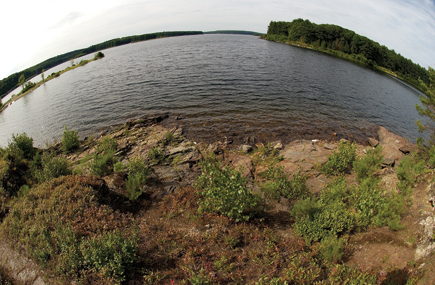
Another unique point of view is provided by the so-called "fisheye"
lens. Nikon's DX series (made for the smaller sensors on their proprietary
D-series cameras) 10.5mm Fisheye is a blast to use outdoors as you can get an
incredible depth of field, from 5.5" to infinity at minimum aperture setting.
The angle of view is 180Þ, clearly a super-wide point of view, even with
the focal length factor from the smaller sensor the digital camera holds. If
you want to eliminate some of the naturally occurring distortion you can do
so with the Fisheye Transform tool in Nikon's Capture program. MSRP is
$815.
 |
|
|
 |
|
|
Get Down
Every photographer tries for that new angle on nature photos. The Kirk Low Pod
is very light, sits on three rubberized feet only 2" from the ground,
has a carrying handle to transport in the field and a 3/8" threaded stud
to mount just about any type of ball head. Current mail-order price directly
from Kirk is $150.
 |
|
|
 |
|
|
Versatile Ball Head
The Really Right Stuff ball head features easy to use friction and control knobs,
twin drop notches, and a choice of four different mounting arrangements (including
a panning clamp) that allow a change out with just an Allen wrench. However,
the unique thing about this ball head is its lower profile, which makes it sit
almost a full 2" below its competitors of the same ilk. It is made here
in the US and has a large 55mm ball with a 50-lb capacity. With a five-year
warranty, list price starts at $455, depending upon model and mount.
 |
|
|
 |
|
|
| |||||||||
|

| ||||||||
- Log in or register to post comments


















 FEATURED VIDEO



Get the Latest Photo Tips, News & Reviews from Shutterbug!






| Camera Reviews Other Reviews | |
Mobile Reviews Photography Reviews Columns | |
News | |
Features | |
How-To | |
Resources |
 © 2024 Shutterbug
AVTech Media Americas Inc., USA
All rights reserved