| |
|
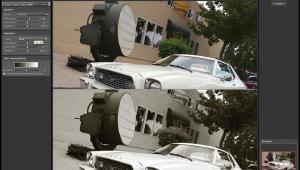
iCorrect 4.0 uses a two-pane ("before" and "after") interface
that makes comparisons and corrections easier for digital
newcomers, such as this comparison of a RAW digital camera
file, with a warmer, more color corrected photograph of
Jennifer L. Groen. |
|
"Nature and books belong
to the eyes that see them."--Ralph Waldo Emerson
All kinds of photographers,
from amateurs to aspiring pros to professionals, are using e-books to
share their vision or sell their services to potential clients. While
Microsoft (www.microsoft.com)
and Adobe (www.adobe.com)
would like you to believe that there is only one--theirs of, course--format
for producing an e-book, the reality is that photographers are successfully
producing them in many ways.
You don't need a Pocket PC
to read an e-book; any laptop or desktop computer will do. That's why
any commonly used visual format will work when you decide to publish an
e-book. After it's created, it can be saved onto a CD-ROM disc or downloaded
from a web site and read by a computer or Portable Data Assistant (PDA).
You can create an e-book using one of many different formats and the decision
about which one to use can have a bearing not only on how easy the e-book
will be to produce but how widespread its distribution will be.
PowerPoint Presentation
Microsoft's PowerPoint is probably one of the easiest formats to use.
Photographers can take images originally created for portfolios or presentations
and by adding a bit of text turn it into an e-book. That's what techies
call "re-purposing." What's more, you can include a free presentation
player on the disc that allows anyone to view your PowerPoint presentation.
Windows or Macintosh players can be downloaded from Microsoft's web site.
The Mac OS version of PowerPoint allows you to save the file in the MOV
(Moving JPEG) format and the resulting file can be viewed with Apple Computer's
free QuickTime player (www.apple.com/quicktime),
but the viewing/reading experience is quite different. Compare the experience
of viewing a presentation with a QuickTime player and a MOV file created
from the same file and you'll see that the images and text have less on-screen
quality than using the full-screen PowerPoint players, which allow you
to see PowerPoint Show files (.pps) at full-screen resolution.
|
| |
|
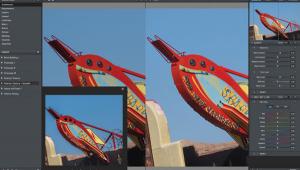
The Bright Colour Wash "Stack" (which includes Simplifier
One, Pure Colour, Edges Colour, Simplifier One (again),
and Bright/Contrast) from buZZ Pro 2.0 was used to produce
this image from an original photograph made with a Minolta
Dimge X at Shutterbug's Digital Photo Workshop in Taos.
©
2002, Mary Farace, All Rights Reserved |
|
PDF Pages
The Mac OS and Windows version of Adobe's PageMaker 7.0 desktop publishing
supports the cross-platform Tagged PDF (Portable Document Format) files
that automatically reflows documents for readability on different kinds
of devices, even at different display resolutions. Publication with other
PDF-enabled desktop publishing software, such as Adobe's PageMaker and
InDesign or QuarkXPress (www.quark.com),
may take more time to produce than using PowerPoint, but the potential
exists for a more design-rich experience. Adobe's free Acrobat Reader
software lets anyone read PDF files and can be downloaded from their web
site and added to the e-book disc itself, making the format accessible
to all platforms in exactly the same visual presentation.
HTML Format
HTML (HyperText Markup Lan-guage) is one of the most accessible formats
and every potential customer already has an Internet browser to read your
e-book, along with navigational aids, buttons, and, don't forget, hyperlinks.
For some potential desktop publishers, HTML may be more difficult to produce,
but there are many ways to use it creatively if you have the knack and
experience. Another clever option is FlipAlbum from E-Book Systems (www.flipalbum.com).
FlipAlbum Professional 4.2 is easy to use and creates stand-alone e-books
whose pages turn like real books. There are several versions of FlipAlbum,
but you'll want the Pro version, which lets you publish CDs for commercial
distribution. You can encrypt your photographs on the disc to protect
them and enable/ disable (your choice) end user printing of the images.
The downside to all of FlipAlbum products is that it limits your distribution
to users of Windows computers.
|
| |
|
Are you tired of sorting through stacks of discs and piles
of jewel cases to find that "one" CD-ROM? KDS' CD Organizer
lets you store and organize all of your CDs (music, DVD,
CD-R, CD-RW, and games) in one easy to access place and
lets you use your computer to find that "one" special disc.
|
|
Plug-In Of The Month
This month's featured plug-in was brought to my attention by Mary Warner
during Shutterbug's Digital Photo Workshop (www.shutterbug.net/workshops)
in Taos. Warner is a terrific photographer with a passion for Photoshop
compatible plug-ins and recommended buZZ (www.fo2pix.com),
a suite of four plug-ins for Mac OS and Windows computers that lets you
turn digital images into "works of art." After coming back from New Mexico,
I downloaded the buZZ Pro package and installed it on the Windows version
of Adobe Photoshop 6.01. The buZZ Pro 2.0 plug-in has a deceptively simple
interface that consists of two dialog boxes: The first has a traditional
interface with sliders and a preview window. The second--called the "Stack"--is
what sets buZZ apart from all the rest and lets you apply multiple effects
to the same file. The 19 effects in buZZ Pro include Simplifier One; Simplifier
Two; Simplifier Three; Blur; Blur More; Bright/Contrast; Directional Blur;
Edges Colour; Edges Mono; Emboss; Gaussian Blur; Pure Colour; Radial Blur;
Radial Screen; Radial Simplifier; Simplifier HSV; Spread Black; Spread
White; and Unsharp Mask. The basic building block effect is the Simplifier,
which lets you remove detail without blurring so you won't lose colors,
quality, shape, or edging. The plug-in ships with 13 preset Stacks, including
Bright Colour Wash, ColouredEdges, ColourPatches, Gloss-Layer, Ink, Neutral
Colour Wash, Oil, and others. You can use the presets or mix any combination
of effects in the stack and even re-order them, while viewing the outcome
in the preview window. When you find something you like, you can save
the combination for future use. The buZZ plug-ins require Mac OS 8.5 or
higher or Windows 95 or higher. You can download a free trial version
from the Fo2PiX web site.
|
| |
|
Microsoft's PowerPoint is the easiest way to produce e-books
and lets viewers interact with your text and photographs.
This page from my "Right in Your Own Backyard" e-book provides
a large image alongside information on how and why it was
made along with specific technical details.
©
2002, Joe Farace, All Rights Reserved |
|
Add Sound To Images
JPEG's mit sound. SoundPix (www.soundpix.com)
offers a suite of products that lets you embed sound directly into any
standard JPEG files at any step along the imaging process. You can do
it at image capture, while editing images, or when publishing images for
the web. The company's software offerings include SoundPix Plus, SoundPix
Sampler, and the SoundPix plug-in. Digital imagers can use SoundPix Plus
and SoundPix Sampler to create audio-enabled JPEG files. To hear the image
sound off, you can use Plus, Sampler, or any application with the SoundPix
plug-in installed. The initial release of the SoundPix plug-in only supports
the Windows version of Internet Explorer.
Get Your CDs Organized
KDS' CD Organizer (www.kdsusa.com)
lets you store and organize all of your CDs (music, DVD, CD-R, CD-RW,
and games) you've got stacked up around the house or office. The CD Organizer
automatically reads and stores disc contents so there's no more stacks
or scattered piles to sort through and jewel cases to look through when
searching for that Rocky Horror Picture Show disc. The CD Organizer software
uses your computer's CD-ROM drive to automatically read and store disc
contents, eliminating manual data entry. After they're stored, you remove
the disc from the CD-ROM drive and place it on the motorized tray that
pops out. The bundled software lets you view the titles of stored discs
on one screen. It also lets you view disc contents (file names and directory
names) on screen. To retrieve a disc, all you do is double-click on a
title from an on-screen list and a tray slides out containing that disc!
To return a disc, double-click the corresponding title on your screen
and place the disc on the empty tray that pops open. If you choose not
to use your computer, the keypad on the top of the CD Organizer tower
allows direct disc access.
Fix Your Images
iCorrect 4.0 is a Windows-only application that costs less than $40 for
the downloadable version. Like all of Picto-graphics (www.picto.com)
other color correction products, you make all of the adjustments to the
file by clicking on part of the image, but unlike the other products iCorrect
4.0 uses a two-pane ("before" and "after") interface that makes comparisons
and corrections easier for digital newcomers. You correct any image's
color by using common reference colors such as Neutrals, Sky Blue, Foliage,
and Skin, and if you don't like what you see, undoes are a button click
away. When an image opens, the program can automatically (it's optional)
set new black and white points. You can also make adjustments to the file's
brightness and contrast using up and down arrows. The only downside I've
discovered is that the program is not compatible with Kodak Photo CD image
files. iCorrect 4.0 is compatible with Microsoft XP and is an indispensable
and inexpensive color correction tool that digital imagers need on their
laptop.
E-Commerce Aid
Electric Logic's WebD71 (www.webd71.com)
is a Windows-based product that generates e-commerce sites for photographers.
The web site that WebD71 produces lets photographs be grouped by thumbnail
and higher resolutions, but all of the high-res files are protected against
download. While the program produces a standard web page, users can customize
its look to fit their wishes. WebD71 doesn't even have to be installed;
you launch it from the CD and can create your new site within 30 minutes.
Once you post client images from an event or assignment, you can give
or e-mail them a PIN number so they can see just their specific photographs,
but are denied access to your other client's images. Check out the company's
web site for demonstrations of some of the e-commerce sites they have
generated using the software.
|