| |
The
Epson PhotoPC 750Z is a new digital point-and-shoot camera
from Epson that combines the high image quality of their
700 model with a fresh body design and a zoom lens.
|
|
One of the things I love
most about photography is its democratic nature. Everyone from "happy
snappers" using recyclable cameras to advanced amateurs to professional
photographers creating images for clients enjoy what I believe is the
most satisfying creative pursuit on the planet. These same users can
have just as much fun using digital cameras as they can film-based cameras.
Far from being monolithic, there are different kinds of digital cameras
available for different kinds of users.
Digital cameras fall into three general categories: point-and-shoot,
field, and studio cameras and backs. The first is the digital equivalent
of familiar point-and-shoot 35mm cameras, where ease of use and low
cost are more important than image quality. If you want to take a picture
of your new baby and include it into a holiday letter, these cameras
do a great job. At the next level are digital field cameras, many of
which are based on single lens reflex 35mm cameras from companies such
as Nikon and Canon. Since field cameras often use the same lenses as
film-based cameras, they are easily integrated into your existing camera
system. That fact alone makes them a popular choice for photojournalists
and other on-location photographers working on tight deadlines. The
ultimate in image quality comes from digital studio cameras and backs,
which are used by advertising photographers who create images based
on an Art Director's sketches. Often these photographs are converted
directly into digital separations for four-color printing. Some studio
cameras must be connected directly to a computer and require high-output
lighting to shorten long image-capture times down to a reasonable few
seconds. These expensive cameras and backs deliver the film-like resolution
needed for advertising, catalog work, and other applications where resolution
is critical.
|
| |
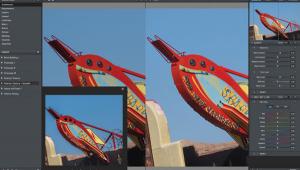
Propeller
is a new Photoshop-compatible plug-in from Nowhouse that
adds new painting capabilities to image-editing programs
like Adobe Photoshop.
|
|
Somewhere between point-and-shoot
and field cameras lies the "bridge" camera. The concept of
a bridge camera is nothing new. Examples abound in film-based cameras
ranging from Nikon's 28Ti to the Contax T2, whose spiritual roots
are found in cameras like the classic Rollei 35. Like their analog cousins,
digital bridge cameras often use a non-SLR design, feature quality lenses,
and offer resolution capabilities similar to some digital field cameras.
If you need relatively high-quality images and a field camera's
price tag seems too high, a bridge camera may be all you need.
For many months I've been using Epson's PhotoPC 700 digital
point-and-shoot camera. The images produced by this modestly priced camera
have been remarkable and have graced these columns--as recently as last
month. What's more, the PhotoPC 700 has the "feel" of
a "real" camera, something often lacking in more expensive
digital cameras. Epson has fixed the only design flaw in this camera with
the introduction of the PhotoPC 750Z with a zoom lens. The 3x glass zoom
lens provides a range of focal lengths equivalent to 34-102mm on a 35mm
camera and provides apertures from f/2.8 to f/8. The highest resolution
available is 1600x1200 pixels and images can be made in 24-bit color or
gray scale. Lower resolutions are available, including high compression
1280x960 pixels that deliver surprising quality when you need to shoot
48 images on the standard 4MB Com-pactFlash card bundled with the camera.
The 750Z's 640x480 resolution mode delivers 164 images in quality
good enough for use on the web. The camera has a built-in flash with a
range of eight inches to eight feet and is compatible with both Mac OS
and Windows computers. It can be used with many Epson ink jet printers
to output images directly from the camera--without using a computer. A
2" LCD color preview screen allows for more precise composition
or to edit the images you've shot. A few seconds after each image
is made, the monitor turns itself off, allowing you to view the photograph
and decide it it's a "keeper." Then the preview screen
shuts itself off to preserve battery life. The 750Z uses four AA Nickel
Metal Hydride (NiMH) batteries, which avoid all the annoyances we've
come to know and hate about NiCds, and Epson includes a neat charger.
For information about the PhotoPC 750Z and Epson's other digital
imaging products, call (800) 463-7766 or visit their web site at www.epson.com.
|
| |
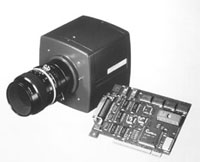
Thomson's
Camelia line of megapixel digital cameras are targeted at
the slide/film scanning, index print production, studio
photography, and scientific imaging markets.
|
|
One of the aspects I like the
best about using digital cameras is the instant feedback they provide
to the photographer. By letting young people see the results of their
efforts in minutes instead of hours or even days, this same feature can
be used to inspire interest in photography. Mattel Media creates computer
products aimed at young girls, something their new Barbie Photo Designer
digital camera is sure to do. With a street price under $70, the camera
has the kind of cute styling you would expect from a camera named after
Barbie, including her trademark pink accent color. Barbie Photo Designer
is designed for use only with Windows computers and can store up to six
photographs. The bundled software lets young photographers import their
photographs and paste them into Barbie postcards as well as their own
digital scrapbooks. Is Barbie that popular? Consider this factoid: Somewhere
in the world, two Barbie dolls are sold every second. For more information
about Barbie Photo Designer digital camera, visit Mattel Media's
web site at www.barbie.com.
At the other side of the spectrum is Thomson's Camelia line of megapixel
digital cameras that are targeted at the slide/film scanning, index print
production, studio photography, and scientific imaging markets. The two
models are based on large format (close to 35mm film size) progressive
scan color CCDs that produce images with 1536x1024 or 1840x1360 pixel
resolution and files in 4.5 or 7.2MB file sizes. The cameras are controlled
through your computer's serial port either in continuous mode or
"frame on request" mode that can be triggered by an external
event or in synchronization with flash or shutter. For more information,
call Thomson at (973) 812-9000.
|
| |
Looking
as cute as its namesake doll, Mattel Media's Barbie
Photo Designer digital camera sports the trademark pink
color and a price point of under $70, making it a great
gift for the young girl in your family.
|
|
It Keeps On Going,
Not. One of the biggest downsides to using digital cameras is
short battery life. Newer cameras have addressed the issue by using NiMH
or Sodium Ion batteries, but LCD preview screens and built-in flashes
gobble batteries faster than a bus load of tourists at a Las Vegas buffet.
Mizco Interna-tional has introduced the new Digi-Power DPS 4000 rechargeable
battery pack that's designed to work with digital cameras from most
leading manufacturers. The DPS 4000 weighs less than 6 oz and its NiMH
batteries provide four times more power than ordinary AA cells. Field
tests conducted with various cameras have shown that the DPS 4000 is capable
of capturing more than 400 high-resolution digital photographs per charge
and the batteries can handle up to 1000 changes. The battery pack costs
less than $40 and includes a leather case that can be worn on a user's
belt. For more information, contact Mizco International at (718) 492-0220.
Ring Around The Flash. S/R Inc. has developed the first ringlight flash
slave for use with digital cameras. The Digi-Slave RF-50 Ring Flash will
work with the Olympus D-600L, D-500L, D-300L, D-200L (and probably the
new D-620L) along with the Agfa 1280 and 1680. Previous ringlight slaves
could not be used with these cameras because they use a rapid double flash.
A standard slave fires on the first flash, while the digital camera captures
the images on the second flash. To solve this problem, the RF-50 is designed
to fire on the second flash making it perfect for macro photography applications.
The suggested retail price of the RF-50 is $249.95. For more information
on S/R products, call (800) 324-7745 or visit their web site at www.cyberramp.net/~srx/flash.html.
|
| |
Mizco's
DigiPower DPS 4000 power pack provides hundreds of full
resolution images for digital camera users before needing
to be recharged.
|
|
You Need Software,
Too. From Down Under comes a software package designed for digital
camera users. IXLA's Digital Camera Suite directly connects with
digital cameras from Casio, Kodak, Ricoh, Epson, HP, Sharp, Olympus, Nikon,
and Fuji. Other camera models are supported via a TWAIN driver that's
included. An Import Assistant guides users through the steps of connecting
a digital camera to a computer, downloading the photographs, then organizing
them into catalogs. A unique feature is the program's ability to
store images back into a camera. The package also lets you create albums,
calendars, invitations, newsletters, greeting cards, as well as presentations
that can include music. A step by step Wizard walks you through the process
of creating your own Internet web pages. The package lets you e-mail digital
photographs anywhere in the world complete with audio, frames, text, and
clip art. IXLA's Digital Camera Suite has an estimated street price
of $29. For more information, contact IXLA at (203) 730-8805 or visit
their web site at www.ixla.com.
Plug-In Of The Month. If you've been envious of
the painting abilities of MetaCreations' Painter program, but haven't
been comfortable with that program's steep learning curve, you can
use Nowhouse's Propeller to add increased painting capabilities
to any image-editing program that accepts Photoshop-compatible plug-ins.
Like Painter's Image Hose feature, Propeller gives you a practically
unlimited supply of interesting brush styles and effects. As you paint,
patterns can be warped along a curved path, producing a fluid stroke that
looks and feels different than traditional painting programs. Propeller
is easy to learn and use and comes with a collection of built-in patterns
or you can add your own by using any PICT, PNG, or TIFF file. The plug-in
supports patterns that have alpha-channel transparency and you have full
control of stroke speed, direction, and all brush properties. To get the
most out of the plug-in, Nowhouse recommends a graphics tablet or pen-based
input device. Propeller supports Photoshop 3.0.4 or later (4.0 or later
is recommended) and works with either Macintosh or Windows platforms.
This spiffy new painting plug-in costs $59.95. For more information about
Propeller, visit Nowhouse's web site at www.nowhouse.com.
|
| |
Want
to add a ringlight flash slave to your digital camera? S/R
RF-50 Ring Flash will do the job.
|
|
Speaking Of Graphics
Tablets. Wacom Technology Corp. just introduced a new line of
five graphics tablets and four input devices with unique capabilities.
The Intuos 4D Mouse is the first pressure sensitive ambidextrous mouse
that features a thumbwheel control for zooming, navigating, and shuttling
videotape. The Intuos Airbrush is a digital airbrush that is equipped
with a pressure sensitive pen tip for controlling height and a pressure
sensitive fingerwheel for controlling ink flow. The Intuos Lens Cursor
is the first with a rotating crosshair lens making it easier to use in
CAD applications. All of these tools are designed to be used with an Intuos
graphics tablet. The new Intuos tablets have been redesigned and feature
doubled tip sensitivity, 1024 levels of pressure, and a new 9x12"
size. Tablets are available from the (mostly useless) 4x5" size
up to 12x18" for the serious graphics tablet users. For more information,
call Wacom at (800) 922-6613 or visit their web site at www.wacom.com.
How Much Is That Stock Photo Of The Doggy In The Window?
When I opened my studio, I used to get calls from other photographers
asking how much to charge for stock photographs. Now when someone calls,
I refer them to Cradoc's fotoQuote software. FotoQuote provides
access to over 2000 prices in over 140 categories and contains everything
you need for pricing and selling stock images. All of the data, from a
working price range for a specific sale to guidance on how to get your
price, is available on one screen. FotoQuote is available in Windows and
Mac versions and lets you print a quote as a fax cover sheet or on your
own letterhead. Cradoc recently shipped Version 3.0 which contains prices
based on actual sales records from national stock agencies and photographers.
A new RightsWriter feature builds a licensing agreement by selecting terms
from pull down menus and allows a license description to be automatically
added to your quote. FotoQuote 3.0 includes 30 electronic categories including
web banner ads, editorial and advertising photos on the Internet, CD ROMs,
electronic brochures and catalogs, in-store point of purchase kiosks,
and online corporate annual reports. Other categories include stock photo
sales to the music and sports industries and still photos for documentary
and feature films. A "Sales Coach" provides advice to sellers
depending on each sale's circumstances. The program displays prices
in international currencies including US, Canadian, Australian and New
Zealand dollars, British pounds, French francs, German marks, and the
new Euro. For more information about fotoQuote call (800) 679-0202 or
visit their web site at www.cradoc.com.
USB: It's A Beautiful Thing. Just as a camera system includes
more than lenses and camera bodies, a computer system is composed of unsung
hardware that helps us with our digital imaging. Your computer needs ports
to connect digital cameras, scanners, and other imaging peripherals, and
implementation of the Universal Serial Bus (USB) standard is going to
profoundly affect all digital imagers. More and more scanners are using
USB connections and I expect to see digital cameras break away from the
slower serial connection most of them use now. Hagiwara Sys-Com recently
introduced its SmartMedia Reader/Writer, a USB-based peripheral for transferring
data from the SmartMedia cards used by many digital cameras directly to
USB-equipped computers at speeds of up to 12MB per sec. A SmartMedia card,
which resembles a Wheat Thin more than their makers would like to admit,
is the thinnest and smallest type of flash memory card and is available
in sizes from 2-8MB. These cards are about 1/3 the size of a credit card,
and just as thin. SmartMedia uses a single EEPROM (Electrically Erasable
Programmable Read Only Memory) chip embedded in the plastic to read and
write data. SmartMedia Reader/Writer supports both 5V and 3.3V SmartMedia
cards and requires no external power supply. The device is plug-and-play
compatible with Windows 98 and Windows NT Version 5.0. Mac-heads will
be glad to know that it also works with Mac OS Version 8.1 or later. For
more information, contact Hagiwara Sys-Com at (619) 546-9989 or visit
the company's web site at www.hscus.com.
Looking to add USB capability to your computer? Keyspan recently released
an entire line of USB products for Windows and Mac OS-based computers,
including Apple's iMac. The Keyspan USB Hub provides four powered
USB ports for connecting USB devices to the iMac or any USB-capable computer.
The Keyspan USB PCI Card provides a low-cost USB upgrade for Power Macintosh
or Windows 98 computers that don't already have an USB port. This
upgrade makes it easy to connect a Mac or PC to new USB devices including
disk drives, joysticks, scanners, graphics tablets, modems, cameras, printers,
and telephone products. The Keyspan USB Serial Adapter provides a way
to connect existing Macintosh serial devices--including graphics tablets,
PDAs, and serial printers to the iMac's USB port. Unlike some single
port solutions, Keyspan's adapter features two serial ports. For
more information on Keyspan's USB products, visit their web site
at www.keyspan.com.
|