| |
I
was just about to make a picture of this Shetland Sheepdog
dressed as a pioneer woman--bonnet and all--when
the owner reached over into the frame to adjust the
bonnet and added a spontaneous element to the image
that would not have been there had I captured it just
a moment sooner. (Image was captured on Konica Centuria
400 film using a Konica Hexar camera and 35mm lens.)
Photos © 2002, Joe Farace, All Rights Reserved
|
|
"Are you telling
me you built a time machine out of a DeLorean?...The way I see it,
if you're gonna build a time machine into a car, why not do it
with some style."--Back To The Future movie dialog
This banter between Marty McFly and Doc Brown was going through my
head when I picked up a Konica (www.konica.com)
Hexar camera and went out to photograph an annual Halloween costume
contest--for dogs. If you haven't already figured it out,
the Hexar is a manual focus, rangefinder film camera and about as far
away in design from any camera I've used in a long while. But
on this sunny October day I decided to play Cartier-Bresson and mounted
a 35mm Hexanon lens with its way cool slotted lens hood onto the camera
and set out to capture a few doggy decisive moments.
You see, I was searching to recreate that most special part of a photographer's
life; that first magical phase when each print handed back to me by
the person at the counter was a pleasant surprise. The Hexar provides
no instant feedback; no LCD panels, not even autofocus, but it's
a finely crafted instrument and just plain feels good in your hands.
What's more its understated looks make the ideal "stealth"
camera for capturing truly candid moments where people (the dogs are
always at their best) don't have on their "photo faces"
because I was photographing their pets and not them. Images from the
Konica Centuria color negative film I used were digitized with an Epson
(www.epson.com) Expression
flat-bed scanner (with TPU) and printed on Konica's QP Professional
Glossy ink jet paper for "real" photographic quality output.
Working with the Hexar was a great experience, and one I hope to repeat
real soon.
|
| |
|
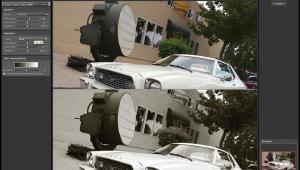
When using iCorrect Professional 4.0, getting the color
right is usually a simple matter of selecting from the built-in
memory colors--foliage, in this
case--and clicking on the grass immediately behind
this classic hot rod to produce one-click color correction.
|
|
Plug-In Of The Month
One of my favorite ways to color correct digital images is with Pictographics
(www.picto.com) iCorrect
Professional. Well, those Burnsville Boffins have gone and created an
even better version--for the most part. Pictographics International
released Version 4.0 of iCorrect Professional, a color correction plug-in
for Adobe Photoshop and compatible programs that's been optimized
for Apple's Macintosh OS X and Microsoft's Windows XP operating
systems. Version 4.0 includes a larger selectable image viewing area,
a preview mode that lets you quickly compare the corrected image with
the original, and an enhanced interface for modifying and creating new
memory color definitions, such as the "foliage" shown in the
example.
With just one or two clicks of the mouse, iCorrect quickly improves the
tonal range, removes unwanted colors, and corrects for pre-defined "memory
colors" including skin tones, green foliage, and blue sky. These
global corrections instantly adjust the colors within the defined color
space. You can edit the default memory colors to create your own for specific
company logos, uniforms, or backgrounds. Picto's Wayne Huelskoetter
told me that the "Version 4.0 interface makes it even easier to
achieve the desired result," but for some reason the Command X (for
Undo) keystroke combination that worked in previous versions does not
work in this new version when using Mac OS 9.2. (I'm not yet ready
to make the jump to OS X, but that's a story for another time.)
The color transform created with iCorrect Professional is linked to Photoshop's
RGB working color space so it's within a profiled, device-independent,
reference color space and the final image is ready for use in color-managed
workflow. iCorrect Professional 4.0 costs $79 and is compatible with Photoshop
5.0, 6.0, and 7.0 and Elements 1.0 and 2.0 for Mac OS 8.6, 9.2, and 10.1
and 10.2 in Native and Classic modes and Windows 98, Me, 2000, and XP.
|
| |
|
Morpheus 1.82 and Morpheus 1.82 Pro software lets you create
photo animations, graphics, presentations, movies, and greetings.
The current Windows-only version of the program supports
Flash, Animated GIF, AVI, and other popular formats for
morphing and warping photos, images, and movies.
|
|
Morph Me Up, Scotty
There was a time when everybody had to have some kind of morphing software
on his or her computer but styles change and the morphing technique from
Terminator 2 has faded from fashion. I'm happy to report it's
back! In case you missed that part of the movie, morphing is a graphics
technique that blends two different shapes over a short period of time.
A sequence might start with an image of a cartoon penguin, for example,
and over time the image gradually metamorphoses in Kafka-like fashion
into, say, a real penguin.
Morpheus 1.82 and Morpheus 1.82 Pro (www.morpheussoftware.net)
lets you create photo animations, graphics, presentations, movies, and
greetings. The current Windows-only version supports Flash, Animated GIF,
AVI, and other popular formats for morphing and warping photos, images,
and movies. While designed for the average user, Morpheus has advanced
features for more advanced uses as well, including the ability to view
morphs frame by frame as they are being created, thus enabling frame-by-frame
adjustments. You can also share any of your morphs with friends, family,
and colleagues. Morpheus 1.82 and Morpheus 1.82 Pro are available through
the company's web site for $9.95 and $39.95 respectively. Where
else can you have so much fun for less than $10?
|
| |
|
The KDS RAD-9 is a 19" LCD flat panel that delivers
superb image quality but carries the modest price tag of
$699. Out of the box at its native 1280x1024 resolution,
the RAD-9 produces acceptable color for business and general
computing but after calibration, it went from very good
to spectacular.
|
|
A Really Big Monitor At
A Really Great Price
The KDS (www.kdsusa.com)
RAD-9 is a 19" LCD flat panel that delivers superb image quality
but carries the modest price tag of $699. KDS says that the RAD-9 is designed
for the business professional, but it makes a darn good photographer's
monitor, too. Out of the box at its native 1280x1024 resolution, the RAD-9
produces acceptable color for business and general computing.
I hooked up a Pantone (www.colorvision.com)
ColorVision Spyder and used its bundled OptiCAL software to quickly calibrate
the monitor. This software is easy to use and by simply following the
on-screen instructions, the display went from very good to spectacular
within a few minutes. Interestingly, the same hardware/software combination
was unable to produce acceptable color on my Apple (www.apple.com)
15" LCD Studio Display, which is fabulous out of the box using its
preprogrammed settings. All of the Mac OS consultants, including Mac MD's
(www.macmdcare.com)
Kevin Elliott, that I've discussed this anomaly with have verified
my experience, not just with Apple LCD desktop screens, but their laptops
as well.
The 19" RAD-9 offers a sharp 0.294mm dot pitch and can display 16.7
million colors for high quality color imaging. The monitor is equipped
with both analog and digital inputs and an advanced on-screen control
system. The styling is slick and the soft silver gray finish complements
my Power Mac G4, which it worked with in true plug-and-play fashion. The
RAD-9 is Windows compatible and will work with all of the recent versions
of the operating system. What's more, it is, like all of KDS USA's
monitors, backed by a three-year limited parts and labor warranty in addition
to the KDS Advanced Replacement Expressed Service (KARES) program that
replaces a customer's defective product with another monitor in
advance of receiving the item.
|
| |
|
Rollei's d330 Motion is a stylish 3.34-megapixel digital
camera with an f/2.8D-VarioApogon HFT autofocus zoom lens
with focal lengths equivalent to 38-80mm in 35mm format. |
|
From Planet Rollei
I may have been a little tough on Rollei's (www.rollei.de)
digital cameras in my photokina report (December 2002 issue), but their
new digicam looks like something I've been asking every manufacturer
to make. Like Canon's Digital Elph, it's a real live digicam
that looks like a classy-looking film camera. The Rollei d330 motion is
a stylish 3.34-megapixel digital camera with an f/2.8D-VarioApogon HFT
autofocus zoom lens with a focal length equivalent to 38-80mm. Autofocusing
is possible over a range from 15.75" to infinity, with a macro setting
to 2.36". It has a real optical real-image viewfinder and a 1.5"
LCD preview screen. The camera features single-frame and continuous-shooting
modes, exposure compensation over ±2.5 EV as well as autoflash
and fill flash. White balance can be performed either automatically or
manually.
The Rollei d330 motion also makes video clips up to 60 seconds and a resolution
of 320x240 pixels. Photographs and video clips can be stored in the camera's
internal 8MB memory or an SD memory card. Mini-USB and video interfaces
are provided for data transfer. During data transfer to the computer,
power is supplied via the USB port so that no AC power adapter unit is
required.
|