| |
Use
Extensis' Intellihance Pro 4.0 plug-in to bring
out the best of your black and white images. Here a Pro
Photo CD image of a Kodak Tri-X 6x6 negative is enhanced
using the plug-in's built-in Photo CD preset.
Photos © 1999, Joe Farace, All Rights Reserved
|
|
There is a popular misconception
that digital imaging is limited to color photography. That's simply
not true. Digital imaging embraces all the same aspects of color--or
lack of color--that conventional photography does. Part of this lack
of understanding boils down to semantics. In computer terms, "black
and white" means there are just two colors in an image--black
and white--so the term "gray scale" is typically used to
describe a graphic image containing continuous monochromatic tones.
Photographers usually refer to monochrome prints as black and white
and computer users prefer the term gray scale, so I'll use both
terms interchangeably.
There are many different ways in which you can work with black and white
digital images. You can start with a black and white print or negative
that's been digitized using a flat-bed or film scanner. Some digital
cameras even have a black and white image capture mode that lets you

make a photograph in gray scale mode, almost as if you had black and
white film loaded in a conventional camera. You can also have your existing
black and white negatives digitized using Kodak's Photo CD process.
Tools Of The Trade. One approach for creating black
and white digital images is to convert an exiting color photograph into
gray scale. The simplest way to accomplish this is to use the Mode command
found in image-editing programs like Adobe Photoshop and select gray
scale instead of RGB (Red, Green, and Blue), which removes all of the
color from the photograph. This process sounds simple, but if you've
ever tried to tune your television to take color out of a colorized
movie so you could see it the way it was originally made, you know that
the result is often flat and boring--more gray than black and white.
Similarly, black and white digital photographs created from color originals
are rarely perfect in their "raw" state. You need a way
to translate those black and white images into the way you want them
to look, much as you would in a traditional darkroom.
|
| |
This
old photograph showing the author's grandmother swimming
with some friends was restored by scanning with the Epson
Perfection Scanner and tweaking in Adobe Photoshop.
|
|
For Photo CD images, you can
use Kodak's free Photo CD Acquire Module to acquire the image--even
if it's originally in color--and convert it to gray scale as it's
being opened. When working with Photo CD images made from original black
and white negatives, there are some differences in the process. When you
open an original gray scale Photo CD image it will not be in gray scale
mode. Instead, it will be in the RGB format it was scanned in. This means
you can immediately experience a savings in file size when converting
it to gray scale. For example, a 4096x6144 Pro Photo CD image takes 72MB,
but when converted to gray scale it drops to 24MB. If the image was shot
in the 4x5 format, like some of the examples in this story, the file size
drops another 3.5MB when you trim the black edges off the initial scan.
This means you can squeeze the maximum quality out of a large format Pro
Photo CD scan and still save the file in just 20.5MB of hard disk space.
The best way to open a color Photo CD image, convert it to gray scale,
and extract the maximum image quality is to use LaserSoft International's
SilverFast Photo CD Photoshop compatible plug-in. You can use this plug-in
to select, convert, and tweak the image before it's opened by your
image-editing program. Start by choosing the Scan Type that includes a
choice of color or gray scale. When you select the photograph you want
to open, the plug-in does a pre-scan, and a large thumbnail of the image
is placed in a preview window. Dotted lines automatically appear and you
can click and drag them to crop the image exactly the way you want. You
have two ways of working with the plug-in: autopilot or manual. To let
the plug-in do all the work, use the Image Type pull down menu to select
the type of corrections SilverFast can make. In addition to Standard,
there are Landscape, Skin Tones, Gold Tones, Technic, Evening, Snow, Night,
H-S Cast, Highlight Cast, and Shadow Cast. Instead of waiting until the
image is opened to apply unsharp masking, you can also apply it within
the plug-in. Since sharpness is related to image size and resolution,
make sure you set output size and output screen of the image before using
Unsharp Masking controls, which are much more extensive than Photoshop's.
As I was completing this story, the plug-in's list price was lowered
to $276.
|
| |
The
IPC Photographic Filter's plug-in was used to convert
this color image into black and white. Then the sliders
can be used as if you were applying color filters to a camera
lens.
|
|
One of my favorite tools for
overcoming the problem of working with color images converted to gray
scale is another Photoshop compatible plug-in called Intellihance Pro
4.0 by Extensis. At its basic level, Intellihance Pro lets you visually
adjust the image's sharpness and contrast. It will also find and
eliminate any dust spots and scratches from your digital image and remove
them without blurring or destroying detail. Intellihance Pro 4.0 ships
with 25 presets--including Photo CD and "digital camera"--that
let you automatically apply a set of corrections appropriate for the source
and these settings can be adjusted further to suit your vision. The plug-in
has a list price of $199.95 and is available for the Mac OS, Windows 95/98,
and Windows NT 4.0.
A less expensive approach uses a photographic rather than computer approach.
The Independent Photogra-phers of Colorado have produced a package of
26 plug-ins that work with any Windows or Macintosh program that accepts
Photoshop compatible plug-ins. What makes the IPC filters different is
that they emulate standard photographic filters within a digital format.
For example, in the set you'll find: 1A, 80A, 80B, 80C, 80D, 81,
81A, 81B, 81C, 81D, 81EF, 82, 82A, 82B, 82C, 85, 85B, 85C, as well as
CFA, CFB CFD, for images shot under florescent lighting. The plug-ins
also include some unique filters--a "Synthetic Polarizer,"
Arial Photography Compensation Filter, Synthetic Sepia and (sic) Ciba-Chrome,
and--ta da--a "Color to Filtered Panchromatic" filter. This
last filter converts the image to gray scale and lets you place the digital
equivalent of a color filter over your image before it's rendered
as a black and white photograph. This filter works the same way, as you
might expect, when using conventional filters in front of a camera lens.
The package costs $35 for non-members. You can learn more as well as see
before and after images by visiting their web site at: ourworld.compuserve.com/homepages/jrapple_LOV/ipc.htm.
|
| |
LaserSoft
International's Photo CD plug-in provides the ultimate
way to acquire a Photo CD image, convert it to gray scale,
and perform an Unsharp Masking--all at the same time.
|
|
Restoring Family Memories.
One of the most fun digital imaging projects I know of is restoring old
black and white photographs. Several years ago, my sister gave me an old
negative of a family snapshot. I filed it safely away and didn't
find it until recently. It looks like a cut negative made with a rollfilm
camera and the image area measures 51/2x33/16". The negative shows
several women swimming wearing bathing suits that have the look of 1920s
fashion. Lately, I've been testing Epson's new Perfection
636 flat-bed scanner with the optional transparency unit that lets various
film formats be scanned at up to 2400dpi optical resolution. The scanner
is $299 and the film unit costs $99, making the Perfection 636 one of
the lowest cost ways I've found for scanning medium and large format
film. The transparency unit is packaged with carriers for 4x5, roll film,
and 35mm film, but my negative measured almost 53/4" edge to edge,
so I just let part of it hang out of the recessed film area. Epson includes
a TWAIN driver that's a "Lite" version of LaserSoft
International's SilverFast scanning software that works with Adobe
Photoshop or any image-editing program that is TWAIN compliant--and that's
all of them. Even with part of the negative hanging out, the scan worked
fine and the digital image opened in Photoshop.
I used the Intellihance Pro 4.0 plug-in to tweak the image's brightness
and contrast, along with the plug-in's "Dust and Scratch"
filter to minimize the abuse this unprotected negative had acquired over
the years. Next, I used a small, soft-edged brush from Photoshop's
Brush palette to spot the white dust spots that were on the people's
faces. To take care of two large defects in the emulsion, I used Photoshop's
Lasso tool to select a portion of the background that was near the damaged
area. Then I pasted these digital "rocks" over the defect
and used the Water Drop tool to smooth the edges of the pasted-on area.
I didn't want to cleanup every visual defect the negative had because
I felt that some of the damage added a patina of wear that befits an 80-year-old
negative. To wrap up the restoration process, I used Sepia Action to give
the image the kind of brownish sepia tone that most people expect to see
in an old photograph. The freeware Sepia Action file was downloaded from
The Action XChange web site at: www.actionxchange.com.
|
| |
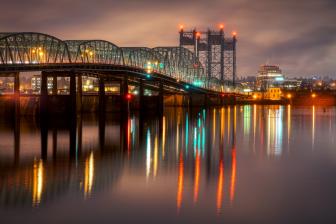
The
original color slide was transferred to Photo CD, then acquired
and converted to black and white with LaserSoft's
Photo CD plug-in. The image was rotated 11/2° and tweaked
using Adobe Photoshop Auto Levels command.
|
|
Black And White Output.
You would think that getting good black and white output from a color
printer would be easy and it can be--but not always. For example, some
dye sublimation printers have a slight cyan bias that may be hard to see,
but when you print a black and white image, the color shift will be immediately
apparent. Most ink, but not all, ink jet printers seem immune to this
problem, while most dye sublimation printers can be affected by it in
some way. One exception is the Alps MD-1300 that uses Micro-Dry ink ribbons
and a four pass technique to produce remarkable black and white (and color)
images on the company's photographic paper. The photo quality ink
set includes an "overcoat" ribbon that produces a protective,
semigloss finish on Alp's photographic paper, which has a weight
and feel similar to a "real" photograph.
As good as your color printer may be, sometimes a gray scale image will
be output with a slight color shift. In those cases, you'll need
to correct the image to achieve a neutral print. Until recently, the only
way to produce color test strips with your computer was to make your own.
All that's changed with the introduction of a Photoshop compatible
plug-in from Vivid Details called Test Strip. Available for Mac OS and
Windows systems, Test Strip can produce horizontal or vertical test strips
that can match the shape or design of your photograph or artwork. The
plug-in lets you interact with the correction process by clicking on the
strip displaying a reduced (or increased) amount of color or density.
You can remove color casts by selecting the opposite color on a color
wheel. Test Strip maintains a Task List that records and displays all
of the color corrections you have made. You can save all of your corrections
as a set, so you can apply the same corrections later on. One of Test
Strip's best features is the ability to save one of its views as
a file and print it on any output device, so you can see the effect of
your on-screen corrections. While not specifically designed just to take
the color shift out of black and white images, if you use Test Strip to
match your monitor color to your printer, all of your color output will
look correct, too. Test Strip has a list price of $149.
Manufacturers/Distributors
Adobe Systems Inc.
345 Park Ave.
San Jose, CA 95110
(408) 536-6000
fax: (408) 537-6000
www.adobe.com
Alps Electric (U.S.A.), Inc.
3553 N First St.
San Jose, CA 95134
(800) 825-2577
(408) 432-6000
fax: (408) 432-6035
www.alpsusa.com
Epson America Inc.
20770 Madrona Ave.
Torrance, CA 90503
(800) 289-3776
(800) 463-7766
(310) 782-0770
fax: (310) 782-5220
www.epson.com
Extensis Corp.
1800 SW First Ave., Suite 500
Portland, OR 97201
(800) 796-9798
(503) 274-2020
fax: (503) 274-0530
e-mail: info@extensis.com
www.extensis.com
LaserSoft International, Inc.
6529 Gulfside Rd.
Longboat Key, FL 34228
(941) 383-7496
fax: (941) 387-7574
www.lasersoft.de
Vivid Details, Inc.
8228 Sulphur Mountain Rd.
Ojai, CA 93023
(805) 646-0217
fax: (805) 646-0021
www.vividdetails.com
|