


- REVIEWS
Camera Reviews 
More Reviews Mobile Reviews Photography Reviews - GALLERIES
- VIDEOS
- BUYER'S GUIDES
Contemporary American Photography In Germany; 7th International Photo Days In Mannheim/Ludwigshafen
Larry Fink's "Forbidden Pictures: A Political Tableau 2005" was one of the highlights at the biggest German photo exhibition "7th International Photo Days," which was located in the cities of Mannheim and Ludwigshafen.
 |
|
|
The Larry Fink exhibition was a major part of a show entitled "Contemporary
American Photography." Around 100 American photographers took part in
this event, the biggest exhibition of contemporary American photography shown
in Europe in memory. The exhibition showed a broad range of styles, themes,
and concepts from the American photographic scene.
"Contemporary American Photography" was arranged by the Cologne
gallery owner Tina Schellhorn, who not only wanted to show the visitors a photographic
viewpoint but also let them see an interesting mixture of American lifestyles,
one that often confirmed prejudices but also broke a few myths.
 |
|
|
Schellhorn became acquainted with many of the photographers at photo exhibitions
in Portland and Houston. "The greatest thing for me was that many of the
American photographers came to our Photo Days on their own account and were
always willing to help with workshops and seminars. German photographers are
much more complicated," she said.
Among the shows within the show that met critical acclaim was that of Alejandro
Tomás. His series, entitled "Los Ranchero Visitadores," documents
a gathering of the rich and famous at a cowboy convention, a world that was
quite new to the German audience. Similar work was shown by Dave Anderson, who
took pictures in the rural city of Vidor, Texas, where he highlighted activities
of the Ku Klux Klan.
 |
|
|
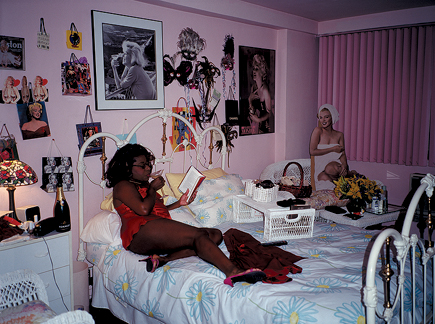
Another side of American vision was Lili Almog's "Bed Sequence,"
a portrayal of women between 18 and 76 years old. Lauren Greenfield's
"Girl Culture" showed young girls under the influence of the media.
The themes of the festival ranged from current documentaries on problems like
AIDS and environmental damage to essays on social development in the countryside
and cities to political satire. Well-known photographers like Steve Hart, Alex
Webb, Jeff Mermelstein, and Benedict J. Fernandez were also shown, as well as
newcomers to Europe such as Dan Nelken and Maggie Taylor.
 |
|
|
In addition to the exhibition of "Contemporary American Photography"
was a second major themed exhibition called "The Art of Being German."
This show was arranged by Hansjoachim Nierentz, the head curator and organizer
of the entire festival. It featured internationally recognized photographers
from Germany, including Bernd Arnold, Regina Schmeken, and Herlinde Koelbl,
famous for her critical images of German political and social life. Many new
young photographers also debuted their work, with many being vignettes of German
living rooms, kitchens, clubs, or public spaces, each of which showed a side
of Germans and Germany itself.
| |||||||||
|

| ||||||||
- Log in or register to post comments











 FEATURED VIDEO



Get the Latest Photo Tips, News & Reviews from Shutterbug!






| Camera Reviews Other Reviews | |
Mobile Reviews Photography Reviews Columns | |
News | |
Features | |
How-To | |
Resources |
 © 2024 Shutterbug
AVTech Media Americas Inc., USA
All rights reserved