


- REVIEWS
Camera Reviews 
More Reviews Mobile Reviews Photography Reviews - GALLERIES
- VIDEOS
- BUYER'S GUIDES

Classic Cameras; Leitz ELDIA And NATRA; The Lowest Price Leica Collectibles?
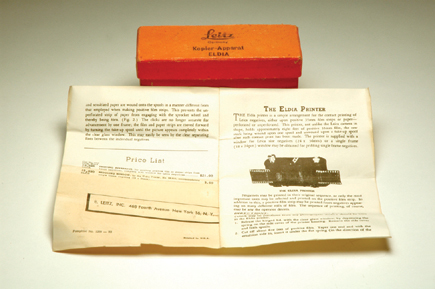
It's made to use with your classic Leica; it's a long-established accessory, first introduced in 1931; it's in gorgeous black wrinkle paint, exquisitely engraved with the E. LEITZ WETZLAR logo; there's a beautiful red safelight glass built into the back; it's in mint condition; it's boxed, with instructions; when it was new, probably 50 years ago, it was $21; and if you could get $75 for it today, you'd be doing well. It's an ELDIA Kopier-Apparat.
 |
|
|
The name probably comes from Ernst Leitz (EL) DIApositiv (diapositives being slides). This makes quite a lot of sense compared with many Leica five-letter telegraphic ordering codes. Anyone for NOOKY, SOOKY, and FISON? NOOKY is a near-focusing device for 5cm Elmars; SOOKY, the same for 5cm Summicrons; and FISON, a variety of lens hood. There were some easy ones, though: ELMAR was indeed the immortal 50mm f/3.5 Elmar and EKURZ was a short (kurz) Elmar, the 35mm f/3.5.
To return to ELDIA, as its name suggests is a contact printer for filmstrips (using slow "ordinary" film, blue-sensitive only) or paper contact prints. The original idea was to shoot negatives; contact-print them with the ELDIA; and then carefully bind them between glass, with a thin, sheet-metal Leica mask and passe partout tape.
 |
|
|
ELDIA first appeared in '31, with a prominent fork beside the window; the earliest models had a detachable pressure plate. By '32 the catch was integral with the swung section, but the finish was still black and nickel. It is not clear when the black and chrome version came in, but it was probably after World War II; this is the sort illustrated. There was a wartime version from E. Leitz, New York and there was a gray and chrome version from Kindermann as late as '71. There was also a glass-plate version in '33, for contact printing 35mm on tiny 2x2" glass plates, but I have never seen one of these although I have a couple of boxes of Kodak plates.
 |
|
|
The big drawback with an ELDIA, even if you can be bothered to go through the rigamarole of using one, is that they are among the most impressive dust-magnets imaginable. You need a spotlessly clean original negative; spotlessly clean copying film; and spotlessly clean upper glass pressure plate on the front. Fail in any of these, or introduce dust or dirt at the processing stage, and you are guaranteed huge black or white blobs, or both, on your projected slide.
Normally, this is a recipe for collectability: accessories that weren't much use are usually pretty rare, which means that collectors adore them. ELDIA is the exception. They actually were fairly useful, principally for producing lecture slides cheaply and easily: as anyone who sat through film-strips in the '50s and before will remember, quality was rarely a primary consideration.
 |
|
|
As a result, they are far from rare. Or maybe they are, and it's just the same few that constantly change hands at very low prices. Either way, nobody loves them very much. The one illustrated here is probably worth $75 because of the box and the rather rare Leitz, New York instruction book. I might even get $75 without the instruction book from a victim who didn't know how common they are, but ELDIAs usually go for between $25 and $45, which must make them the lowest-priced classic collectible Leica accessory in the world.
| |||||||||
|

| ||||||||
- Log in or register to post comments























 FEATURED VIDEO



Get the Latest Photo Tips, News & Reviews from Shutterbug!






| Camera Reviews Other Reviews | |
Mobile Reviews Photography Reviews Columns | |
News | |
Features | |
How-To | |
Resources |
 © 2024 Shutterbug
AVTech Media Americas Inc., USA
All rights reserved