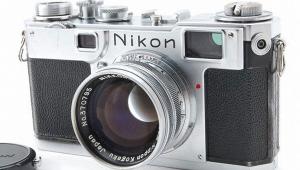
7s with Dream lens, starting bid £2750. Ended with no bids.
Have prices suddenly risen or is someone desperately optimistic?
Item No. 271160902368
| Camera Reviews |  |
More Reviews | |
Mobile Reviews Photography Reviews |
In 1961, when the Canon 7 was introduced, its revolutionary new standard lens was advertised as being four times brighter than the human eye. How such a thing could be measured is somewhat questionable, but what is undoubtedly true is that the lens was a lot bigger, and with a much wider aperture, than had hitherto been seen on a 35mm camera.
This was the now legendary 50mm f/0.95, a bunch of optics that became known as the Canon Dream Lens. It was a huge chunk of glass whose lens cap had a diameter of 75mm and, at a time when most rangefinder camera standard lenses had filter threads of perhaps 40-50mm, this one boasted a whopping 72mm.
 |
|
|
The camera was the first from Canon with a built-in meter coupled to the shutter control. The meter was a selenium type, whose larger than usual cell took up the best part of half the width of the body. There was a 10-second delayed action control and flash photography was covered by FP- and MX-type sockets.
Pressing a small stud on the back of the camera allowed the film speed, of between 6 and 400 ISO, to be set in a window contained in the shutter speed dial. As the dial was then rotated to choose the required speed, so an aperture scale in a window on the top plate moved in tandem. A needle in the window, powered by the selenium cell, moved across the scale, and the indicated aperture was set manually on the lens. There were two color-coded scales: orange for high-sensitivity light values of 6-13, white for low-light values of 12-19. The meter's sensitivity was changed by a tiny knob on the back of the body.
Looking through the viewfinder when the Dream Lens was fitted, photographers found its huge diameter obscured a good part of the view in the bottom right-hand corner. The obstruction also partially obscured the actual field of view, for a 50mm focal length, shown by a parallax-corrected suspended frame.
One way around that problem was to fit a separate Canon 50mm viewfinder, which incorporated a parallax adjustment, but that idea was hampered by the fact that the camera had no accessory shoe. To get around that little difficulty photographers had to buy the special Canon Accessory Coupler, which fit to the top plate and added an accessory shoe to the camera.
The viewfinder cutoff was not apparent when using lenses other than the Dream Lens. For these, viewfinder frames could be selected by turning a selector knob in the top plate for 35mm or 85mm and 100mm, the last two appearing together.
 |
|
|
Depth of field from the Dream Lens at its larger apertures was obviously shallower than usual. In fact, the scale around the lens had only one designation for f/0.95, rather than the usual two on each side of the focus point, and when using that aperture depth of field at 10 ft was no more than 2".
| |||||||||
|

| ||||||||
COMMENTS
7s with Dream lens, starting bid £2750. Ended with no bids.
Have prices suddenly risen or is someone desperately optimistic?
Item No. 271160902368
FEATURED VIDEO









| Camera Reviews Other Reviews | |
Mobile Reviews Photography Reviews Columns | |
News | |
Features | |
How-To | |
Resources |
 © 2024 Shutterbug