


- REVIEWS
Camera Reviews 
More Reviews Mobile Reviews Photography Reviews - GALLERIES
- VIDEOS
- BUYER'S GUIDES

Business Trends
The Spontaneous Eye
An Interview With Miami-Based Robin Hill Page 2
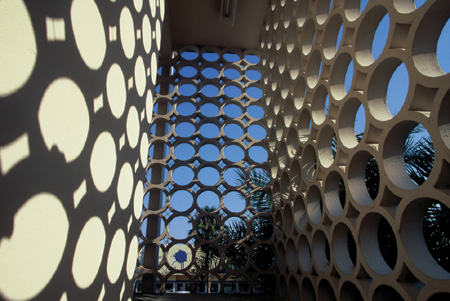
RH: The directional change was going from travel or architectural photography and fine art being separate to architectural photography and fine art combined. I was shooting fine art all along but not crossing over into the architectural assignment client work. The clients I have now (the architects) not only hire me for architectural photos of their buildings but also buy prints to hang on the walls of the buildings they were designing.
 |
|
|
SB: How did your
various interests work together to combine different markets for photography
in order to make one very good one?
RH: I was always interested in all sorts of things--especially
dance, art, jazz music--and the challenge was to find a market for my various
interests. I had to find a market for what I wanted. If you look at classic
architectural photography you might notice that all photographers go about it
in a similar way--my style is about improvisation and spontaneity. The
MiMo architectural project gave me the opportunity to bring all my interests
together into one.
 |
|
|
SB: How did the
architectural work for MiMo cross over to fine art?
RH: "Art Basel" in Switzerland is one of the biggest
and most prestigious art fairs and it started coming to Miami Beach. Their executive
director picked one of my MiMo pictures for the cover of his program so that's
how the art side started. The MiMo photography exhibit at the Municipal Art
Society was in March of 2002 (it was the best attended exhibit in the 100-year
history of that organization) and one of the attendees was Donald Albrecht.
He is the curator for architecture at the Cooper-Hewitt, National Design Museum.
He saw some of my photos of famed architect Morris Lapidus and asked me to exhibit
a couple of the photos in his new exhibition called "New Hotels for Global
Nomads."
 |
|
|
SB: What's
next for you?
RH: The Miami Design Preservation League presented me with
an award in April this year for my work in helping the cause of historic preservation
of MiMo buildings. This resulted in the City of Miami Beach designating a new
historic district for the MiMo buildings. The book called MiMo: Miami Modern
Revealed comes out in September this year and is published by Chronicle Books
and features many of my MiMo photos. I'm working on a book called Motel
Florida to be published by Rizzoli as well as something on Frank Lloyd Wright.
The MiMo exhibition is up at Miami International Airport and goes to the Florida
Museum of
History in October 2004, along with another exhibition I'm doing in Fort
Lauderdale.
 |
|
|
Bringing the philosophy of present moment awareness into my assignment work has transformed it. There still has to be an overall structure (like the melody of a song), but within that structure I leave a lot of time to play and be creative. As long as I explain to my clients up-front that I work in this way, it all seems to pan out rather well.
To learn more about Robin Hill's photography, visit his websites: www.robinhill.net and www.miamiphotographer.com.
| |||||||||
|

| ||||||||
- Log in or register to post comments


































 FEATURED VIDEO



Get the Latest Photo Tips, News & Reviews from Shutterbug!






| Camera Reviews Other Reviews | |
Mobile Reviews Photography Reviews Columns | |
News | |
Features | |
How-To | |
Resources |
 © 2024 Shutterbug
AVTech Media Americas Inc., USA
All rights reserved