| |
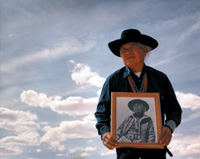
Clah holds a portrait of his father taken many years ago.
The purpose is to show the family resemblance between
father and son.
Photos © 2003, David H. Davis, All Rights Reserved
|
|
The traditional portrait
business has changed with new technology and new client needs and requests.
Fads come and go, but the one thing all portrait photographers have
to face is how to make a good profit--even a better profit--in
today's new marketplace. The answer may rest in one of the most
common business growth techniques--product diversification. Ultimately,
anyone can take a portrait, even a very nice portrait, but what is there
after selling your customer all of the wall prints and albums they need?
David H. Davis has developed
a solution. Based in Colorado, he has been a free-lancer, then a full-service
photo studio owner, since 1974. Though Davis still teaches and publishes
(he is a PPA Certified Professional and holds a Master of Photography
degree), he was looking for a project that would allow him both creative
freedoms and additional profit centers.
|
| |
Using
the sunset light to model Brannon and Krystle's faces,
and the rock swirls to compose the two young people, this
portrait unites both a calm feeling and an underlying drama.
(Near Page, Arizona.)
|
|
Shutterbug: You
are known for your "marriage" of a fine art style with a profitable,
commercial photography business--please explain how it applies to
your portrait work.
David H. Davis: I've always believed that I should
enjoy my photography, whether it was at the studio or in the field. Since
the majority of my portrait work is done outdoors, it is a natural transition
to apply my fine art approach to clients who want something different.
We always try to have fun and let our ideas work in concert to create
a more interesting result than we initially planned.
Fundamentally, our portrait work is strengthened by the fine art, and
the fine art is refined by the portrait work. In this exciting time of
an expanded photographic toolbox, this marriage of fine art photography
with portraits has made it more important than ever to know how the client
intends to use the image--what the actual end product is going to
be. Naturally, the client helps control their finished product by providing
input into the process, and I get to ask all the pertinent sales and journalistic
questions to determine which set of tools to use.
|
| |
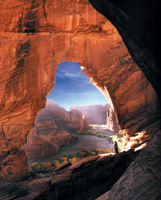
This
grand view portrait of Travis Terry was taken at an alcove
in Canyonlands National Park.
|
|
SB: What
lead you to expanding on your creative level of portrait work?
DHD: I was presented with an advertising assignment that sent
me into the world of the Native Americans in the Southwest. While working
on that project, I decided that it would be interesting to create images
that combine these indigenous people with the dramatic landscapes of the
Colorado Plateau. Early in the project I challenged myself to create all
of these images with available light. As the "Native Americans in
the Landscape" collection continues, I get to meet new people and
find new locations to create images that keep appearing in my imagination.
The lessons learned from this project have allowed me to create more interesting
portraits in the studio. When our portrait clients see the expanded set
of possibilities they have confidence that we will consider all of their
ideas, no matter how far out they seem to be. I believe that the "marriage"
of fine art style to the portrait business also affects the perceived
value for our clientele. Signature portraits continue to be in high demand
because they are personalized.
|
| |
Michelle
Bowman greets the sunrise at White Mesa Arch on the Navajo
reservation.
|
|
SB: Who are
your typical portrait clients and how do you market your work?
DHD: High school seniors, children, families, and business
professionals make up the majority of our portrait clientele. Direct mail
is our main marketing method, especially for the high school seniors.
Our children and families are primarily repeat customers or referrals
from current clients. We do send a variety of contact letters and a newsletter
from time to time. Many of the business professionals and executive portraits
are created for companies with whom we have established relationships--these
include banks, hospitals, real estate companies, and professional groups.
|
| |
Milton Tso, draped in Pendleton chief robe, shows his eagle
feather in the eagle head chamber of Lower Antelope Canyon
near Page, Arizona.
|
|
SB: What
has been your best marketing approach to get new business?
DHD: We are continually experimenting with new ways of
attracting clients, preferring guerilla-type techniques that establish
strategic marketing alliances. Very seldom do we use traditional print
and broadcast-type media. During the slower winter season we offer a variety
of specials to attract folks who will let us experiment with their sessions.
We devote more time to each session to try out new equipment, new techniques,
and new photographic media. Often these practice sessions bring in more
folks via word-of-mouth advertising when they see what their friends and
family are creating.
SB: Now, you have a new "product" that expands
upon the traditional portrait sale. What is the DVD and how are you marketing
it as a line of different photo products?
|
| |
Showing
the intensity of youth, Ryan poses for an individual portrait
while we were doing the "White House Guards"
on horseback. (Canyon de Chelly, Arizona.)
|
|
DHD: Facerock
Productions, LLC is the realization of a dream to build a company that
can produce and distribute a variety of photographic art. Native American
style and subject matter is the primary focus of our product line. Our
investors have pledged a portion of the profits to be used to mentor and
otherwise develop the talents of youth from the various reservations in
our region, and give them an outlet for their work.
Our newest product is a unique piece of entertainment marketing. It is
a DVD that includes a multimedia show of Native American images created
over the past 10 years. Using interesting dissolves, zooms, pans, and
other transition techniques, the "Native Faces--Desert Light"
show moves along with narrative in the Navajo language and English subtitles.
This gives the viewer an opportunity to hear the native language in a
new context. The background music is licensed from and performed by several
leading Native flutists. Many of the images featured in the program are
available as fine art prints, posters, note cards, or in limited edition
customized photo books.
We realize that fewer people will purchase fine art photographs than posters,
note cards, and books, so having a complete product line gives people
a choice of enjoying images from multiple price points. (Author's
Note: For more information about Facerock Productions visit either www.dhdavis.com
or www.facerockproductions.com.
The websites are in a state of constant change and at press time are a
source of information more than actual working e-commerce sites.)
|
| |
This
dramatic long view portrait was created at an overview in
Canyon de Chelly, Arizona, to illustrate the relationship
of man with the valley. Earl Watchman lets the wind blow
his hair to add some motion to the composition.
|
|
SB: So you
are selling both to the end customer and through distributors?
DHD: Yes, distribution relies heavily on strategic marketing
alliances with galleries; music and flute producers; blanket manufacturers;
gift shops; websites--our own and linked with others, other artists,
as well as family-owned Native enterprises. We are negotiating to install
kiosks with looping audio/video programs that are targeted at tourists
visiting the Navajo Nation.
SB: This will be food for thought for the established
photographer looking to go to the next level of marketing. It sounds like
big business! What advice do you have for those just starting out? What
can someone getting into the portrait business anticipate as far as pitfalls
to avoid and opportunities to pursue?
DHD:
Beginning photographers should seek out a mentor that is doing what they
think they would like to be doing. There is no substitute for experience
and no better way to learn than to become a part of the daily routine
of an established photographer. This may not be glamorous, but you will
learn the real world skills in context and be prepared to go out on your
own. You do not need to make all the same mistakes every photographer
seems to want to make. Put your ego in the back seat for a few years and
learn the business.
|
| |
Little
Kenya tells grandma Mary a story. Mary's weavings
are well-known works of art and this is a rare portrait
and glimpse into her simple life on the Navajo reservation.
|
|
It really is possible to be
creative, have fun, and run a photography business. While you pursue your
niche, study those things that interest you. Study subjects that will
give you better communication and sales skills, then study anything and
everything that will allow you to connect with the people you plan to
meet. Building a photography business is an ongoing process that requires
continuing preparation, patience, and persistence. Above all, you should
develop you own unique vision. Use this vision to develop your own photographic
style. Then use the business knowledge and experience that you have gained
as a protégé or apprentice, and find a way to create image-based
products that will create a residual income for your lifetime. Have fun!
|