| |
Photos
© 2003, Patrick Ecclesine/Telepictures, All Rights
Reserved
|
|
I never really believed in
the term "overnight success" in photography that is, until
I met one. Patrick Ecclesine's (www.ecclesine.com)
achievements took actually a week or two and they were not just handed
to him. The combination of opportunity, recognition of that opportunity,
sheer guts and persistence made him the lighting success story you will
read here. The two most important lessons learned are: one, if you don't
ask, the answer is "No." Two, once the technical preparation
is in place, go for it. Literally, he took this opportunity to do what
he had been taught in his acting career--to step into the moment
and let instinct take over. Here is his story:
|
|
Shutterbug: Briefly
describe your photography background.
Patrick Ecclesine: I turned to photography as a way to
avoid the high school bullies who wanted to beat me up due to an uncanny
resemblance I had to the front man of a very popular boy band. The safest
place for me to be during lunch hour was the darkroom.
I forgot about photography until the summer I went backpacking through
Europe. My uncle knew I was tinkering with photography so he pulled 14
rolls of vintage Kodachrome he'd had sitting on a shelf. I'd
spend my afternoons wandering through beautiful and unfamiliar cities
snapping pictures with my first 35mm camera, a Pentax K1000. I had a 70-300mm
telephoto lens as well. When he (my uncle) came back from the lab he was
genuinely enthusiastic by the photos I had taken on my trip. I remember
him telling me that I was good enough to be a professional photographer.
But photography wasn't my thing--acting was. So I moved to
L.A., got a job waiting tables, and started auditioning. Initially I landed
guest starring roles in some sitcoms and a soap opera, but things weren't
going the way I had hoped. Frustrated, I picked up the camera again. In
just a couple of months I took a headshot of almost every single waiter
who worked at my restaurant. (I also persuaded a few celebrities who came
into the restaurant to sit for me.) It was in that time that I heard about
a new sport called SlamBall.
|
|
SB: What is
SlamBall and your interest in the sport?
PE: America's first extreme team sport, SlamBall
is a hybrid game of basketball, football, and hockey. It is full body
contact and the special competition trampolines, which are built into
the floor, propel the players 20 ft in the air to the basket. I have been
shooting since the early days when SlamBall was played in a garage with
a court that was made from chump change and spare parts. Now SlamBall
is on national television, the sport is $8 million deep, and it's
played on a revolutionary spring-loaded portable court that will be set
up in cities across America for the national traveling tour this year.
|
|
SB: You were
just starting out as a photographer. What particular problems did you
come across in the beginning?
PE: The light levels in the warehouses where SlamBall
has been played have always been low, so I would shoot high-speed black
and white film since I didn't have the budget or the knowledge about
strobes. I shot those early games with black and white 1600 speed film
(Ilford Delta 3200 pulled to 1600 and Tri-X pushed to 1600). I really
didn't have much of a choice; the light levels in the garage were
low. I didn't have any equipment besides my camera body, so high-speed
black and white was the only way to go. The grainy black and white film
gave SlamBall a gritty, urban vibe, reminiscent of 1970s rock photography.
SB: So what inspired you to learn about lighting and
using strobes?
PE: Last year when the TNN network stepped in to produce
the show they wanted to replace me with a professional sports photographer
who could capture the Sports Illustrated quality shots. They said my work
was "too artsy." In danger of losing my job, I pulled out
all stops and persuaded them that I could get them the shots they were
looking for if they gave me the budget. They agreed but then I didn't
have the slightest idea what to do next.
|
|
SB: That sounds
like a wonderful business opportunity, but without the technical knowledge,
what made you take on this challenge?
PE: I see a lot of photographers who get stuck. They
say to themselves, "No, I can't do that yet," and so
they stay small. They take classes, they do a little of this, they do
a little of that, and they fail to grow. Photographers need to provide
for themselves and what they do, because nobody else cares. The vast majority
of the people who control the photography jobs and the money really don't
know good from bad. So if you are good and approach these people with
confidence, then you get the job. It's as simple as that.
SB: You are saying act confident, even if you don't
feel it?
PE: Exactly. I did it by acting outwardly bold with TNN
even though inwardly I was trembling.
SB: What happened when you got the job?
PE: I had exactly five days to figure out how to: light
a warehouse, use strobes, hang them in the rafters, and wirelessly rig
them to fire from the floor. Since I was only allotted 30 minutes on the
last day of filming there was no time to test the setup. So I decided
I had to shoot digital to make sure I got it "in the can."
But I'd never shot digital before, so I had to learn how to do that,
too.
SB: How did you get the lighting and camera help so fast?
PE: I did it by begging Sports Illustrated to talk to
one of their lighting technicians. I did it by asking the right questions
to the right people at the rental houses. I did it through extensive preparation
and visualization. Two weeks before a really cool photographer, VJ Lovero,
dropped by one afternoon and captured some SlamBall shots for Sports Illustrated.
He was happy to help me out. He explained that I needed to triangulate
three strobes over each basket; two strobes would aim down at the back
of the backboard about 40 ft between each strobe. The third strobe would
be mounted at half court at a 30Þ angle aiming directly at the backboard
to create a triangular pool of light that centered around the rim. He
also explained that I would need a PocketWizard to trip the flash remotely.
I said, "Pocket what?"
So next I went to PRS in Hollywood. This was my first time ever setting
foot in a rental house. The Sales Manager, Robert Harvey, was very helpful.
He explained that the Speedotron strobe system was great for capturing
action shots because the Speedotron's incredibly short flash duration
would freeze action shots with no blur around the edges.
While I was waiting for the Certificate of Insurance to arrive I spent
my days on the Internet researching everything I could about sports photography.
The more I read the more I realized that I needed to go digital.
SB: How did the shoot finally come together?
PE: My Certificate of Insurance came in on Thursday afternoon.
I raced down to PRS all ready to go. Robert walked me through everything
I was going to need and he assembled the rental package. I rented the
Nikon D1X with a 1GB Microdrive and a rechargeable battery (I would use
my existing Nikon 24-120mm f/3.5-5.6 AF D lens). I also rented the Speedotron
2403 B pack and three Speedotron 102 heads with 8" reflectors. Of
course I got head extension cables so that I could stretch the heads up
to 40 ft away from the pack.
I also got a PocketWizard kit. Robert set me up with some C-clamps, explained
the various strobe settings, and gave me the run-down on the PocketWizard.
I went through everything twice, repeating it back to him to make sure
that I understood. He wished me luck, and gave me some encouraging words.
On the last day of filming, production ground to a halt and gave me 30
minutes to get the shots TNN needed for publicity. This was costing them
over $10,000 in lost production time and I didn't have an assistant.
One of production's grips helped me to hang and safety the heads
onto the rafters. It took about 10 minutes to get the heads mounted and
aimed at the rim. The grip took off and left me alone on the catwalk.
I set the 2400 ws pack so that the wattage was evenly distributed and
each head received 800 ws. Then I took out the PocketWizard and plugged
the receiver into the strobe pack and I put the transmitter into the hot
shoe of the D1X. I clicked the shutter and sure enough all three heads
fired!
When the last game of the morning had ended it was my turn to take center
stage. I had spent an entire week preparing for this moment. I had cleared
it with production and I had asked a handful of players to be a part of
the shoot. A hundred people stood around and watched as I scaled the backboard
and took my position on top of the rim. My hands were shaking as I aimed
the rented D1X down at the hoop.
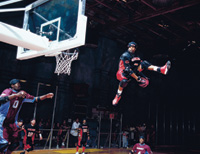
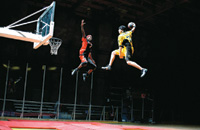
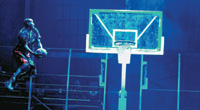
After several minutes of tinkering I found that the best exposure was
in fact f/5.6 at an ISO setting of 200. The best thing about the D1X was
its flash sync of 1/500 sec. This high-sync speed allowed me to completely
drop out the background. This way the action is crisp as a tack, the subject
is clearly emphasized, and the background is black as night.
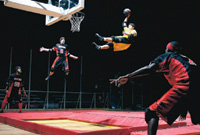
Once I dialed in my equipment I had to yell to the players to execute
different game scenarios. Time was short, so I began to direct them. I
had two guys blocking each other to the left of the rear tramp and I had
another two guys fighting on the center island while one of the league's
biggest stars would fly toward me full speed for a slam dunk. After reviewing
it again in the LCD, I repositioned the players so that I could see everyone's
face. I got the shot I was looking for, so I yelled for everyone to stop
as I climbed down to the ground. My time was up.
SB: This is your first major lighting assignment. How
did it turn out?
PE: My pictures from that 30-minute session have been
printed in Time magazine, New York Times, L.A. Times, Men's Health,
Variety, and Hollywood Reporter. I've been promoted to Official
League Photographer and I now write the weekly column about SlamBall called
"From The Floor" on the website (www.slamball.warnerbros.com).
SB: Any advice for those photographers hesitating to
take on big challenges like this one?
PE: Here's the big secret: the guy who gets the
job probably isn't much of an artist! He's a businessman.
So if you're an artist who is sensitive to the moment and you have
a unique point of view then you've already got a leg up on the competition.
My advice is to realize that total mastery over your craft is unattainable.
If you want to turn your dreams into a reality then forget about your
limitations, focus on your opportunities, and act boldly. Focus on the
objective to get the job, learn as you go along, and get paid for it!
With risk, resourcefulness, and faith the impossible becomes possible
in an instant. Anything you think you can do, you can do. So stop wrestling
with yourself and get to it.
|