| |
Photo
1.
© 1999, Caryl Bryant, All Rights Reserved
|
|
There are many different
ways to approach the design and production of promotional materials.
First you'll need "primary" promotional material.
These visual pieces are used most often for sending ahead to get an
appointment or for leaving behind after showing a portfolio. For this
column, we will discuss and show print promotions. Electronic promos
such as CD-ROMs can be used in addition to the printed pieces or as
portfolios.
Some production methods for primary promotion pieces include: photographic
prints, mounting photos to card stock, laser color copies, ink jet or
LaserJet prints, and black and white prints. These methods work best
when you have a small target audience or are just starting out and have
very little money.
With a larger audience, you may want to invest in four color printed
materials. More money, but less labor and per unit cost than above.
Design and quality of production is the key either way. You don't
have to spend a lot of money for promotion pieces to do them well.
|
| |
Photo
2.
© 1999, Caryl Bryant, All Rights Reserved
|
|
As you can see from the before
and after (Photos 1, 2 and 3, 4), text or copy adds to the power and influence
of your primary promotion materials. With Photo 1, Caryl Bryant is simply
making a visual statement. Nice, but so what? With her Photo 2, she has
added a marketing message, "Black & White Portraits";
a strong benefit, "When you want something different and personal";
and most important, a call for action, "Call for appointment."
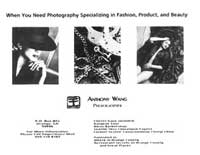
Anthony Wang takes a very traditional layout in Photo 3 and improves upon
it with Photo 4. The improvements include an eye-catching headline speaking
from the client's perspective, "When You Need"; a call
for action, "For More Information"; and he even adds credibility
with a client list and publication credits.
|
| |
Photo
3.
© 1999, Anthony Wang, All Rights Reserved
|
|
"Secondary" promotional
materials are added once you have the basic visual materials for selling.
Some of these production approaches include: mini-portfolios, capability
brochures, client- printed materials, and specialty advertising items.
The mini-portfolio is not really a portfolio at all. It is a sample portfolio
given to a client to keep on file. The ultimate combination of concept,
design, copy, and photography comes together to produce a real "keeper"
and promo pieces clients can call and ask for from your ads or direct
mail. Good design and planning does not mean spending a lot of money.
The most flexible format for a mini-portfolio is a presentation folder
(add your logo label to personalize the cover) and inserts printed in
advance and used as needed, depending on the client. This format is the
most easily used and customized for individual client presentations.
|
| |
Photo
4.
© 1999, Anthony Wang, All Rights Reserved
|
|
A capability brochure can be
combined with a mini-portfolio or used as a stand-alone piece. It usually
is an information or copy-heavy piece that includes your marketing message,
background, client testimonials, client list, facilities description,
map to your studio, and even equipment inventory. In addition, it can
be packaged with cost proposals to help you get the job you are bidding
for.
Client-printed pieces using your photos create opportunities for self-promotion.
You get the value of the equity in a "household name" client
and the client pays for the production. Depending on the client, you buy
or negotiate a price to get several dozen or a couple of hundred copies
on the same print run. When a client is printing single sheets, you can
check to see if you can get yours with the backside left blank. Then,
you can get them inexpensively back-printed with your own promotional
copy.
When you have done everything else, be creative and use a specialty advertising
promo piece. Being creative does not mean spending a lot of money. These
promo pieces tend to be best used for name recognition and reminders,
rather than traditional selling promos. They are useful items (pens, notepads,
coffee cups) that you give to your clients. You can order them from any
catalog supplier of specialty advertising. Some creative ideas are photo
notecards, pop-up photo calendars, and the most useful, photo-image mousepads.
Whatever you choose, make sure it echoes the marketing message of your
primary promo pieces and is nice enough for the clients to want to keep.
|