| |
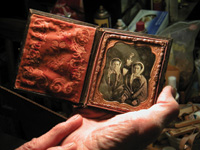
Digital Meets Daguerre: The daguerreotype is in the hands
of photography collector Harvey Zucker, who happened to
be showing it to Steve Rosenbaum, who happened to have
a 2-megapixel digital point-and-shoot camera handy. The
8x10 print of this image is proof of digital capability
and quality.
© 2003, Steve Rosenbaum, All Rights Reserved
|
|
I'll never forget what
Jason Schneider said. It was the mid-80s, and Sony was holding another
press introduction of another version of the Mavica. Back then when
you said the words "digital imaging," you were talking about
Mavica, but the Mavica wasn't really a digital camera. It recorded
images onto a tiny disk of videotape. The Mavica was, in fact, a still
video camera, which turned freeze frames into prints. And most of the
prints, as I remember, looked like pointillism gone terribly wrong.
But Sony wasn't giving up on the concept of an electronic camera
that didn't use film, so there we were, hearing all about a new
and improved Mavica. "We" were the photo press, and we weren't
buying "new" or "improved" that day, and it
was as we sat down to lunch after the presentation that Jason, then
editor of Modern Photography, said, "The trouble with still video
is that it's still video." I laughed, enjoyed lunch and
then, so smart and smug, went back to work in a world where film reigned
supreme, and always would.
|
| |
Move
On: Steve Brown shot three rolls of film to make sure
he got this shot. With digital, which he now shoots, he'd
have known right away that he got it, and then he could
have spent his time getting more pictures in the great
sunrise light.
© 2003, Steve Brown, All Rights Reserved
|
|
Today Sony still has cameras
called Mavicas that still record images onto disks, but these Mavicas
are true digital cameras. And digital cameras are everywhere. Deservedly
so, as they are capable of making great pictures. They also make photographers
better photographers.
Better For Business,
And For Creativity
I'd been thinking about this because several months ago Kodak released
the results of a survey of professional photographers in which three of
five pros said that digital cameras were creating new business opportunities
for them. That's nice, I thought, but what I was hearing from pro
photographers was how digital was creating new creative opportunities.
Commercial, portrait, wedding, sports, nature, outdoor, news, and editorial
photographers who were using digital cameras were saying that this new
tool was making them better.
|
| |
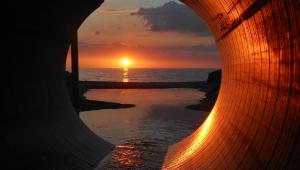
Southern
Exposure: Pete Turner took this photograph with his digital
SLR at the Westin Regina Resort Los Cabos, Baja California
Sur, Mexico. For unlimited control of color, Pete starts
with a digital camera, then explores the possibilities
of Photoshop.
© 2003, Pete Turner, All Rights Reserved
|
|
There's no reason amateur
photographers can't enjoy the same creative benefits. Simply, you
can do more with digital--and that's why digital is inevitable.
Not because it's the latest toy or it's hip to carry around
or it comes with a bevy of buzzwords to make the tech heads happy. It's
just better.
If you're a photographer who's shooting with digital, you're
probably going to turn the page right about now and move on to the next
story. You already know about digital's benefits and advantages.
But if you're a photographer who thinks that digital photography
is the fifth horseman of the apocalypse, you might want to stick around.
Pro photographers, whose livelihoods depend on delivering the goods, don't
agree with you. They're making better pictures with digital.
Quality And Longevity
If it's quality you're concerned with, on these pages you'll
see a photograph that photographer Steve Rosenbaum took with a 2-megapixel
point-and-shoot digital camera. The digital file of that image produced
a gorgeous 8x10 print; trust me, it's on my bulletin board and I'm
looking at it right now. Great results, rock-bottom megapixel count. Quality?
Case closed.
Worried about the longevity of your digital prints? There are papers and
inks billed as archival. Don't trust the manufacturers' definition
of archival? Frame the print and hang it up anyway. In five or 10 or 20
years, if it looks like it might be fading, go to one of the hard drives
where you keep your backed-up digital files and print out a brand-new
edition of your masterpiece. Slip the old one out of the frame, put the
new one in its place.
|
| |
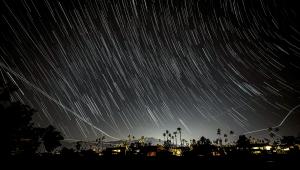
Northern
Exposure: Daniel J. Cox's digital SLR had no trouble
capturing the northern lights and the polar bears of Churchill,
Manitoba, not to mention a quick grabshot of a reminder
of just how cold it was up there.
© 2003, Daniel J. Cox, All Rights Reserved
|
|
New Look At Old Trees
Wildlife and nature photographer Jim Balog once commented on his role
at a digital photography workshop by saying, "I'm there as
a creative inspiration. I'm the one who says, `Hey, here's
what we can do with these cameras that's unique and transcendent
from other forms of photography.'" One of the things Jim did
with his digital SLR was document the oldest and tallest trees in America.
He didn't stand on the ground and look up--he made a series
of startling images by climbing up into the trees, rappelling, and shooting
overlapping exposures on the way down. Then he loaded the images into
his computer and assembled up to 200 individual frames of each tree into
a portrait. The digital files produced incredibly detailed images that
Jim has printed out as 8-foot-long prints. By using digital, Jim saw what
he got as soon as he got it, and he didn't need to scan any pictures.
Check out the results of his efforts at his website, www.jamesbalog.com.
Quick Review
The great sailboat at sunrise photo that Steve Brown made on Chesapeake
Bay was done with a film camera. Today he'd shoot it with his digital
SLR. He took the photo by fitting his camera to a monopod, turning the
rig upside down and holding it over the side of the boat, making his exposures
with a cable release, all the time wondering what the heck he was getting.
"I burned through three rolls of film," Steve says. "When
you're trying for a shot like this, you keep shooting just to make
sure." Today, he'd know what he got simply by looking at the
back of his camera. The point is not that digital is going to make us
lazy; rather, it's going to free up time so we can move on and make
more pictures because we'll know we've got this one nailed.
All The Options
How'd you like to have every color film ever made, available to
you in your camera, all at the same time? You've got it--it's
the digital white balance control. When you're shooting film, your
color results are going to be dependent to a large extent on the film
you choose. A digital camera, color master Pete Turner has said, "completely
turns color control over to the photographer."
Standing Up To The
Challenges
The durability of digital cameras? Photojournalist Kevin T. Gilbert takes
digital SLRs to photograph Eco-Challenge races. He's been to Argentina,
Fiji, Borneo, New Zealand, and a couple of places I can't spell.
He's shot digital in fog and rain and mud, from rafts and canoes
and helicopters. He's crawled through bat caves and fought off leeches
and come back with the pictures. Well, actually, he didn't have
to come back with them--he transmitted them to his client within
hours of capturing them.
About a year ago Daniel J. Cox headed to Churchill, Manitoba, to photograph
polar bears, only to find it was so cold the bears wouldn't come
out of their dens. While waiting for things to warm up, he photographed
the northern lights at minus 46Þ Fahrenheit. Eventually the bears
showed up and Dan photographed them at minus 35Þ on a day his tripod-mounted
digital SLR was out in the open for six hours. He protected the batteries
in his pocket, but the cold soaked camera got no special treatment. Since
there was nofilm to advance, he didn't have to worry about it getting
brittle and breaking. Neither did he worry about static electricity, or
his fingers freezing when he changed film. One memory card was all the
storage space he needed.
|
| |
Jim
Jordan took this photo for Mervyn's stores catalog
with his digital SLR. Digital, Jim says, turns models
into partners. "It brings the energy level up when
they see me react to the image on the back of the camera,
and they know what I'm going for in the picture."
© 2003, Jim Jordan, All Rights Reserved
|
|
Model Partners
Advertising and editorial photographer Jim Jordan says that digital turns
his models into his partners. "Digital brings up the energy level...when
people see me react to the image on the back of the camera. I walk right
over and show the models the picture and say, `Look what we got!'
It builds everyone up. And if anything isn't working, we know right
away and can fix it." Chances are you aren't taking pictures
for the covers of magazines or for clothing ads and catalogs, but you
can surely use digital's instant feedback to help you make better
pictures of family and friends.
The Cost Factor
There is one hesitancy to digital, and that's cost. Not for digital
point-and-shoot cameras; if you consider the features packed into those
small wonders, they're terrific values. But what you're probably
interested in is the digital SLR, and those cameras range from "Gee,
that's a little pricey" to "My first new car cost less
than that." While you can get a terrific digital SLR for under $2000,
what a lot of us are waiting for is the under $1000 model. No one thinks
we're going to have to wait very long.
Put away the garlic and the silver cross. Digital photography is a whole
new world of creativity, opportunity, satisfaction, and fun. Explore it.
|