| |
I
took the prism off of my Hasselblad to get this worm's-eye
view. Light must have leaked into the mirror chamber and
fogged the shot. Next time I'll compose, then place
my hand over the screen.
Photos © 1999, Jay Abend, All Rights Reserved
|
|
Flare is one of those nagging
photography issues that you always think you have control over, till
it bites you on an important shoot. Flare, more properly referred to
as veiling glare, is the haze that covers all or part of your image
when extraneous light reaches the film. It is much less of a problem
today than in the past. The advent of multi-coating, ingenious internal
baffling and flocking, and computer-designed zoom lenses have almost
totally eliminated flare from common flare-inducing subjects like bright
white objects. Today if you use modern equipment the primary cause of
flare is light shining directly into a lens, reflecting from internal
lens surfaces and causing a bright haze.
Those of you who own vintage gear like old single or uncoated Leica
glass, Hasselblad glass, or vintage large format lenses, already know
what I'm talking about. I still use a bunch of old Hasselblad
chrome lenses, which don't offer the latest in anti-flare multi-coatings.
When well shaded, they produce excellent results. Get just a little
bit of extraneous light into the front of the lens and forget about
it--big-time flare. My 150mm Sonnar is so bad that even very bright
white seamless will produce a softer, lower contrast image than the
same shot with my nice multi-coated 150 CF lens. Besides bright objects
that are in the scene, like sunsets, highlights on glass and chrome,
or bright sunlight objects like white T-shirts, you can do an awful
lot to reduce or even eliminate flare in your everyday shooting. Here
are some tips.
One Source Lighting. Most of us shoot with one light
source--usually the sun or an on-camera flash. While you can always
eliminate flare by placing the sun behind you, you rarely find the best
lighting with flat sunlight. The magic tends to happen when a subject
is backlit or lit by strong sidelight. The lens shades that accompany
most prime lenses do a reasonable job of shielding extraneous sunlight,
but zoom lenses present a whole different problem. Even the most intelligently
designed lens shade for a zoom lens leaves a good portion on the front
element exposed most of the time. Shoot into a setting sun or in a situation
where strong sidelighting exists and you run the risk of lighting up
the front surface of the glass. While this may not create the kind of
classic "zoom lens" hexagonal highlight flare, it will for
sure lower the contrast of the scene. Flare like this is usually not
noticeable in the viewfinder since it's such a fine difference.
On the light box, it's another matter. If your client is expecting
sharp punchy chromes, you're in trouble.
|
| |
Whoops--I
used my Polaroid extensively to set up this shot. Since
I was hand holding I drifted out past the gobo I had set
up and got hit with direct flash and lots of flare.
|
|
On-camera flash should be a
cinch right? After all, the light source by definition is behind the lens.
But beware, my friends, of the many sources for reflection in the room.
It's the wedding photographer's nightmare--shooting those
"table shots" of all the aunts and uncles one circular table
at a time. Sooner or later you'll get those proofs back from the
lab with the dreaded flash in the mirror flare. Even if your flash isn't
reflected right back into the middle of the frame, a mirror just out of
the frame can still ruin the shot. The solution? Get used to firing your
flash once manually while looking through the viewfinder. You should instantly
get a rough idea if a lot of light is bouncing back. Glass windows, chrome
handrails, and even crystal chandeliers can create the same effect, so
it pays to keep your eyes open.
Pros often use an adjustable bellow type lens shade. By dialing the bellows
out as far as possible without intruding into the frame, you've
just about guaranteed that a light source outside of the frame won't
create any lens flare. Since there are adjustable bellows that have the
familiar 2:3 rectangular format of 35mm film and your choice of filter
thread sizes, you should be able to match one up to almost any 35mm lens.
Multi-Source Lighting. For you hot light or studio flash
owners, you're probably already a member of the scrim and gobo society.
Scrims--those small pieces of cardboard, plastic, or metal that get clamped
to boom arms or light stands--are easy to position just out of the field
of view of your lens, but between the lens and the offending light head.
Gobos--the larger panels, usually mounted on wheels--can physically isolate
the camera and keep all the extraneous light out of the field of view.
I have a couple of old office partitions that I found in the commercial
complex where my studio is housed. I had some metal supports fashioned
with large 4" casters, and now I can wheel them all over the studio.
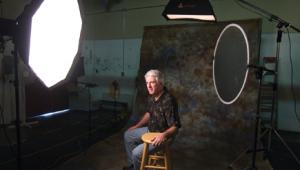
I like to light large products with two large (4x6') light banks
from slightly behind the product, with another large box overhead. The
overhead bank is easy to shield with a camera-mounted scrim. The two large
light banks are so tall that I need the gobos. I wheel one gobo on each
side of the camera, and move them so they are just out of the frame. This
keeps all the light off of the lens, and also makes it a little easier
to focus.
Unexpected Sources Of Flare. You can generate flare in
a number of different ways. I learned the hard way that a medium format
SLR with no waist-level or prism viewfinder sitting in direct sunlight
will sometimes allow a little bit of light to enter the mirror chamber.
This kind of light leak creates a faint overall haze that essentially
ruins the image.
The Zoom Problem. How do you efficiently protect a zoom
lens, especially one of the new breed of wide to tele-zooms? Well, the
built-in lens shades are of limited value, and there is no way to hang
a scrim on the camera that will work for every focal length. I like to
use one of those slick little "FlareBuster" devices that has
a small circular scrim at the end of a short adjustable arm. The whole
thing just slips into a hot shoe, so it couldn't be easier. If you
have an SLR that shows most or all of the final image, you can set your
shot up, move the scrim till it is just showing in the corner of the frame,
and then zoom-in a hair to eliminate it from view, or nudge it slightly
to just kick it out of the frame. This is a great solution if you're
hand holding, since wherever you move physically, the scrim will stay
in the same position relative to the lens.
Using Flare Creatively. Of course there are times where
you want that classic flare look. Strong backlighting will most probably
eat into your contrast too much, but that off-center direct sunlight with
a multi-element zoom lens will create that classic step-and-repeat pattern
of iris-shaped reflections. This look is so popular that it is now a built-in
Photoshop effect. You can actually add lens flare to a clean shot. Go
figure.
My favorite lens for this effect is the excellent Tamron 28-105mm f/2.8.
This lens has such an effective combination of multi-coating and internal
flocking that I can tilt it into nearly direct sunlight and grab nice
images. By playing with the zoom ring and the position of the sun I can
fine-tune the effect.
|
| |
Here
is the classic use of lens flare. If you look closely you
can see the Iris-shaped reflection on the lower right of
the frame.
|
|
The Point-And-Shoot
Problem. If you're like me, you bring an inexpensive point-and-shoot
camera with you when you're not carrying your bigger gear. For most
happy snaps these cameras do a remarkably good job, but their lenses,
especially those with long-range zooms, just don't have the same
level of internal reflection control as pricier SLR lenses. I have been
guilty of trying to get too cute with my fancy little point-and-shoot
camera. I shoot into sunsets, backlight my subjects, and try to use the
ambient light to my advantage. More often than not some of my shots have
bright orange flare along one side of the image. It's tough to try
and scrim the lens on a point-and-shoot, since the viewfinders are usually
not too accurate. I still try and hold my hand up and block the sunlight,
since these cameras are easy enough to shoot one handed.
How many times have you seen snapshots from your friends and family with
a garish flare-ridden reflection of the on-camera flash ruining the image.
Of course to them its par for the course. For you and me, it's unacceptable.
Since you can't pre-flash with a point-and-shoot to see where the
reflections are, you've got to be careful and examine the scene
thoroughly. Even those little fixed lens point-and-shoot cameras can have
terrible problems with flare.
Modern lens technology has made us lazy just like every other form of
photographic technology. We shoot today with little regard for the direction
of the main lighting, since nine times out of 10 the film turns out fine.
Lens flare? Fix it in Photoshop.
Constantly looking out for the direction of the sun, the angles of your
flash units, and the presence of reflective surfaces in a scene are what
help make a really thoughtful photographer. |