| |
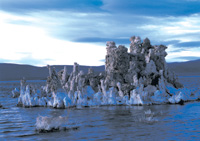
Here
front tilt was used to place the zone of sharp focus so
it coincided with the skeletal bush and the top of the
tufa tower. I could probably have merely stopped down
far enough to accomplish this but it was windy and I didn't
want to lengthen the exposure time any more than necessary.
Photos © 2003, Joseph A. Dickerson, All Rights Reserved
|
|
Many years ago, still fresh
out of college, I worked with a 21/4x31/4" Century Graphic. I
bought it used with three lenses and it was so cool. Pebble-grained
gray leather covering, bright red bellows, and a coupled rangefinder.
Wow, I naively thought, it would do anything. Weddings, portraits, scenics,
products, you name it. Anything a client wanted got shot with that spiffy
little Graphic.
It certainly wasn't the most sophisticated camera, but back then
that little Graphic with its three lenses blew my equipment budget for
a whole year. Sadly, my little gray and red Graphic is long gone, but
it instilled in me a love for small, lightweight, versatile cameras
that use medium format film. Fast forward nearly 40 years and you'll
find that that passion has not diminished one bit.
|
| |
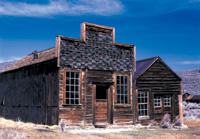
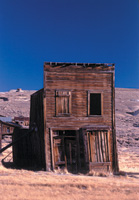
This
was tricky as the buildings are actually leaning toward
one another a bit. Having bubble levels on a view camera
can be very handy in this kind of shot. Bodie State Historical
Park, California.
|
|
One thing that has changed
is that I am now a multi-format photographer, which is definitely a mixed
blessing. When my wife and I travel the country in our converted van I
love to shoot the historic missions, bridges, rustic barns, Victorian
homes, and lighthouses we find along the way. My favorite camera for these
subjects, as well as the grand landscape, is a 4x5 view camera. However,
as Ann and I approach retirement age, and prepare to do a lot more traveling,
I'm starting to be concerned about the volume of camera gear I carry.
So, I have been thinking about ways to shave some of the weight, and bulk,
off the view camera outfit without simply leaving it behind.
I gave some thought to swapping my current monorail system for a field
camera. But, switching to a field camera only reduces the size of the
camera itself. Everything else--lenses, film holders, etc.--remains
essentially the same. If, on the other hand, I were to travel with a 6x9
view camera the whole system would shrink, at least to some degree. This
is now viable because roll films have improved so much in the last few
years. This makes it possible to do a lot of my shooting with a smaller,
lighter camera utilizing a more economical film stock with very little
loss of quality.
I did own a Gowland 6x9 for a bit so I was already familiar with Peter's
lightweight, reasonably priced, and very compact cameras, but I wanted
to see what else might be of interest.
|
| |
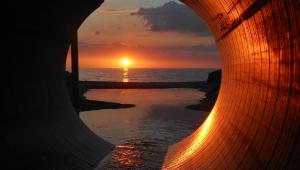
No
concern about parallelism here, but front rise allowed the
horizon to be placed low in the frame without having to
tilt the camera. Sunrise, Santa Ynez Valley, California.
|
|
Size And Weight Considerations
Size and weight are the issues that initiated this exercise in the first
place so I felt they should be the first things considered. My current
monorail camera, without lens, weighs a tad over 7 lbs. The 6x9 Gowland
weighed in at about 21/2 lbs, so anything in the 3-4 lb range would be
really great and I, rather arbitrarily, decided that 5 lbs would still
be acceptable. However, I found some 6x9 monorail cameras actually weighed
considerably more than my 4x5. (By the way, many of today's 4x5
field cameras fall into that 3-5 lb range so they may constitute a viable
option even if you plan to shoot mostly roll film.)
Check The Movements
The next feature we should consider is movements. There are two distinct
and separate movements on a view camera: tilt/swing and rise/fall. Some
cameras may also be equipped with a third movement, lateral shift. Let's
review each of these briefly to see what we really require.
|
| |
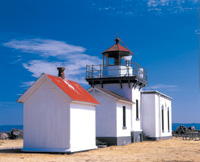
A
very basic architectural shot, front rise applied to maintain
verticals and the lens stopped down for adequate depth of
field. Point No Point lighthouse, the first lighthouse on
Puget Sound, Washington state.
|
|
Tilt is a tilting, around a
horizontal axis, of the front or rear standard of the camera. Swing is
like a tilt but the standard rotates around a vertical axis. Applied to
the camera's front standard, tilt or swing affects the plane of
focus. It is often stated, wrongly so, that this increases depth of field.
It doesn't. It merely changes the plane of focus so that it more
closely matches the plane of the subject. Applied to the camera's
rear standard, tilt or swing will affect the shape of the subject or perspective.
A complete tutor on the use of camera movements is beyond the scope of
this article--check the sidebar for some books on this subject if
you need to review. While front swings and tilts are important, they are
less so for the camera back. In fact, my Gowland's rear standard
had only tilts and I never really missed the other movements at all.
|
| |
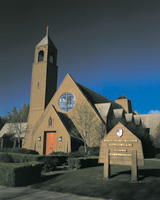
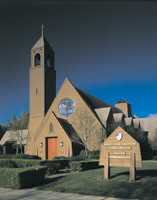
With
the camera tilted up the verticals are no longer parallel
which makes the church look like it's about to go
over backward. Saint Mark's In The Valley Episcopal
Church, Los Olivos, California.
|
|
Rise and fall is pretty much
self-explanatory. You raise or lower the standard, which in turn moves
the image on the ground glass. Again, many field cameras dispense with
rise/fall on the camera's rear standard, as front rise/fall is more
likely to be employed. Lateral shift, or slide, is rare on field cameras,
as the same thing can be accomplished, albeit less conveniently, by moving
the tripod. I wouldn't take a camera off my short list solely because
it didn't have shift, but it can be a convenient feature.
Bellows Exchange
Another feature that can be useful in the field is an interchangeable
bellows. A standard pleated bellows is very inflexible when it's
collapsed on itself, as it will be with wide angle lenses. Changing to
a bag bellows allows for unrestricted movements with these shorter focal
lengths. So, if you do a lot of wide angle work, look for an interchangeable
bellows. Also, make sure that the standard bellows allows focusing with
the longest lens you hope to use.
|
| |
By
using front rise rather than tilting the camera the vertical
lines are corrected and the architect, not to mention the
parishioners, will be much happier.
|
|
Telephoto lenses can be used
as a work-around for cameras with a short bellows, but they tend to be
pricey. Another nice feature is a standard size lensboard. Many cameras
use proprietary lensboards, so if you want to use the lenses between two
cameras you'll need to remount the lenses every time you switch
cameras. With a more common lensboard, such as the Linhof Technika, the
boards are often interchangeable between camera brands or there may be
adapters to allow compatibility.
I've composed a chart
that compares some 6x9 cameras that look like good candidates for field
photography. But remember, camera selection is a very personal process
and there are things to be considered other than just features and price.
I once bought a technical camera that really looked like the logical replacement
for my beloved Graphic. But the first time I used it in the field I discovered
that the control knobs were so tiny and ill-placed I couldn't operate
the camera with my bare hands, much less with gloves on. My point? Try
before you buy.
|
| |
No
amount of view camera magic will make this subject look
parallel but at least we can prevent it from looking any
worse. Bodie State National Historical Park, California.
|
|
Oh yeah, don't forget,
there is no universal camera...trust me!
Suggested Reading
An Ansel Adams Guide: Basic Techniques of Photography, Book 1; John P.
Schaefer; Little Brown and Co., 1271 Avenue of the Americas, New York,
NY 10020; ISBN 0-8212-1882-4; soft cover (also hard cover); 432 pages;
$35.
Kodak Book of Large Format
Photography; Roger Vail; Silver Pixel Press, 21 Jet View Dr., Rochester,
NY 14624; ISBN 0-87985-771-4; soft cover; 112 pages; $19.95.
Large Format Nature Photography;
Jack Dykinga; Amphoto Books, 770 Broadway, New York, NY 10003; ISBN 0-8174-4157-3;
soft cover; 144 pages; $29.95.
Photographing the Landscape;
John Fielder; Westcliffe Publishers, Inc., PO Box 1261, Englewood, CO
80150; ISBN 1-56579-150-9; hard cover; 191 pages; $50.
|
| |
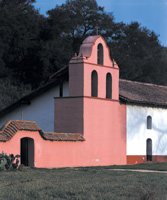
| Front
tilt was used to include the top of the campanario while a
slight front swing brought the front of the mission wall into
focus. Mission La Purísima Concepción, Lompoc,
California. |
|
View Camera Technique, 7th
Edition; Leslie Stroebel; Focal Press, 200 Wheeler Rd., 6th Floor, Burlington,
MA 01803; ISBN 0-240-80345-0; hard cover; 376 pages; $64.95.
Manufacturers/Distributors
Arca-Swiss Inc.
(773) 248-2513
fax: (773) 248-2774
Badger Graphic Sales, Inc.
(Ebony cameras)
(920) 766-9332
fax: (920) 766-3081
www.badgergraphic.com
|
| |
With
the ceiling included in the shot I couldn't use front
tilt to help with focus. However, as view camera lenses
usually have smaller apertures than similar focal lengths
for other camera types, I could stop down to maintain adequate
depth of field. Mission San Luis Obispo De Tolosa, San Luis
Obispo, California.
|
|
Gowland Productions
(310) 454-7867
fax: (310) 454-6779
www.petergowland.com
HP Marketing Corp. (Linhof
cameras)
(800) 735-4373
fax: (800) 282-9010
www.hpmarketingcorp.com
Schneider Optics, Inc. (Horseman
USA)
(631) 761-5000; fax: (631) 761-5090
www.horsemanusa.com |